Introduction: journey continues … trains through … Turkey, Bulgaria, Romania, Moldova, Hungary, Slovakia, Czechia, Germany, Austria, and Liechtenstein … as I travel through Europe, the scale of the world changes … the countries are smaller … but mostly … grateful to be within the European Union (Schengen area) and temporary reprieve from crossing international borders with the emergency passport.
FRI 31 JULY: Doğu Ekspresi (eastern express) departed Kars (8am). Train departed late, difficulty connecting the train cars, an ominous warning.
Train is called express, not due to its speed, but rather, there are few scheduled stops (1pm Erzurum | 6pm Erizincan | next day | 2am Sivas | 6am Kayseri | 1pm Kirikkale).
Journey is tiring and tedious. Pass wheat fields, and armies of sunflowers, bright yellow faces greet the morning sun in the east. To watch paint dry, to watch grass grow may be more interesting. Is this how I experience the world; why did I not fly (2-hours).
Share couchette cabin with three Turks. Bench seats fold down into bunks, linens provided. There are no working power outlets in the cabin. There are no working outlets in the snack car. Only working power outlet is in the wash closet, no shit. Take a dump, wash hands, charge iPhone; repeat.
Cigarette smoke is inescapable in Turkey. Some passengers smoke cigarettes in the WC. Stench wafts through the passenger cabin, and slow to dissipate. Queue the next smoker. I am sensitive to cigarette smoke, ever since I was a child, remember smoking sections on an airplane. Triggered headaches (then), triggers migraines (now).
Saturday, train arrives Ankara station five-hours late. 1300-km (800-mile) journey takes 31-hours; understand that train is sometimes ten-hours late. One of those journeys where the train does not make up lost time, train only falls further behind schedule. If I do not get what I want, do I like what I get.
MON 03 AUG: awake before dawn, metro not yet in operation, walk to the station. High-speed train from Ankara to Istanbul, 350-miles (4.5-hours). Arrive Söğütlüçeşme Station, and M1 metro (subway) under Bosphorus Strait to Yenikapi Station. Following seven-months of travel, cross the boundary from Asia to Europe. Connected by three bridges and two tunnels, Bosphorus Strait links the Black Sea to the Sea of Marmara.
WED 05 AUG: awake pre-dawn, slow to wake, shake the lead out of my body. Early-morning run along the T1 tram line, wide tourist avenue that runs through old Istanbul toward the mosques. Free from traffic, do not disturb the tourist crowds. I often see runners come through these congested places at peak hours, simply inconsiderate.
Six weeks in Turkey; enjoyed first visit (2023) more than second visit. Could not escape, inescapable cigarette smoke. It is likely that I will return, as Istanbul is a strategic airport hub, connecting Europe and Asia. Would certainly enjoy traveling through eastern Turkey, independently, on a motorbike.
M1 metro from Yenikapi Station to Halkali Station; overnight train from Istanbul to Sofia Bulgaria. Crossed Turkey east to west by train, all 1,000-miles (similar width as Texas).
Thursday, train arrives Sofia at 2pm, three hours late; 350-mile (18-hour) journey. Exit Turkey immigration at 3am, enter Bulgaria immigration at 5am. Agent treated me nicely, and inquired about emergency passport. Present the damaged passport, and this seems preferred over a lost or stolen passport. Perhaps the first border crossing where I am not completely stressed out. There were fewer than 30 tourists on board the train (no locals), and perhaps it was a non-threatening post for the agent, too.
European Union initiated its Entry-Exit System (EES) this year, consisting of digital images and fingerprints. Airport roll-out has gone poorly, with passengers delayed in long queues, and missed flights. On the train platform, step into a modern booth and complete the process quickly, no different than any immigration post. Photo and prints are valid up to three years. One advantage is that it saves my passport from being stamped at the border, especially since it has only five pages.
Some readers may argue that I should have returned to the United States on the emergency passport, and should not have continued travel. In other words, no sympathy for hostile immigration agents. That said, I could have returned directly to the United States on the damaged passport (Tashkent > Istanbul > New York City).
For some reason, every muscle in my body aches, as if I was smashed by a baseball bat. No cold or flu symptoms, perhaps overtired. Take no pain reliever, and go to bed.
Friday, Sofia (Serdica) is charming and pleasant. Along the wide Vitosha pedestrian mall, the buskers are out busking. Tram and metro (contactless credit card) are easy to navigate. Travel to Sofia Sever (north) train station, re-confirm onward train ticket, and the city appears to slowly disintegrate further from the city center.
Bulgaria, an eastern Soviet-bloc country since 1946, gained its independence in 1991. Bulgaria joined the European Union in 2007, and replaced its local currency, Lev (lion), with the Euro in January 2026. Prices are listed in Euros and Lev. Local language is Bulgarian, but script is Cyrillic; grocery shopping is slow and tedious.
SUN 09 AUG: pre-dawn, walk to Sofia Sever, derelict train station that serves northbound trains. During the summer, there is 250-mile (10-hour) direct train from Sofia to Bucharest. Train departed 7am, shared cabin with well-traveled Kiwi (NZ).
Train departs Sofia valley, low-hanging mist clings to the rolling mountains. Cross Danube River at Ruse, from Bulgaria to Romania. Pass through aggie fields of corn, sunflower, and wheat. Both countries are in the EU, there is no formal immigration procedure, but agents board the train to review passports. From Bucharest Gare du Nord, light rail to airport, and check into hotel prior to pre-dawn flight.
MON 10 AUG: five-minute walk from hotel to airport, pre-dawn flight to Chișinău Moldova (non-EU). There is a queue to exit immigration. Entry-Exit System (EES) drifted into maintenance mode, despite the crush of people with international flights. Agents begin to process travelers in off-line mode, so that people do not miss flights. Brief flight, one-hour, and sleep for the duration. Local bus (#30) to city center.
Tuesday, travel by marshrukta (fixed-route minibus), $5 USD (one-way), from Chișinău to a country that does not exist. 90-minute drive, mostly unremarkable to Tiraspol, Transnistria (Trans-Dneister), breakaway state, recognized as part of Moldova, that lies along the Dniester River between Moldova and Ukraine border.
Romania and Moldova existed as a single country during the inter-war period (1918-1940), and its people speak the same language, Romanian. Russia seized Moldova and created the Moldovan Soviet Socialist Republic (SSR). Moldova gained its independence in 1991, but Transnistria region wanted to remain part of the SSR.
If Transnistria was not a break-away republic, there is no good reason to visit Tiraspol. At the border, present emergency passport, supervisor called … fvcking American … stink eye … and receive printed day pass to visit the region.
Region is a time capsule of sorts, monuments of Lenin, concrete slab apartments, and streets dotted with Russian-built, Lada automobiles. Transnistria GDP per capita is half of Moldova. Region is mostly claustrophobic, and I just want to leave.
WED 12 AUG: train car may only be described as FUGLY; originally built in East Germany during the 1970s for the Soviet rail network. Overnight train, 300-miles (14-hours) from Moldova (non-EU) to București Romania (EU).
On board the train, dinner is large slice of Babă Neagră (black grandmother); custardy, rich, toffee-like cake. Share the compartment with an intrepid traveler from Dresden.
Ungheni border, train cars are hoisted, and the bogies (wheel sets) are swapped out from 1520-mm Russian-width gauge, to 1435-mm standard-width gauge. Last time I experienced bogie-swap was Trans-Siberian Railroad (2010), crossing the border from China to Mongolia. Following the swap, westbound train from Kyiv Ukraine is attached for the onward journey to Bucharest.
Immigration was not any easier. Moldova asked to see damaged passport prior to exit stamp. Romania immigration had to take another digital photo and fingerprint. This is the penultimate immigration border until I return to the United States (October 1st). Remain within the European Union (Schengen area) for the remaining six weeks.
It is difficult to visit Romania and not discuss Nicolae Ceaușescu, dictator of communist Romania (1965-1989). Following a citizen-led revolt, he was found guilty of genocide, and executed by firing squad on Christmas day; Merry Karma.
FRI 14 AUG: 15-hour overnight train to Budapest Hungary, grateful that it is the last overnight train. Journey remains within the European Union; there is no border immigration between Romania and Hungary; Budapest is simply charming.
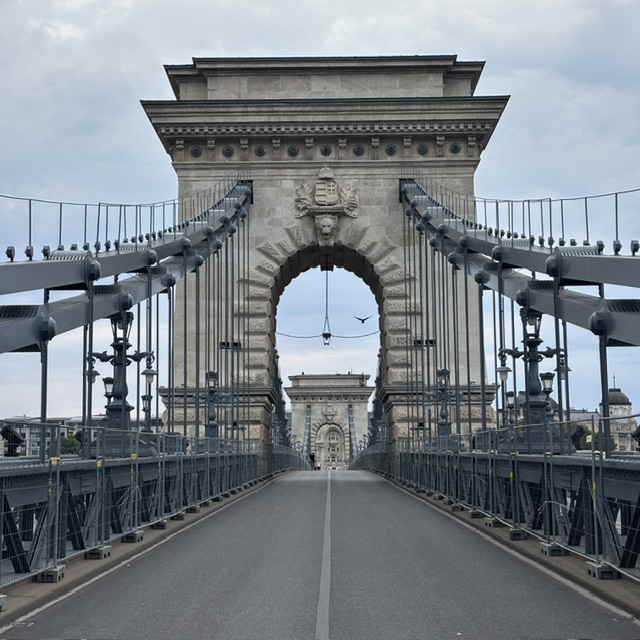
Sunday, explore Buda Castle along the west side of the Danube River, and St Stephen’s Basilica on the Pest side of the Danube; many pedestrian malls, teeming with tourists.
Reminded of Sir Georg Solti; he conducted the Chicago Symphony Orchestra (1969-1991); Solti was born in Budapest, studied with Béla Bartók, and received the Kennedy Center Honors (1993); he is buried nearby, at Farkasréti Cemetery in Budapest.
TUE 18 AUG: overnight rain brings cooler, more comfortable temperatures in the morning. Metro to Nyugati station, train to Bratislava Slovakia. It is a modern train, with scheduled through service to Berlin (11-hours). Clean and quiet, and grateful for the brief duration (3-hours), short walk to city center.
Headache, but not a migraine, for the duration of the day. Take medication, but it does not work, and the duration of pain becomes tiring. Entertain little of Bratislava. Some days, would be just as pleased to sit on a couch and watch a movie.
Wednesday, guest house is located on the central pedestrian mall, and wake to the rhythms of the passing trams at sunrise. Body and mind are grateful for real coffee (French press) in the shared kitchen.
Explore the compact, historic old town, located along the banks of the Danube River. Slovakia was part of Czecho-Slovakia, until the end of communist Czechoslovakia (1989), and the creation of the independent, Czech and Slovak Republics (1993).
FRI 21 AUG: wake early, pre-dawn. Tram to train station, one-hour train to Vienna (Wien Hauptbahnhof). As train approaches city center, sounds of Wiener Philharmoniker Fanfare, Richard Strauss (1924) echo in my head.
Drop off backpack at hostel (secure locker) and explore Vienna (Roman: Vindobona). More importantly, mid-day appointment at Apple store (last visit was New Delhi). Genius Bar appointment to remove detritus from USB-C port; charging has been finicky and fussy. Crowded store, underwhelming customer service, but issue resolved for no cost. By the end of the day, my eyes are burning with fatigue.
SAT 22 AUG: overnight rain, cool morning gives way to bright sunshine, regional train to Prague Czechia (4-hours). Dvořák Cello Concerto (B-minor) surges through my head.
Sunday, explore Prague old town: astronomical clock, St Vitus Cathedral at Prague Castle, and Karlův Most (Charles Bridge), medieval stone arch bridge that crosses the Vltava River. Surprised to learn that there are 40 Starbucks locations in Prague.
Monday, cannot find affordable barber, likely, last haircut on this journey. Splurge on straight razor (bald) haircut. If unfamiliar with the straight razor, watch the opening scene from The Untouchables (1987). Barber uses slick gel, no knicks or cuts. Inspect shiny dome in the mirror before departing, do I not see, Sir Patrick Stewart.
TUE 25 AUG: morning train to Munich Germany (six hours). At the Czech Republic border, German immigration agents inspect passports, and also inspect my damaged passport. Greeted in Munich with rain; was greeted with rain in Munich last year, too.
Typically, I am a voracious reader; I miss reading books. Sometimes, I find a good title at guest house or hostel, and may read a few pages. Prefer real books, but too bulky.
Wednesday, visit corners of the world that bring a person to tears, but not tears of joy. Morning rain clears, and gives way to rays of sunshine. Smell woodsmoke, or is it smoke from the crematoria. Pass through the metal gate of Dachau Concentration Camp Memorial Site; arbeit macht frei (work sets you free). Dachau was the longest serving concentration camp (1933-1945) until its liberation by the US Army.
Heinrich Himmler, Munich Chief of Police and leader of the Nazi SS (Schutzstaffel), established Dachau for political prisoners and “enemies of the state” who opposed the Nazi party. Dachau initially held 2,000 inmates, and was expanded in 1937. At the time of liberation in 1945, there were more than 30,000 inmates on the main grounds.
Traveled to Munich in July 2025; sheepish that I did not visit Dachau, and I return. Journey to bare witness, journey to hear the cries of the world. Would I have survived. Would I be as dehumanizing as the SS guards. Would I be as willfully ignorant as the local townspeople and residents.
Purchased one-day ticket (Zone M-1 | $14 USD from kiosk), for the round-trip journey. S2 (commuter) train to Dachau station, and 726 bus to the memorial. Entire journey less than one-hour; no need for guided tour. Entry to the memorial is free.
If curious, Zone of Interest (2023), documents the life of Auschwitz commandant Rudolf Höss. Hear Auschwitz, but never see Auschwitz; its presence is only felt. Won Academy Award for best international feature film; German with English sub-titles.
Is democracy resilient enough to withstand attacks on freedom of speech, freedom of press, political opponents, at the hands of neutered congress and deferential court.
Earlier in the day (8:45am), avalanche-induced flood wave crashed through Gyirong Port at the Tibet-Nepal border. Primary border, Zhangmu Port, was destroyed in 2015 earthquake. Intention was to travel Hunza Valley from Pakistan to China, Tibet, Nepal, India, and the United States, except, unable to obtain China visa. Would have crossed this border, and onward to Kathmandu, at the end of August (plus or minus a week).
FRI 28 AUG: pre-dawn train to Salzburg Austria via Berchtesgaden; do not visit Eagles Nest. Bus to summit ($40 USD), and the site sacrificed history to become a beer hall. Transportation from Berchtesgaden to Salzburg was underwhelming. Bus and train frequency did not keep up with demand (tourists, locals, and military); no ticket kiosks, and no contactless credit card.
Saturday, explore old town Salzburg, birthplace of Mozart, and reminded of his late-period works: Symphony N.40 (K.550), Clarinet Concerto (K.622), Requiem (K.626).
SUN 30 AUG: morning train to Innsbruck Austria; grey, treeless mountain summit contrasts with lush, green valleys. Many stores and shops are closed. Town is compact; Hofgarten offers respite from tourists; soft grass beneath bare feet.
MON 31 AUG: pre-dawn thunderstorm gives way to sunshine. Scenic train through the mountain valley to Feldkirch Austria; connecting bus (#11) to Vaduz Liechtenstein. Lovely, little corner of the world; quiet, green, pastoral, fresh air. It is pretty, but also, pretty expensive. Equivalent cost of diesel is $11 USD per gallon. Liechtenstein is one of two double landlocked countries in the world (visited Uzbekistan in July 2026).
Cost: cumulative travel costs, during past 248-days.
Lodging: $5,907 total | $24 day (private room: 154 nights | 62%)
Transport: $6,905 total | $28 day (plane | train | bus | ferry | taxi)
– – Philippine Airline ($1100 JFK – MNL, 18-hour non-stop, $61 flight hour)
– – Four flights ($300 Bangkok, Myanmar, Bangkok, Chiang Mai)
– – Six flights ($1,600 India, Maldives, Sri Lanka, India, Bhutan, Nepal)
– – Seven flights ($1,000 inter-India on IndiGo; Karachi Pakistan)
– – Two flights ($300 Islamabad to Skardu; Kabul Afghanistan)
– – Three flights ($500 to Tashkent; to Baku; to Tbilisi)
Food: $901 total | $4 day
Other: $5,033 total | $20 day (FX | ATM | visa | tourism | RV & motorbike)
– – Bhutan ($1,375 five-day, four-night | travel prohibited without guide)
– – Afghanistan ($2,500 seven-day, six-night | Untamed Borders)
Total: $18,745 total | $76 day | $27,600 annualized
– – Cash burn: $796 | $3 day (when credit card not accepted)
Credit card accepted more frequently; have not recently exchanged currency.
Currency: Philippine Peso (PHP), Myanmar Kyat (MMK), Thailand Baht (THB), Laos Kip (LAK), Cambodia Riel (KHR), Vietnamese Dong (VND), Maldivian Rufiyaa (MVR), Sri Lankan Rupee (LKR), Bhutanese Ngultrum (BTN), Nepalese Rupee (NPR), Indian Rupee (INR), Bangladeshi Taka (BDT), Pakistani Rupee (PKR), Afghan Afghani (AFN). Uzbekistani Som (UZS), Azerbaijani Manat (AZN), Georgian Lari (GEL), Armenian Dram (AMD), Turkish Lira (TRY), Moldovan Leu (MDN), Romanian Leu (RON), Hungarian Forint (HUF), Czech Koruna (CZK), and Euro (Bulgaria, Slovakia, Germany, Austria).
Conclusion: what is the cost of long-term travel, about $76 per day (lodging, transportation, food, etc.). What is the price of long-term travel: dog bite (Ecuador, India), hit by a scooter (India), damaged passport (Afghanistan-Uzbekistan border). As I continue to travel to more demanding corners of the world, the hits may continue.
Life is often a constant message to improve oneself; life coaches, influencers, podcasts. To grasp for inner change is self-deception. Instead of trying to fix and outrun; accept, and surrender. Anything that I have ever let go of has claw marks.
Often wonder if travel changes a person or not. Often wonder if people may even change. Perhaps it is delusion to believe that people may change, to rearrange deck chairs on the Titanic. Why does it seem that any intention of change often achieves the opposite, or, at best, only soften sharp edges. Is it equanimity to accept that people may not change. Does it take a lifetime to learn to tolerate and accept myself.
Do not try and bend the spoon. That is impossible. Instead … only try to realize the truth … there is no spoon. Then you will see, that it is not the spoon that bends, it is only yourself (Matrix, 1999).
 garthmonroe