Introduction: first journey to India was 2011, my first solo trip. India should never be the first solo trip. No iPhone, just a handful of maps from the Lonely Planet guidebook.
Experience was a frontal assault and completely overwhelming. Thirty-day journey, and almost every day, considered quitting and returning home. On the return flight, United Airlines, New Delhi to Newark (15-hours), boarded aircraft, hugged the purser, and pleaded, “take me home, please.” Appropriate response: unbridled laughter.
Fifteen years passed before I found the tenacious resolve to return to India.
Travel remains uncertain with a dubious cease-fire in Iran and drone threats throughout the Middle East. Dubai is the second busiest world airport; 1,200 daily departures and 300,000 daily passengers. Intention is to travel east, June-July, towards the Caucasus. Qatar is the largest exporter of liquified petroleum gas, and ceased all production at the start of war; airlines are running low of jet fuel.
Almost every day is a challenge. To be rigid, in the face of culture shock, yields nothing but suffering. Why do I travel in this manner; long-term travel shatters deeply-held beliefs and false assumptions.
This dated reference to India still rings true for the uninitiated or experienced traveler.
India: miss at your peril – it is the highlight of independent travel – however bear in mind, a lot of hassle, heat, and long distances. Wow, here it is, the epitome of Asia and all travel. That love it, hate it thing that everyone speaks about. Yes, it is damn trying and hard work, but, India has so much to offer on and off the tourist trail: English spoken, culturally and historically fascinating, good transport, cheap, and just plain brilliant. But take it easy and do a little bit at a time.
Adam Coutts | Intro to Meditation (July 21, 2010) and Travel Independent.info
This really is one of the few places on the globe you can still get serious culture shock and sensual overload. India really is just so much it is almost impossible to introduce and summarize, perhaps the only common theme is you will feel like all your senses are being assaulted. It is hard to understand and explain just why somewhere so often dirty, hot, ugly, and full of hassle has such an appeal. The answer lies enigmatically with it being often the exact opposite. There is just no way that it will not have an effect on you and if – like me and thousands of others – you leave after your first trip loathing it, you will probably remember your visit fondly, and be back many, many times.
WED 01 APR: onward bus, Kathmandu to Pokhara; pick-up point is vague, it is not a bus station, but rather, tourist buses parked one-mile along the street curb. 125-mile, eight-hour journey along Prithvi Highway. Built between 1967-1974, the two-lane undivided road is choked with traffic; no passing lanes, no traffic lights, no speed limits. Parts of the highway are asphalt, but, much of the road surface is mud and gravel. In February, an overnight bus went off the road, into the Trishuli River, and killed 19 people. It is possible to fly, but, to miss the experience.
Thursday, priority is to see the local dentist; slight discomfort. Dentist speaks some English, and surprised that the office has digital x-ray, cost $2 USD. She tells me that an old amalgam filling needs to be replaced. Wait until I return to United States.
Is there a tale of two Pokhara; make-believe tourist version, tucked next to Phewa Lake, and the chaotic, noisy, real-life version. With remainder of the day free, hike to the Peace Pagoda. Dense, green foliage, bird song, and well-marked trail is a fine opportunity for forest bathing. Everyone along the trail is in good spirits, too.
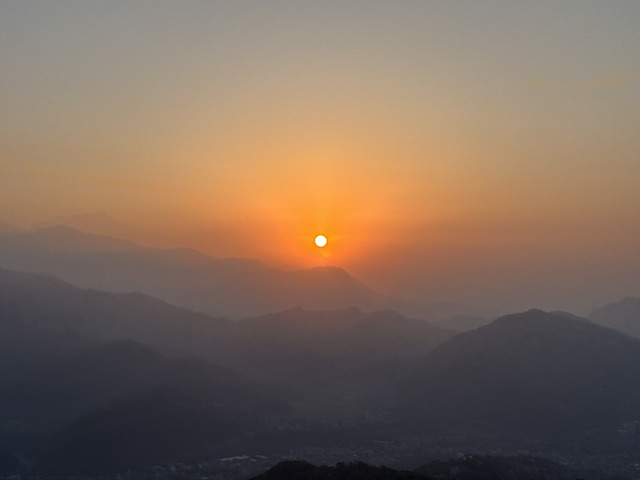
Friday, wake at 3:30am, to reach Sarangkot by sunrise. Considered hiking; too early, too dark. Annapurna cable car to the summit ($12 USD credit card). Morning light along the mountain ridge is dramatic, and worth the 10-kilometer round-trip walk.
SUN 05 APR: walk to Pokhara bus station, and a teenager joins me. Maybe he wants to practice his English, maybe, he wants to speak with a tourist. He is polite, he does not ask for money, and we go our separate ways, a fleeting moment of kindness.
Morning departure, Pokhara to Bhairahawa; bus is full, no tourists, only locals. Bus company sends text message, license plate number, so that I board the correct bus.
Day illustrates the preference for certainty, where certainty does not exist. Bus drove southeast, towards Kathmandu (and Chitwan). Asked the ticket attendant (twice) if this is the correct bus to Bhairahawa, and twice, his head nodded, side-to-side.
At Gaindakot, bus changed direction, and drove southwest towards Bhairahawa. In the dusty lowlands, the bus becomes oppressively hot, there is no AirCon on-board.
Bus entered city center, and like a dying animal, broke down by the side of the road. Bus driver flagged down local bus, and the few remaining passengers get picked-up for the thirty-minute drive to the bus station. It would have been much worse if the bus broke down on a remote mountain pass; 160-mile journey, 9-hours.
Check into the hotel, and surprised to find an afternoon street market in the setting sun. One food stall is swarmed with locals and black flies. I am served steamed dumplings (momos) with hot sauce that makes you reconsider after the first bite. Owner treats me with great kindness, I wonder, if he may read the sorrow on my face.
MON 06 APR: sleep like the dead, but wake up exhausted, how can a bus journey be so exhausting. Walk to the land border, and reach the border gates at sunrise.
Land-border crossing is another exercise in uncertainty. Do not know how the border crossing will unfold, it is always different, it is always uncertain. Will the border be a desolate no-man’s land, or a chaotic, maddening, and bustling scene.
I am stamped out of Nepal, before walking into India, my passport and visa information is recorded in a log book. Cross the border, and tucked out-of-sight, enter India immigration office. I have (full-page) five-year multiple-entry tourist (sticker) visa from NYC consulate affixed to my passport that allows me to enter and exit India at land borders. Travel guidance for on-line eVisa is less clear, check the rules carefully.
Exit immigration, several locals stop me for a photo. I shake their hands and smile, it is easy to cooperate, and if the experience brings them joy, so much the better.
No drama, no trauma, no duplicity, I am surprised. Board local bus for three-hour journey south to Gorakhpur ($2 USD). India teaches a person to travel slowly. Do not have more than one objective for any given day, anything else is punished severely.
Did not visit Lumbini Nepal, birthplace of the historical Buddha (2-hour round trip from Bhairahawa), and did not visit Kushinagar, final resting place of the historical Buddha (3-hour round trip from Gorakhpur). Did not have the energy; air quality is very poor; it is hot, dusty, and dry, and already have a low-grade headache.
Travel India for the next seven weeks, may need to suspend any expectations. Do not need a great day, only need a day, any day, just give me a day. A day that does not overwhelmingly get the better of me. A day where I may exist without hating life too much. A day where I may exist without hating myself too much. Is that too much to ask. Perhaps I should rename this blog post, “no good days (daze).”
TUE 07 APR: early morning is dark and still. Surprise. There is a locked, heavy gate across the hotel exit. Too high to climb over, too low to climb under. Ring doorbell, nothing happens. Call WhatsApp, nothing happens. Is this how I miss today’s train (#2). Finally, I hear a phone ring, sheepish-looking receptionist opens the gate.
Back-up plan was to return to my hotel room, remove sheets from the bed, tie them to the balcony railing, and rappel down from the second floor. Queue MacGyver.
Little stirs in the early morning darkness, not even stray dogs. Men piss along the side of the road. Maybe it is too early to tout and torment the tourists. Cattle grates keep roaming livestock out of the train station. Gorakhpur station is crowded, there is little respect for personal space, and physical proximity is often grotesquely violated.
Population: India 1.5-billion | 4x | USA 350-million
Economy: India: $4-trillion | 8x | USA $31-trillion
GDP per capita: India $2,500 | 34x | USA $85,000
Population density (people per km2): India 450 | 13x | USA 35
India has the fourth largest rail network in the world, 84,000-miles. Booked train tickets on 12Go. It does not sell all the train routes, but sells the more popular train routes, and easier to navigate than the India rail site. Tickets go on sale 60-days prior, and frequently sell out, plan ahead. Use IXIGO iPhone app to confirm seat assignment and real-time train status (ie. platform). Plan worldwide travel with The Man in Seat 61.
Still enjoy the movie, Best Exotic Marigold Hotel (2011), and enjoyed the book behind the movie, These Foolish Things by Deborah Moggach (2004). Also enjoy the movie, Slumdog Millionaire (2008), and enjoyed the book, Q&A by Vikas Swarup (2005). The movie, Life of Pi (2012) is magical, and so is the book by Yann Martel (2001).
WED 07 APR: visit coffee shop, close to the newly refurbished, Gomti Nagar station. Purchase an Americano, first real coffee in 100-days, and feel like a gangsta.
There are food carts outside the train station. There is nothing in English, and I am mostly ignored. I study what is being served, and try to observe the cost. I am served something, but do not know what it is called. Food has some serious heat, and my eyes do not know if they should cross or water.
Fifteen-hour, overnight train (#3) from Lucknow to Jaipur operates three nights per week. There is little decorum. People talk loudly on their phone, watch Tik Tok videos without earbuds, and toddlers screech. Cabin does not become subdued until 10pm. I have an upper bunk, and slide one leg through a backpack strap, just in case.
Train arrives on-time at 7am, and I am assaulted by tuk tuk drivers the moment my foot steps off the train and onto the platform. Touts are not a personal attack, and they are as intense in India as they are in Cairo Egypt. Tourists have money, a walking ATM, an ATM with feet. If someone offers you chai tea, they are not being kind, they want something in return. There is nothing free in India.
Jaipur is called the “pink city.” Maharaja Ram Singh had most buildings painted pink in preparation for a visit by Queen Victoria (1876). Find a barbershop in the non-tourist part of the city. Somehow, I become the life of the party, and we celebrate with chai tea. Cultural bonding is consistently the most rewarding at the barber shop. Barbers comment on the ill-conceived, ill-planned, and ill-executed war in Iran; the short-lived cease-fire; and the president’s notorious ability to double-down on stupid. Now we know what happens when a president starts a war that he does not know how to end.
SUN 12 APR: fifteen years ago, picked-up paper train tickets at the tourist desk, and read a bulletin board with a long (dot matrix) printout for seat assignments. While technology has come a long way, you still want a confirmed reservation, and not a reservation listed as wait list (WL) or reservation against cancellation (RAC).
Enter Jaipur station, there is baggage screening and a metalometer, a good place for personal items to get stolen. Follow suit, and walk around the security checkpoint.
The station is a crush of humanity, pushing and shoving. So many people are touching me; cannot tell if people are pulling at my pockets or tugging at my backpack zippers.
Train (#4) departs 4pm, and there is no decorum on board; a person would get thrown off an airplane for such behavior. Ideal environment to evaluate best-in-class, noise-cancelling headphones, good luck. Train arrives Jaisalmer, on-time, at 5am.
Check into nearby hostel, pleasant surprise, upgraded from dorm to private room. Drop off backpack, and explore Jaisalmer Fort and the various havelis (ornate mansions). Daytime temps exceed 35c, try to stay indoors between 12-6pm.
WED 15 APR: wake at midnight, difficult, even for me, 2am train (#5) to Jodhpur.
Few people on the train platform, only one tourist. Local police and high school sports team subject me to an informal interrogation. They are often the same questions, and they become tedious. Some people do not recognize the social queues to end polite conversation. It hurts my face to smile and laugh for such a long time. It takes a great deal of concentration to decipher broken English.
Are you married: no. Do you have children: no. How old are you: 56 (but you look 35). What is your work: accountant. How much do you earn: enough. How long do you visit India: two months. Board the train, and exhausted, quickly fall asleep.
Maybe I am too polite, maybe I am a pushover. More than once, I am railroaded into someone’s shop. The person who steers me into the shop earns a commission. I tell the shop owner that I wish to buy nothing, and quickly exit.
I am not always a pushover. One afternoon, bicycle was going to hit me at a high rate of speed; would have been severely injured. Extended and locked out my arms, clotheslined the biker, and sent him to the ground. Helped him up and walked away.
Delayed train, arrive 9am in Jodhpur, the “blue city.” Many homes surrounding Mehrangarh Fort are painted shades of blue, which dates back to the caste system.
Children approach and beg for money, perhaps of their own initiative or their parents. They grab my hand or arm, sometimes, they try to reach into my pockets for money.
Drop off backpack at hotel, conduct various errands, temperature is 35c. Travel day is long, and I run out of energy long before I can return to my room.
Thursday, explore the city at sunrise, the narrow lanes of the “blue” city. Stray dogs are overwhelming and unnerving. Dogs are active in the morning, before temps reach 35c. Stray dogs eat: (stale) roti, crackers, garbage, and shit from baby diapers, no joke.
Friday, nipped by a dog at the public market. Attacked from behind, did not hear or see. Single puncture, broke the skin, no bleeding. Detour to emergency room, treated professionally by English-speaking doctor. Wound cleaned, tetanus booster, anti-rabies booster #1 (ARV | Day 0), one in each shoulder.
Also received two doses of equine rabies immunoglobulin (eRIG), which immediately introduce antibodies. Doctor tells me the two injections will hurt, tells me to bite down on a tongue depressor. Needles appear as long as the doctor’s arm. Had a metallic aftertaste in my mouth following the injections. Breath mint, anyone.
Observed many dog bite patients in the waiting room, local citizens with severe wounds and bleeding. Jodhpur hospital treats 75 new dog bite victims each day, 1.5% of the population, annualized. Dogs account for 99% of all rabies cases. Public hospitals in India are required, by law, to treat rabies at no cost. Left untreated, rabies attacks the central nervous system, and is 99% fatal. How was your day.
SAT 18 APR: early morning, pre-dawn, walk to nearby traffic circle. One stray dog, okay, but, a dozen stray dogs adopt pack behavior, intimidating and un-nerving.
Morning bus (#2) to Udaipur. There is no bus station. Instructed to wait at the traffic circle, stand in the street, and flag down the bus. Five-hour journey, and bus overheats on a steep hill. Driver uses precious, packaged drinking water to refill the radiator, and throws the empty bottles on the ground. Better than getting stranded in the middle of nowhere. Experience reminds me of driving the Grapevine Pass in southern California.
Monday, walk to Udaipur hospital for anti-rabies booster #2 (ARV | Day 3). Hospital staff speak Hindi, no English. Body language suggests that they were not going to deny care, but, they were certainly not enthusiastic. For now, treated until the next dog bite.
Cannot find local bus to the airport; find tuk tuk ($4 USD) for the fifteen-mile drive. The ride is slow (<60 km/h), no suspension, and breath-in traffic exhaust. Reminded of the lottery of birth, to have been born in the United States. This person will drive a tuk tuk for his entire life. Women will never drive a tuk tuk, they will sweep the streets.
Udaipur hostel was underwhelming, check into airport hotel, easier to manage tomorrow’s early-morning flight to Mumbai. Visit road-side food stand, far stretch to call it a restaurant. Inexpensive, spicy, and good. Owner likely sees few tourists; he seems pleased that I enjoy his food, and he treats me with kindness. He asks my name, and I share Adam, my middle name. Similar to Spanish-speaking countries, Adam is easier to pronounce than my first name.
TUE 21 APR: walk from hotel to airport, morning flight form Udaipur to Mumbai. Train is 20-hours, too long, even for me. Metro (aqua line) to city center, and check into AirBnB. Do not have enjoyable memories of Mumbai from 2011, intention is to move onward as quickly as possible. Spy stray cats in India for the first time.
Wednesday, sunrise run along Marine Drive. Pedestrian area is buzzing with energy as people walk, run, and exercise. Air is thickly humid, and wonder if iPhone will fly out of my sweaty hands. Forty-five miles of barefoot running in four months, influenced by the limited ability to run in places free from traffic; free from the risk of getting hit.
THU 23 APR: walk to Chhatrapati Shivaji Maharaj Terminus, UNESCO world heritage site, Indo-Gothic style, built between 1878-1887. It is one of the busiest train stations in India with 18 platforms; film location for Slumdog Millionaire “Jai Ho” final scene.
Walk along platform 11, for five-hour train (#6) to Pune. Police officer checks my ticket and leads me to the correct train car. There is no one else on board, he sits next to me, tells me that I have pretty (blue) eyes and touches my knee. It is deeply uncomfortable. He quickly departs when his adjacent train departs the platform.
Friday, slow start to the day, deeply fatigued, and get out of bed after sunrise. Sit quietly on the couch, drink coffee with AirBnB host. Go out for morning walk, but quickly return to escape the blaring horns of traffic. Not sure if fatigue due to rabies vaccination, or, travel fatigue, does it even matter. There is a western-style grocery store nearby; treat myself to tahini, kefir, kimchi, and kombucha.
SUN 26 APR: Google maps leads me to the metro station, but blocked by tall fence. Ground is dusty, but twelve inches of clearance, crawl underneath, and dust myself off. Mind over matter; if I do not mind, it does not matter.
Overnight bus (#3) from Pune to Hampi. There is no bus station, just a chaotic bus stop along six-lane highway. The alternative is a 12-hour train departing at 1am.
Uncertainty often requires patience, perseverance, persistence, and politeness. It is a bus stop, but not a conventional bus stop. There is little confidence that the bus, any bus, will actually stop. If you glance down at your iPhone, you risk missing the bus. Wait around all day; then what. Is it possible to find equanimity among such chaos.
Spy the bus livery. Step into the highway, and flag down the bus. People may insist that Hampi is magical, but getting to Hampi is far short of magical. Thirteen-hour bus arrives 8:30am; coffee, please. Walk five-miles to stretch out my legs. Two motorcycles pick me up for a short hop, ask for nothing in return, only kindness.
Monday, explore the temples at sunrise, UNESCO world heritage site, most of the sites are free. Morning temperature is comfortable, no angry traffic horns, only bird song. For several hours, I am by myself, it is quiet, and feel rate of respiration slow down.
TUE 28 APR: sleep in until sunrise, wake up to the rustling sound of Gray Langur monkeys dancing in the tree tops. Overnight train (#7) to Mysore, depart 9pm.
Wednesday, these are not the droids you are looking for. Oddly enough, 12-hour overnight train arrived on-time at Mysore. Step off the train, on to the platform, and assaulted by tuk tuk drivers. Reply quietly, do not want a tuk tuk, and walk away.
Fifteen years following my first journey, I return to India to give the country its proper due. Traveled 75 of 200 countries, India remains a challenging destination for solo travel. India beats me up and beats me down, does it even make a difference.
I learn the three “E’s” of India: to exist, to experience, to endure. Travel to India reminds me of the benefit to be flexible, and the ability to bend; to be rigid is to be punished. Over a long enough period of time, I settle in to India. Over a long enough period of time, turbid water, mud settles to the bottom, and the water becomes clear.
I am not in the Middle East, but, to travel during war in the Middle East, makes any travel difficult. Do not hold your breath, the journey does not get better anytime soon, not before August 1st, when I reach Istanbul, the crossroad between Asia and Europe.
Cost: cumulative travel costs, during past 125-days.
Lodging: $1,885 total | $15 day (private room: 61 days | 50%)
Transport: $3,983 total | $32 day (plane | train | bus | ferry | taxi)
– – Philippine Airline ($1100, JFK – MNL, 18-hour non-stop, $61 per flight hour)
– – Four flights ($300, to Bangkok, Myanmar, Bangkok, Chiang Mai)
– – Six flights ($1,600, to India, Maldives, Sri Lanka, India, Bhutan, Nepal)
Food: $381 total | $3 day
Other: $1,820 total | $15 day (FX | ATM | visa | tourism | RV & motorbike)
– – Bhutan ($1375 five-day, four-night | travel prohibited without guide)
Total: $8,069 total | $65 day | $23,600 annualized
– – Cash burn: $472 | $4 day (when credit card not accepted)
India is cash-based economy (currency over credit card); able to use a tourist version of India’s digital Unified Payments Interface (UPI) to reduce reliance on rupee.
Currencies: Philippine Peso (PHP), Myanmar Kyat (MMK), Thailand Baht (THB), Laos Kip (LAK), Cambodia Riel (KHR), Vietnamese Dong (VND), Maldivian Rufiyaa (MVR), Sri Lankan Rupee (LKR), Bhutanese Ngultrum (BTN), Nepalese Rupee (NPR), Indian Rupee (INR).
Conclusion: ignore the garbage, shit, mud, pollution, the stink, filth, and flies. Ignore spitting, touts, and blaring horns of traffic. Simply the cost of travel to India. With each breath, try to forget everything, try to remember less and less. Live each day, as if, I have amnesia, and unable to remember how unbearable was the previous day.
Often wonder if long-term travel is a waste of time and money. Maybe, long-term travel is nothing short of meditation practice. Breath-in, breath-out, and try to forget everything, to let go of everything. “To study the Buddha Way is to study the self; to study the self is to forget the self” (Dōgen Zenji, Genjōkōan).
If a meditation retreat is long enough, the body-mind gives up and surrenders, and maybe the same could be said of long-term travel. Eventually, give-up and surrender to the entire experience, and engage with the world as it exists (thy will be done).
 garthmonroe