* * * * * sensitive subject matter | reader discretion advised * * * * *
Part I: Why Charlie Left Us
In fall 2000, studied for CPA exam. One morning, took a break to read the Sunday paper. Came across this article published in the Hartford Courant (October 1st 2000), written by Mike Swift, titled, “Why Charlie Left Us.” It’s a fairly damning account of suicide, and provides a glimpse on how the act of suicide harms surviving family and friends.
At the time, it was difficult to read the article without an emotional response. After finished reading, it confirmed for me that suicide could be an exit strategy, but would likely cause undue grief on family and friends. I re-read the article as I prepared this post, and again, difficult to read without an emotional response.
About 200 miles from Hartford in northern Vermont, Interstate 91 reaches its highest point — 1,856 feet above sea level. Beyond this divide, the rivers flip and begin to flow north instead of south. Towns are so small that a voice called out on Main Street has an echo. Even the atmosphere feels different, fresher somehow. Before sunset, the air can have so much clarity that the sun’s rays pick out insects and bits of dust in the air, converting them into incandescent flecks of floating copper. You are not really surprised when you reach a crossroads, and a highway sign directs you to turn left to reach Eden.
In a sense, it is another country, one that was home to my friend, Charles Tenny. And I am going there, in hopes of explaining the unexplainable. I am a reporter and that’s what we do: Try to explain things so that we, and the people we write for, understand what happened. We don’t always succeed. Charlie was a journalist, too — a fine one, who covered G-7 economic summits in Washington and Munich, and had bylines in newspapers ranging from the Asian Wall Street Journal to his hometown paper, The Chronicle, of Barton, Vermont.
You remind yourself, as you drive through northern Vermont, that even this Eden has its dark side. It is dirt poor by southern New England standards. Try living here in March, when winter is already four months old. Angry signs on barns proclaim “Take Back Vermont,” in part the intolerant counterattack to new laws that allow gays to join in marriage-like civil unions.
But it was Charlie’s home. “In America, at least, there’s no place that suits me so well as Vermont,” he had written in his last letter. You could call Charlie Tenny a nonconformist, though I suppose some people would call him a misfit. After Charlie nearly died in 1994 after being hit by a car while working in Tokyo, he decided to quit his job and kayak from northern Vermont to the Gulf of Mexico. He was not an expert kayaker; colleagues warned him it was a bad career move. But Charlie’s resolve was set. The following year, he walked from his parents’ front door in Vermont and paddled for nine months – – down the Barton River, into Quebec, up the St. Lawrence River, through the Great Lakes, and down the Mississippi River to the Gulf.
Sometime later, a friend in Montreal with whom Charlie had stayed on the kayak trip got a call. Charlie wanted to come visit again. This friend had given Charlie a ride across part of the city of Montreal. Charlie had decided to return to walk those miles so he could be satisfied he had covered every foot of the trip — every single foot — on his own power.
Unlike most of us, Charlie never learned to compromise. He was incapable of telling a lie.
Or so we thought. Because one morning last December, after thinking and carefully planning in secret for months and possibly years, without a hint of warning to his parents, his two sisters, his friends, or his co-workers, Charlie left a note in his apartment in Watertown, N.Y.
“I’ve headed to the Adirondacks,” it began.
Charlie went into the forest, tossed a rope over a tree, and hanged himself until he asphyxiated. In perpetrating this grand deception, he plunged his family and his friends into another country: a place where grief wars with anger and guilt and remorse, where the world feels like it has lost some vital essence, as rare and untouchable as flecks of copper in a Vermont sunset.
When Charlie Tenny was 2, he snatched a toy truck away from a fellow toddler who happened to be the future emperor of Japan, the current Crown Prince Naruhito. Charlie’s parents, State Department diplomats posted in Japan, were horrified. Fortunately, the Royal Family did not take offense. This is but the first example of Charlie’s willfulness, and his lifelong disregard for convention.
At 22, Charlie secured a ride on a chemical tanker bound from Japan to Thailand, the first leg of a long bicycle journey across India. The officers were Japanese, a language Charlie spoke fluently, but the crew was Korean, which Charlie did not understand well. It was a rough, hot voyage. Charlie wrote long, evocative letters on napkins — the only paper he could find — and amused himself by reciting “Casey at the Bat” and other long poems that he seemed to have the ability to memorize effortlessly. When the ship pulled into a dark slip in Bangkok, a gaggle of Thai prostitutes came aboard. Not all were able to make a sale, however, and Charlie felt sorry for them. So he took tea to the unsuccessful ladies who were waiting in the galley. Seeing this, the Korean first mate exploded in anger, blasting Charlie for this unauthorized use of company tea. I smile when I imagine what those hard-boiled prostitutes must have thought at the sight of the chivalrous American, standing there with a pot of steaming tea and being excoriated in a language he could hardly understand.
It is impossible to talk about Charlie without telling stories, and once you start to swap them it is difficult to stop. And on an August afternoon, the sun hot and Charlie eight months dead, I am sitting on the porch of Charlie’s father Frank and mother Robin in Barton, telling and listening to stories.
Charlie was a nomad, one friend said of him: He seemed at home everywhere he went, but nowhere in particular. He spent about half of his life in Japan and half in the United States, and his sensibilities were as much Japanese as American. When Charlie was elected class speaker at Colby College for the class of 1984, he presented his graduation address wearing a formal Japanese kimono. Charlie finished with a really funny gravel-voiced imitation of Louis Armstrong singing, “I’m a little bit short of elbow room / But let me get some, / And look out world, here I come.” I know few people who could bring off a good Louis Armstrong while wearing a formal kimono.
When Charlie was accepted to Columbia University’s journalism school, he decided to say goodbye to Vermont by hiking the Long Trail, which runs the length of the state from Massachusetts to Canada. I came along for the first 100 miles or so. As we hiked out of Williamstown, Mass., Charlie announced that he was taking up bird watching, and was carrying an Audubon bird guide. I scoffed; I thought bird watching was for old people in funny hats. But a few days later, on Glastonbury Mountain, the Audubon guide by chance fell open to a photo of a beautiful sleek bird, with black, Zorro-like bands over the eyes: a cedar waxwing. What a thrill it would be, we thought, to see such a wonderful bird. Probably impossible to see, though. But within minutes, a sleek bird flitted out of the forest and alighted 20 feet in front of the shelter, looking at us. It was a cedar waxwing — a backwoods miracle! I soon learned, of course, that the cedar waxwing is fairly common in New England.
They had always been there; I just hadn’t been able to see them. Now I do. Charlie had a way of transforming the world for the people around him, without even trying.
Frank and I laugh as we tell these stories, but the laughter trails off into bitterness.
Charlie was 38 when he died, the same age as me. Since he left, I have responded to his death by playing the good reporter, trying to become something of an expert in the field of suicide. I could tell you, for example, that about one million people will take their lives this year, that the world suicide rate has increased 60 percent during the last 45 years. I could tell you that in the United States, suicide kills more people every two years than the total number of Americans who died in the Vietnam War. I could tell you that in Connecticut, which has among the lowest rates of suicide in the nation, many more people committed suicide in 1998 than died as a result of AIDS, murder, or injuries from firearms. You wouldn’t know it from the media. Many U.S. newspapers, including The Courant, have a policy of not reporting that deaths are suicide unless the act is in a public place or involves a public figure.
I could tell you that psychiatrists say the great majority of people who kill themselves, as many as 95 percent, are suffering from a diagnosable mental illness; that if they had been receiving treatment, thousands could have been saved each year. I could tell you that some mental health professionals are arguing that depression often manifests itself very differently in men than in women — through intense activity, risk-taking and irritability, not just feelings of fatigue and sadness — and that as a result it is frequently missed in men, with fatal results. Men die from suicide at four times the rate of women.
Western culture has had a stigma against suicide that can be traced back to 563 AD, when the 15th canon of the Council of Braga enacted the first of what were to be centuries of systematically escalating penalties against people who committed or tried to commit suicide.
A 1660 law in Massachusetts Bay, for example, required that suicides be buried at a crossroads. Such bodies were often buried with a stake through the heart to prevent the soul from wandering.
A French law of the same era required that the corpse of a suicide be dragged through the streets, before it was thrown on the town dump or into a sewer. In Britain, until the late 1800s, suicides, by law, had to be buried at night.
I could tell you that in 1969, the year we landed men on the moon, suicide was still a crime in seven states.
I have come to believe that the stigma, the silence, and the sense of shame surrounding suicide and mental illness, carried forward from our ancestors, is killing people.
I have come to Vermont on a sort of a pilgrimage. Webster’s defines a pilgrim as a “wanderer.” Since Charlie died, I have done plenty of emotional wandering, with little progress toward a destination. Learning about suicide has done little to untangle my feelings. In the months before Charlie’s death — the time that he was most alone, his thoughts conjugated by the apparent value-less-ness of his life — I thought many times about calling my friend. For no apparent reason, I felt vaguely worried about him. But I never did call.
Afterwards, I developed a detailed fantasy, one I played out over and over in my mind, of the telephone conversation between us that never happened. Charlie says he’s been doing a lot of skiing and hiking in the Adirondacks. I immediately say we should schedule a trip. Late February or early March is the logical time for a winter trip, when the days are longer. Charlie agrees, of course. Now, once he says he will do something, Charlie is never going to just blow it off. So, he has no choice but to cancel his suicide. I cannot conceive that our conversation could go any other way but this.
But, because I never did pick up that telephone, I cannot escape the wormy feeling that I am some kind of accessory in my friend’s self-murder. Part of what I carry into the Tennys’ home is shame that I failed their son.
Charlie’s younger sister, Laura, meets me in the driveway. When Charlie died, Laura felt she had to take pictures of Charlie around to her co-workers, saying, “This is my brother. He killed himself.” I have the same urge to bear witness; it is one reason I am writing this story. The Tennys know I have come to interview them for a story about Charlie. All of us are nervous and don’t know exactly what to say. But I know my presence has brought the family back face-to-face with the reality of Charlie’s death.
“Last night Charlie was in my dreams for the first time I can remember since he died,” Laura wrote her mother the day after I called to ask her permission to write the story. “In my dream we all knew he was going to do it, or had already done it, but he wouldn’t let any of us talk him out of taking his life. Instead he was trying to help me edit a poem or an essay about dying. He was the same old Charlie, but sad and serious.”
The night after I interview Laura for this story, I dream about Charlie, too. I am in the old television show “Fantasy Island,” and Charlie is Mr. Roarke — mysterious, evasive, but in total control. “I cannot give you what you want,” Charlie/Mr. Roarke says to me in the dream. He gives me something else, but in the morning, I can’t remember what it is.
Charlie’s parents are true intellectuals. When they retired from the diplomatic corps, they built a house on land they had bought in Barton overlooking a lake that curves off around a distant line of hills. Classical music fills the house through the day; “The American Scholar” sits on the couch. I have been coming here to hike, bike or ski as long as I have known Charlie — 16 years.
Charlie’s parents look younger than their ages — Frank is 79; Robin 74. Frank has the sturdiness of the maples that surround their home. A former newsman, he’s still a news junkie — tuning into NPR and the TV news programs in the morning and periodically burrowing into The New York Times and the Burlington Free Press during the day. Robin, by contrast, has the constant motion of a warbler, moving through the house to care for their elderly dog, running down to the lake for a swim, reorganizing things in the jumbled house. I’ve always liked them.
We pile in a car and drive up to Charlie’s grave, in the village cemetery on a hill above Barton. Laura, her husband Rob and I sit on the grass where Charlie’s ashes were buried. His parents wander off among the tombstones, seemingly distracted by something.
In the days after Charlie’s mother called me in The Courant’s newsroom to give me the news, I felt an obsessive need to know every awful and lurid detail of Charlie’s journey and death, as if knowing everything he was thinking, everything he did, would answer one question: Why?
Now, back in the house in Barton, Charlie’s mother leads me upstairs. She leaves me alone in the study, crowded with bags and boxes stuffed with the artifacts of Charlie’s life — journals, letters, poems, articles Charlie wrote, articles about Charlie, college papers, resumes, speeches, essays. Details, I think, looking at the mass of paper: Put them together and there might be an answer.
Charlie would think it amusing that anyone would be interested in such a quest about his life. There may have been somebody somewhere who was smarter, who had more humility or more courage, but I don’t think I will ever meet him. Charlie loved to laugh at the world’s foibles. He and his older sister Carol once made a pact to confuse the world as much as they could — he thought people got stuck in narrow ways of thinking and that surprise was good for them. He loved to make puns, and would throw them around with the ease most people toss a baseball. I can see his smile, the way his eyes and nose crinkled up behind his Buddy Holly-style glasses, usually mended with tape because Charlie couldn’t be bothered to fix them.
Unfortunately, Charlie could not see himself with the love that we saw him.
Among the papers I find a journal, the first one Charlie ever kept. It describes a hitchhiking trip through Japan in the 1980s, when Charlie spent two years of college studying abroad. He gets picked up by businessmen, by a Buddhist priest with whom he discussed Western philosophers, and then, by an attractive young woman. Charlie is so flustered by her that he completely loses the ability to speak Japanese.
Charlie’s isolation from women, he made clear in his final note, was one reason for his final act. “The outlook has been clear that I’m not likely to marry. I think I could have made a tolerable husband, and I know I’d have enjoyed fatherhood.
“Shy. I’ve been too selective, and it was clear that the women in whom I was interested could — and should — do better than the likes of me. Charitable friends won’t approve, but that’s the way I’ve seen it.”
These words cut me more than any in his suicide note, because he had brought up the subject of women with me several times. He knew I wore similar emotional handcuffs; I was well into my 20s before I had my first real relationship with a woman, and even then, I was a ghost to her.
But as the years went by and Charlie was still alone, while I got married, I had been so afraid to embarrass Charlie that I never brought it up again. I gave Charlie his distance, never confronting him about how his messy clothes, his hair, his taped-up glasses ensured that a woman never got close to him.
Robin returns; she has more to show me.
There’s the closet in Charlie’s room, still overflowing with his stuff. Then Robin points to a pair of insulated flannel shirts, one green plaid, one blue. They were what Charlie was wearing, she says, when he killed himself.
Robin walks out into the hallway, alone. I have an urge to sniff the shirts; they seem to carry the vague smell of wood smoke.
“I’m glad I had him,” Robin says from the hallway, partly to me, partly to the air. “I’m glad for the years we had together.”
Charlie visited his parents in Vermont and his sister outside Boston about two weeks before he died. On their last night in Barton together, Charlie and his parents were reading aloud “To His Coy Mistress,” by the 17th century poet Andrew Marvell.
Charlie read:
But at my back I alwaies hear
Times winged Charriot hurrying near:
And yonder all before us lye
Desarts of vast Eternity.
When the family went to bed soon after, Charlie did something uncharacteristic for him: He hugged his mother. She thought her son was acknowledging the fact that she was getting older, that she wouldn’t always be there, and that he would miss her when she was gone.
There were other warning signs, but they make sense only collectively, and only viewed in hindsight. At about the age of 12, a psychiatrist had evaluated Charlie as having “a low self-concept” and “isolation from peers.” In recent years, a mental health professional probably would have noticed symptoms, those that some mental health professionals say are especially associated with men, of clinical depression. Charlie had been abnormally irritable, for example.
Little things seemed to tick him off. He was working long, hard hours. He was having trouble sleeping. One friend described a recent skiing trip in which Charlie hugged the edge of a cliff; such risky behavior didn’t seem to fit my friend. His sister Carol thought he was withdrawing — she found it tougher to reach him. He always seemed to be away on some new solo weekend trip.
Carol, a linguist and writer, tried to engage Charlie, even asking him about relationships with women. But Charlie rebuffed her.
No one knows if Charlie’s death might have been preventable, had the doctors who treated him for his head injury in 1994 or someone else had seen his depression sooner. But Charlie’s symptoms did not all fall under the traditional definition of depression, which some psychiatrists and psychologists have started to criticize as being too “feminized.” The result, they say, is that depression is missed in many men such as Charlie.
Unlike many people who commit suicide, Charlie never told a single person anything about his emotional anguish. Like any illness, depression has a progression, and by his final year, Charlie’s had gone too far. Not only was he thinking about suicide, but he had gone so far as to write out a series of draft suicide notes.
“Hope this doesn’t intrude on people’s lives too much . . . no one should feel guilty — I haven’t talked about this,” he scrawled on the back of a New York Times crossword puzzle several months before his death. “Aug. — been writing scattered notes June, July & Aug. been fun so far.”
When Charlie finished his kayak trip down the Mississippi, he planned an immediate return to journalism. After his successful five- year stint in Japan, during which he was promoted to Chief Asian Energy Correspondent for the AP-Dow Jones Financial News Service, he had a good interview with the Wall Street Journal about the possibility of being a correspondent in Asia, his parents said. But the Journal told him he needed experience at a daily newspaper.
He ended up as the one-man Lowville bureau of the Watertown Daily Times, a small afternoon paper in upstate New York.
Daily journalism drains you, especially if you are working alone. Reporters crave community. With the constant demands of producing copy, withstanding the salvos of people who don’t like what you’ve written, prying information out of resistant officials who think you’re a jerk, you need it. In most newsrooms, reporters find community with fellow reporters. And until now in his adult life — at Colby, among the fellow expatriate journalists he worked with in Tokyo — Charlie had always had community, if not always intimacy.
Still, before he died, Charlie was transferred to the main newsroom in Watertown, and the timing of his suicide remains incomprehensible to me. He did it while his sister, Carol, was in China adopting a baby girl. Carol got the news of Charlie’s death in Los Angeles, between flights on the way home to Pittsburgh. She screamed “No! No! No!” so loud that people came running across the terminal.
Back home, Carol fell into depression.
“I did feel my life changed unalterably from the moment I found out that Charlie did what he did,” Carol told me. “I would look at teenagers laughing, and I would just be amazed. They were like foreign animals. What are these people doing? There just seemed to be such a gulf between me and them.”
In public places, Carol would suddenly blurt out, “I love you, Charlie.”
“I thought I was saying it quietly, but people would look at me funnily. I know I became sort of a funny person, but I couldn’t talk to anybody without telling them about [Charlie’s suicide]; it was a central fact of my life.”
One of Charlie’s last acts, completed the day before he died, was to order and wrap Christmas presents for his sisters. For Carol and her new daughter, he ordered a child’s rocking chair, wooden toys and a set of blocks that spelled out the name of his new niece:
R-U-T-H. The gifts arrived on Carol’s doorstep about a week after Charlie’s death.
Laura had planned to call Charlie the day before he died, but came in late from Christmas shopping and never made the call.
“Ever since then, it’s been, even if I couldn’t stop him from dying, couldn’t I at least call him and tell him that I loved him, you know?” Laura, who does landscape architecture for Harvard University’s Arnold Arboretum, told me. “I feel guilty for that, and I feel guilty for not knowing, for not seeing him for a year, for, I don’t know, being too self-involved, and thinking about my house and my job and all these silly little questions; about just worrying about my whole life and my choices, not thinking about him enough.”
Seeing the hurt that Charlie put on his sisters, his parents and others, including me, makes me angry. How could he think so little of his connection to us that he would choose to sever it forever?
When I ask Robin whether she has attained any sort of peace regarding her son’s death, I see her eyes flash in anger.
“Peace?” she says incredulously. “Do you have peace?”
When the state troopers showed up at their door Dec. 13, Frank and Robin had just finished writing Charlie’s Christmas card.
The troopers asked if they had a son named Charles Tenny.
“I said, `Yes, but he lives in New York state,’ ” Robin said. “Then I jumped up and I said, `Is he all right?’ And they said, `He’s deceased.’ I still keep hearing that from time to time.”
Lately, she said, the sadness is heavier than ever, and the fact of her son’s suicide still hits her like a physical blow. Frank and Robin had called Charlie weekly to check on him, and the family was close. But Robin wishes she had told Charlie more often how proud she was of him.
“I’m still shocked at his . . . sadness, but [also at] our not realizing it was a major depression. We’d in no way have thought he would kill himself,” she said.
Unlike many survivors, the Tennys never kept secret that Charlie had killed himself, putting that fact into his newspaper death announcement. And they haven’t encountered one trauma that survivors often face — the wrong and unfair judgment by others that there must have been something wrong with the family for this to happen. By talking about Charlie’s suicide, the Tennys have taken the first step survivors need to take to survive a suicide.
Carla Fine, author of “No Time to Say Goodbye,” a 1997 book about surviving the suicide of a loved one, recommends joining a survivor support group. Suicide is like no other death, says Fine, whose husband, a surgeon, killed himself in 1989. It brings a grief that is like no other grief, and perhaps only another survivor can truly understand the place you are in. “We are transformed” by suicide, Fine told me. “You can’t hide it. I wouldn’t advise anybody to just not think about it.”
Carol and Laura say that while they are angry about Charlie’s death, that the world did not tolerate his different-ness, they are not angry with him. They say they understand how much pain he had to be in to do what he did. And they’re right. Yet, to hold that thought, to realize the crushing anguish Charlie must have felt to do what he did, is shattering. Because I think: My friend was dying; he was in pain, and I didn’t help. I didn’t even know.
Such are my thoughts as I drive the back roads of northern Vermont. I follow a gravel road over the backbone of the Green Mountains, motor past cemeteries cut into cornfields; I loop around town greens and past clapboard grange halls. I have left the Tennys’. I’m headed for the Adirondacks.
Charlie did not slip into death; he marched there deliberately.
He lived the final three days of his life in a burst of activity, energized into doing things he had never done in his life, as if he stood on the brink of a place where almost anything was possible.
On Saturday, Dec. 11, Charlie and three hiking companions from Watertown drove across upstate New York and climbed Big Slide Mountain near Lake Placid in the Adirondacks. Charlie had never done a winter climb like this.
It was a windy day, not bitterly cold for the high peaks in December, but with poor visibility in blowing snow. Looking like a throwback, Charlie wore his standard outdoor gear — wool pants and thick wool and flannel shirts under a cheap yellow nylon shell. He eschewed the high-tech, lightweight Gore-Tex, polypropylene and plastic boots that virtually all winter climbers wear now. He didn’t even wear gloves that day. There was a layer of snow over a crust of ice, and Charlie didn’t have an ice axe or crampons, the steel claws that climbers wear on their boots to set their footing on ice and snow. Still, he kept pace with the other climbers, and while quiet that day, he didn’t seem any quieter to them than usual.
The wind buffeted the climbers, washing over the four men like the current in a river, as they struggled toward the 4,240-foot peak. There is a visceral thrill to that kind of exposure on a winter mountain, a palpable sense of the force of your own life as you fight the elements. When the climbers got down and went for a meal to warm up, they felt elated. They felt alive.
One of the climbers, John Hartzell, tried to get Charlie to talk about his family and his career.
“I was having to draw stuff out of him, but he didn’t bring up anything that was negative at all. He didn’t express any negative feelings,” Hartzell told me.
Charlie’s parents called him the following day, Sunday, Dec. 12. Charlie told them he was thrilled about his climb up Big Slide, but he seemed distracted, as if he was very busy and didn’t want to be bothered. He mumbled something when Frank suggested he buy a set of crampons for future winter climbs.
Charlie told his mother he had to go to an office picnic; she promised not to keep him talking long. There was an office party at the Watertown Daily Times that day, but Charlie never showed up. In reality, he was industriously cleaning his room, something he may have never done before in his life, and carefully ordering and packing Christmas presents for his family.
The following morning, Monday, Dec. 13, Charlie’s landlady heard him leave at about 5 a.m. — two and a half-hours before sunrise. She assumed he was going into work early. Charlie drove alone into the darkness beyond Watertown, heading east, though the flurries of snow that fell intermittently that morning. He followed New York Route 3 into Adirondack Park, passing through the hamlets of Natural Bridge, Fine, Star Lake. Even in his tinny little red Ford Festiva, he would have traveled the 110 miles into the heart of the park in about two hours. His last town would have been Tupper Lake, a sagging northern village of tired frame houses, with a derelict factory, a tall brick smokestack and its fair share of liquor stores.
Had it been a clear day, his last grand view of the mountains that he loved — because he loved mountains everywhere — would have been pulling out of Tupper Lake. The road falls away in front of you there like the first pitch of a roller coaster, and the blue Adirondack peaks stand out in the distance, filling the horizon from 20 miles away. On a clear day, the sun would have been rising in his face about then. If he were ever going to turn back, this would have been the time.
But on this overcast, wintry day, the mountains would have been shrouded. Charlie drove onward.
Beyond Tupper Lake, the forest closes in along the shoulders of Route 3. Dense and unbroken except by a few streams and swamps, it feels nothing like Vermont. In Vermont, the beauty comes from the open spaces, from seeing the broad bumps of the Green Mountains across the open fields and town greens and valley bottoms. Driving into that Adirondack forest is like rolling under a dark blanket.
Finally, a sign: “Boat Launch. 1000 Feet.” He turned the boxy little Ford off the highway and steered it back through a series of gravel parking lots, until he reached the fourth one, well out of sight from the road. He switched off the key. Except for the whining of an occasional set of tires out on Route 3, he was utterly alone, enveloped only by silence in the gray early morning light.
He had no doubt he was doing the right thing, the only thing. He left two notes — a Xeroxed copy he left in his apartment, and one he carried with him. At some point, he added a few last words in the margin of the second note, addressed to his colleagues at the Daily Times:
“None of you could have helped: I hate to mention the grisley [sic] fact, but while knowing you (and in spite of it) I’ve periodically thought I must do this in the next month or two. “This is my choice.”
Eight months and three days after Charlie’s death, feeling a sense of foreboding and fear, I drive my car into that same boat launch, maneuvering between the mid-August pack of pickups, SUVs and boat trailers. The fourth lot, the place I have come to see, is deserted but for three pickup trucks, whose owners are nowhere to be seen.
Charlie’s parents and Laura had told me that you couldn’t tell which tree it was, and that had given them a feeling of calm about the place. But when I step out of my car, my attention is immediately drawn to a birch with a prominent limb extending about 12 feet above the ground. It is low enough to easily toss a rope over, high enough to give you plenty of clearance off the ground. The tree is in the most secluded corner of this parking lot, out of sight from any of the other lots. I walk over and look at the limb. Parts of the bark seem to be abraded, and I suddenly know: This is the tree.
I sit on a large granite boulder beside the tree, dangling my legs toward the ground. I look across the lot at a solitary pine, and I follow its trunk upward toward the sky, where dark tendrils of cloud boil against a blue so pure it feels like infinity. This tree, this sky, would have been the last thing Charlie saw before he kicked out the piece of wood beneath his feet. Then the sobs come, and my shoulders shake like an old man’s palsy.
I spit an obscenity into the air.
After awhile, I get off the boulder and whip a rock into the woods. I am so angry, and all I want is to hear the satisfying plock of a rock squarely striking the trunk of a tree so hard it leaves a mark and ricochets off into the woods. It always helped when I was a boy. And it works again now. Calm again, my arm aching, I sit under the birch and spend some time listening to the silence, to the way the wind blows through the leaves of the maples and the birches. Back when Charlie was here in December, the wind would have had a different song — that hollow roar of winter blowing through empty branches. I stand there, listening, so long that a spider crawls all the way up my chest unnoticed until it reaches nearly to my neck, and I see it and I flick it off.
I keep giving myself deadlines to leave, but it’s too difficult. I wasn’t here for Charlie at the end, and I have to live with that fact, but I am here now. If I ever come back to this place, I will never feel this close to Charlie again.
But in the end, I know I have to leave, to go back to my wife, my friends, my life. I pick up a few rocks to take home from this place, and snap a few photos. I feel like I should say something to Charlie, if only to apologize for swearing at him earlier, something I never would have done if he were alive.
So I just talk. I won’t tell you everything I said, but it added up to this: “The world needed you, Charlie.”
Then I say what I have come here to say. “Goodbye.”
I get in my car, start the engine, pull out of the lot. I can feel my friend behind me, but I don’t look in the rear-view mirror, I just keep driving, through the mountains, through the afternoon, my little car pushing 75, 80 mph, just driving to get home.
Part II: Letters to the Editor
Readers submitted letters to the editor after this article was published in Hartford Courant. Letters provide a range of reader feedback & emotions.
As a journalist jaded by years of sad stories, it is difficult for me to admit that the story of Charlie Tenny (“Why Charlie Left Us,” Oct. 1) moved me deeply. Mike Swift’s article brought back memories I thought had been dealt with — like my aunt’s suicide 25 years ago. Or the more recent events in my life where I, like Charlie, found myself writing and rewriting what would have been my final goodbye. In1999, I took on more and more daring and life-threatening tasks. Depression ruled my life.
What stopped me? I don’t really know. Will I ever consider it again? I don’t know that, either. What can others do to help? I hate to place the blame on society as a whole, but societal stigmas against the mentally ill (and, like it or not, depression is a mental illness) make it difficult for people like me — people like Charlie — to seek help. Eliminate societal stigmas against the mentally ill and a few more of us might willingly seek help. And a few more lives could be saved.
= Carol Pettit, Wallingford =
Tears filled my eyes as I read Mike Swift’s article about Charlie. Our family has experienced the same unresolved closure to a death of a loved one by his own hand — our son and brother. Our family will never be the same because of Kurt’s death in December 1991. His brother and sister and father (and I) continue to search for answers to questions that will never have clear answers. There are times when we discuss it and we think we have resolved the issue but it really never comes to a clear resolution. The only thing I can hang on to is the supposition that his pain to live must have been much greater than his pain to die — whether it was for himself, his family or others. Swift’s article was written with great sensitivity and says things that I have also felt with experiencing such a loss. I have learned to speak of his death honestly in the hope that it will be helpful to someone else. We can no longer hide the facts under a bushel — for it is in sharing that our own pain lessens just a tiny bit and may be of help to someone. Thank you again for honestly sharing your feelings. It takes great courage to do so.
= Kathy Neuhaus, West Hartford =
Thank you, Mike Swift, for sharing Charlie and your journey with us. Suicide knows no gender, racial, age, ethnic or religious boundaries and the grief resulting from the death of a loved one by suicide may well be the heaviest burden we ever experience. The aftermath and stigma leaves families, friends, and communities devastated as they struggle to understand or make rational sense of this horrific event.
Besides Charlie’s story, thank you for the hard facts, statistics, and resources available to survivors. For those left behind to rise from the ashes of this devastation, there are too many “Charlies” and too many of us.
Pat Peta works with Safeplace, a support group for the survivors of the suicide of a loved one. She is also on the New England board of directors of the American Foundation for Suicide Prevention. The Petas lost their 17-year-old son James to suicide.
= Pat Peta, New Hartford =
I was very moved by Mike Swift’s cover story, “Why Charlie Left Us.”
It is a short step between major depression, suicidal thoughts, and suicide. I know many people who have experienced major depression, so I know.
I agree with Mr. Swift that the stigma, the silence, and the sense of shame surrounding suicide, and mental illness, is still with us. It should not be.
If you know a relative, friend, or acquaintance who is always sad, you may suggest — ever so gently — that he or she seek professional therapy. You can learn a lot by listening and observing, and politely offering an encouraging word to the afflicted person.
= David L. Walter, Vernon =
Part III: The Bridge
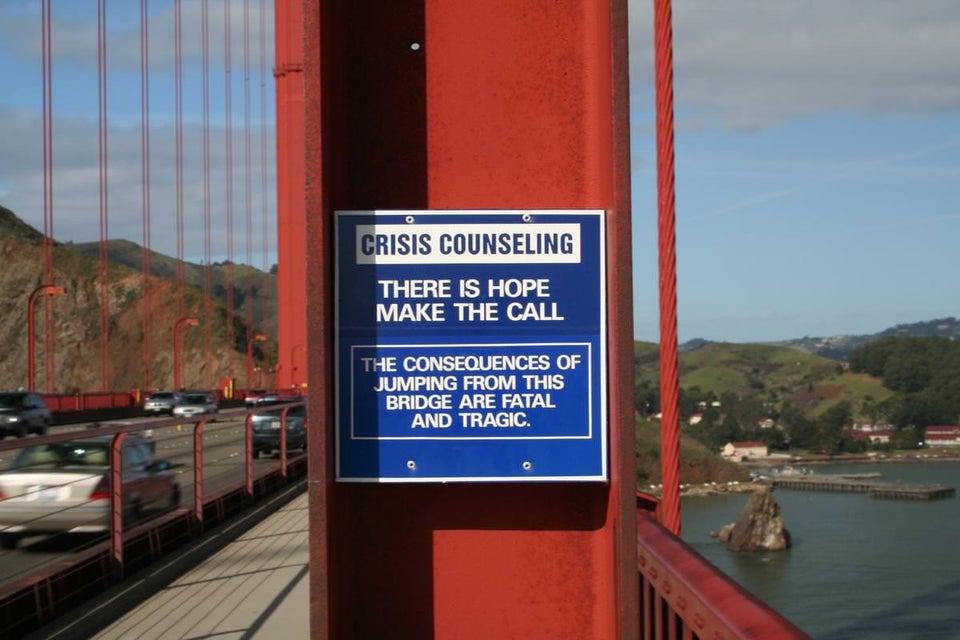
The Bridge is a documentary; watched on DVD from Ottawa Public Library; film may be available in whole or in part, on YouTube. Documentary includes interview with Kevin Hines, one of the few people who survived a suicide attempt by jumping from the Golden Gate Bridge, and documents Gene Sprague; his jump is both dramatic, and soul-crushing.
The Bridge is a 2006 documentary film by Eric Steel spanning one year at the Golden Gate Bridge, which connects San Francisco with the Marin Headlands. The film shows a number of suicides, and features interviews with family and friends of the suicide victims.
The film was inspired by Tad Friend’s 2003 New Yorker article, “Jumpers.” The film crew shot 10,000 hours of footage, recording 23 of the known 24 suicides in 2004.
The Golden Gate Bridge, first opened in May 1937, was the most popular suicide site in the world during the documentary’s filming, accumulating 1,200 deaths by 2003. Its death toll has since been surpassed by the Nanjing Yangtze River Bridge in China.
The four-second fall from the bridge spans 245 feet; victims hit the water at 75 miles per hour “with the force of a speeding truck hitting a concrete building.” Jumping holds a 98% fatality rate; some die instantly from internal injuries; others drown, or die from hypothermia.
In his article, Tad Friend writes, “survivors often regret their decision in midair, if not before.”
In the 1970s, the city’s newspapers sparked “countdowns” as the death toll closed in on 500 recorded fatalities. Television crews covered the scene as bridge officials managed to stop fourteen prospective jumpers, among them, a man with a sign reading “500” pinned to his T-shirt. The media frenzy was even more intense in 1995, as the total drew close to 1,000.
Steel said he was shocked that, despite the Golden Gate Bridge’s notoriety and history, nothing had been done to prevent people from attempting suicide. “Most bridges…have put up suicide barriers precisely for this reason.”
A suicide deterrent system (net), approved in 2014, is being installed twenty feet below the Golden Gate Bridge, and is expected to be completed in 2023, at a cost of $207-million.
Part IV: Kevin Hines
Kevin Hines appears prominently in The Bridge, and is one of the few people who has jumped from the Golden Gate Bridge, and survived; he is active in suicide prevention.
Kevin Hines survived an attempt at taking his own life by jumping from the Golden Gate Bridge. He has shared his story at more than 2,000 college campuses, and 3,000 high schools, and co-founded the Kevin and Margaret Hines Foundation, which provides funding and education for suicide prevention.
Kevin was adopted by Pat and Debbie Hines when he was nine months old. At age ten, he was put on Tegretol to control epileptic seizures. By age sixteen, he was taken off of Tegretol due to reduction of his epileptic seizures, unaware that Tegretol was suppressing symptoms of bipolar disorder.
Manifestations of Kevin’s depression included mood swings, paranoia, and hallucinations. Kevin wrote and discarded a number of suicide notes, until the seventh one. He told his father “I don’t want to be here anymore.” His father replied, “You have an obligation to be here. We love you.” On Monday, September 25th 2000, Pat was concerned about his son and offered to spend the day with Kevin. Kevin declined, as his father dropped him off at City College. Kevin then took a bus from City College to the Golden Gate Bridge.
Kevin contemplated not jumping, reasoning that if anyone demonstrated concern, that he would not commit suicide. A female police officer, and male bridge workers passed him without stopping. A woman with a German accent approached Kevin, and asked him to take her picture, but she did not mention anything about his tears, or ask about his well-being.
After she left, Kevin took several steps and threw himself over the rail. Kevin had instant regret, “when my hands left that rail – and my legs curled over – as soon as I left the bridge, I thought, I don’t want to die.” He went over the railing head first, but turned himself around to land in the water legs first. After he surfaced, he felt a creature nudging his body, which he initially thought to be a shark, and punched at it. The creature was later identified by a witness as a sea lion. The sea lion helped to keep Kevin afloat until he was rescued by the Coast Guard. Kevin crushed three vertebrae, and sustained other injuries
Kevin’s mission, through his foundation, is to provide mental health education and suicide prevention information. Kevin also co-wrote the documentary film, Suicide: The Ripple Effect, awarded Best Story at the 2018 Nice International Film Festival in Nice, France.
Part V: Letter
Drafted more than a dozen suicide notes. This draft was written in April 2012; each revision became more succinct than its predecessor; writing is often an act of elimination.
Dear Mom and Dad:
I am sorry; I could not go on any longer.
My life has not been, and is not, worth living.
I have believed for some time that this outcome was inevitable.
Words will never be enough, and I am sorry to put you through this trauma.Love,
Garth
Suicide & Crisis Lifeline | 988 | 24-hours per day | 7-days per week

