Introduction: people ask if I am excited to travel, no, not really, not this time. December felt like it went sideways, as if, pushing rope uphill. Recognize what lies in front of me, the nature of the countries, the nature to cross land borders, and the duration of this journey, nine months. So many butterflies in my stomach that I could take flight.
I follow world news; in the United States, rarely impacted by what occurs overseas. But not immune from overseas travel: tropical cyclone (Ditwah) ravaged Sri Lanka after Thanksgiving, followed by an outbreak of Chikungunya. The same storm flooded southern Thailand. A hospital is bombed in Myanmar, following a four-year military coup, and hostilities continue along the Thailand – Cambodia border.
Why do I travel; I would likely decompose sitting on a couch in the United States. Travel this year will stretch beyond my comfort zone, through less developed parts of the world, where it is difficult to travel with not much more than an outline, a rough idea of border crossings, visa requirements, and vague ideas about public transit. Will this finally be the year where I shed my inherent nature, by (brute) force.
Please join me for nine-months overseas: 28 DEC | Philippines, Myanmar, Thailand, Laos, Cambodia, Vietnam, Maldives, Sri Lanka, Bhutan, Bangladesh, India, Pakistan, Tajikistan, Uzbekistan, Azerbaijan, Georgia, Armenia, Turkey, Bulgaria, Romania, Hungary, Austria, Lichtenstein, Switzerland, France, Monaco, Andorra, Spain, Portugal | 01 OCT.
SAT 27 DEC: Friday evening, snow storm blankets greater New York City, some areas receive 12-inches of snow. Wake up in Connecticut to 7-inches of snow, shovel out the car and driveway. Four trains operate to New York City without disruption (Shoreline East, Metro North, Long Island Railroad, AirTrain), pleasant surprise. Snow is cold and dry, and passing trains create white-out conditions of vaporized snow.
Downsized backpack again, Tom Bihn (Synik) 22-liter. Weighs 15-pounds fully loaded, mostly my laptop. Middle school students likely carry a larger backpack to school. During the past decade, downsized from 40-liter, to 35-liter, to 33-liter, to 26-liter.
Not able to find non-stop flight from New York City (JFK) to Bangkok, settle on 18-hour non-stop flight to Manila, Philippines. Ticket counter does not open before 9pm, there is no place before security to take a nap. Once I receive my boarding pass and clear security, the hour is late, and do not want to nap and risk missing the flight.
SUN 28 DEC: flight departs 3am, one-hour late, delay to load cargo. Following 26-hours awake, fall asleep, and several hours later, pay the price with a migraine; sumatriptan quickly mitigates the intense pain.
Philippines does not have Russian sanctions; Philippine Airlines is allowed to overfly Russia. Reminded of Korean Airlines flight 007, shot down in 1983, after the aircraft strayed into Russian airspace. Wonder if this flight will be blown to bits by Putin.
MON 29 DEC: somewhere over Mongolia, six hours remain inflight. Fly over China and Hong Kong, aircraft begins its descent towards Manila, and I am overwhelmed by the feeling of isolation and loneliness. Like pulling a Band-Aid from a wound, perhaps the sensation will subside once I re-adjust to being on my own. Arrive Manila Philippines in the morning, visa-free for US citizens, but need to register on-line 72-hours in advance. Light rail to Makati City, and check into private AirBnB (small studio). I am using more private rooms this year, given the nine-month duration of this journey.
Considered visiting many corners of the Philippines: Baguio (bus), Boracay (flight), Cebu (ferry), Iloilo (ferry), Puerto Princesa (flight), Vigan City (bus). Considered various day trips: Mt Pinatubo (erupted in 1991), Pagsanjan Falls, Taal Volcano, and Hundred Islands, but difficult to coordinate between Christmas and New Year. Wanted to visit Corregidor Island (Bataan), but the ferry from Manila went out of business during COVID. It will be a busy year, do not need to create extraneous travel.
Philippines became a US territory in 1898, following the Spanish-American War. Invaded by Japan, the day after the attack on Pearl Harbor, and was not liberated until 1945. Philippines gained its independence in 1946. Philippines may know more about corruption than less. During high school, read Time Magazine, and learned about dictator, Ferdinand Marcos, deposed in 1986, following twenty years as president.
Visit Chinatown and the historic walled city of Intramuros. National Art Museum, free to the public, robust presentation of Filipino art and artists. Visit the Mall of Asia, one of the largest malls in the world, and walk along (man-made) Dolomite Beach and Manila Bay. Despite its popularity, skip fast food chicken and spaghetti at Jollibee.
Public transportation is underwhelming for such a densely populated city, but travel all three lines of the light rail (green, yellow, purple), for an inexpensive tour of the city. After several days, I build up the courage to travel by the city’s iconic Jeepney. Including the driver, almost 25-people can pack into these vehicles for a ride that costs less than a dollar, and spares my feet from a lot of walking.
Do not have any expectations of Manila beyond a transit hub, it does not disappoint or surprise. It is not a garden spot, but it is civil and safe. There are twisted knots of electric utility wires that look like they should short out or electrocute. Almost everything is made from cement and rebar, no surprise given the heat and humidity.
Roosters crow at sunrise, an unexpected sound in a large city. Overwhelmed by the smell of effluent, and smoke from fires. Workers burn leaf material and other detritus when sweeping city parks, rather than bag or bin. Mopeds dart through streets choked with traffic. People wear flip flops or Crocs; I fit right in with barefoot sandals.
Locals are pleasant and friendly, and share New Year greetings. 30% of the global cruise industry work force is staffed by Filipinos, praised for their industrious work ethic, professionalism, and language proficiency. Frequent reminders of homelessness, and children are not shy about begging, and attach themselves to my pant leg. No shortage of stray dogs, cats, puppies, and kittens; to see animals suffer is never easy.
I am not the sharpest knife in the drawer, and do not untangle Myanmar currency dilemma until my last day in Manila. Exchange $200 USD to Thai Baht before departing Manila. Similar to Beirut Lebanon (2023), unable to use credit card or ATM in Myanmar. There are two exchange rates; government exchange rate (1 USD = 2100 Kyat) and street exchange rate (1 USD = 3900 Kyat). There is an iPhone app, Myanmar Market Rates, that publish real-time exchange rates for Kyat across a market basket of currencies. US dollars need to be in pristine condition, but condition of Thai Bhat is more forgiving. I will only exchange as much Thai Baht as necessary, and spend any remaining Thai Baht during subsequent two weeks in Thailand.
MON 05 JAN: it is a cornucopia of public transportation to the airport; Jeepney, light rail, and bus ($1 USD) for midnight flight, Cebu Pacific, from Manila to Bangkok. Cabin temperature is so frigid that I can barely sleep.
Bangkok Thailand, airside transfer desk is useless; watch one passenger miss his connecting flight to Kuala Lumpur. I am told to clear customs, and obtain boarding pass after Myanmar tourist visa verified ($50 eVisa online). Most flights to Yangon Myanmar (Rangoon Burma) originate from Bangkok (one hour). Boarding gate is packed with 150 people, pleased that I am not the only person going to Myanmar.
On the flight, I meet Ollie (UK), his wife (Burma), and their two young children, traveling to Myanmar on holiday to visit family. He suggested that many issues in Myanmar may be fixed with a smile and a cash bribe. You might ask, why do I only visit Myanmar for three nights; however, the more appropriate question may be, why did I visit at all.
Myanmar’s democratic government was seized during 2021 military coup. US State Department travel advisory: Level 4-DO NOT TRAVEL, due to: civil unrest, armed conflict, arbitrary enforcement of laws, land mines, and unexploded ordinance.
US State Department rates 22 of 200 countries, Level 4-DO NOT TRAVEL. Where does a person travel after Europe and Japan. Travel writer Rick Steves suggests that, “Fear is for people who don’t get out very much.” As for me, it is a race to the bottom.
Independent travel guidance on Myanmar is mixed; some tourists report that they were not allowed to take trains north to Bagan (temples), and others report that they were removed from overnight bus by police, unless the officer was bribed. Travel north to Mandalay (former capital) is not considered safe.
Traveled to Port-au-Prince Haiti (2016), and Beirut Lebanon (2023); it is possible that my experience in Yangon Myanmar will not be entirely different.
Clear customs, exit the terminal. Bus routes do not load in Google maps, and I ask if there is a bus to the city center. Some people point to the left, other people point to the right, and some people reply “no.” Most people do not speak English, and there is no iPhone Google Translate (Burmese). After trying in vain for an hour, in 90-degree heat and intense sun, I surrender, and pay 300 Thai Baht ($10 USD) for 30-minute taxi to city center. Rick Steves might make small talk with the driver, but I sit quietly in the back, and try not to choke on traffic fumes. It has been a long day with little sleep.
Exit the taxi, Yangon does not look or feel different than any other city that I have visited. If I did not know of the travel advisory, I would never guess. Everyone treats me politely: customs and immigration, police officers, armed soldiers, and local citizens.
Check into the hostel, and find currency exchange office; walk out with 250,000 Kyat and provided rubber band to hold the thick, wad of bills together ($65 USD).
I receive a cell phone signal, but no LTE data, and not here long enough to justify eSim. Most public restaurants and coffee shops lock down their WiFi, and I mostly grope in the dark. WhatsApp, Facebook, WordPress, and VPNs are blocked by the military junta (to reduce or control misinformation). There are rotating electrical brown outs during the day, no different than Port-au-Prince, Beirut, or Cairo Egypt (2023).
Terribly long day, or, maybe it was two days – a marathon – with little sleep, a lot of walking, and grateful for a warmish shower, and a restful night of sleep with AirCon.
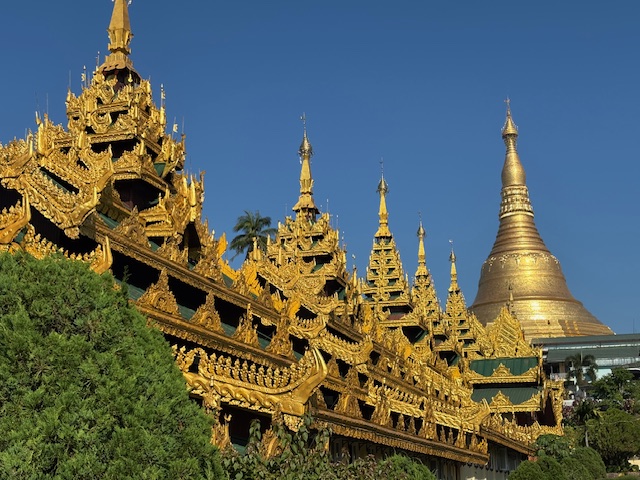
Tuesday, morning air is cooler, sun is not yet intense; smoke perfumes the air. Monk robes appear in a rainbow of colors, some wear orange, brown, or maroon; female monks wear pink or white. Monks walk through the streets, and play recordings of Buddhist chants. I do not recognize the Burmese language, but I recognize the cadence of the three refuges (Pali: Buddham Gachami, Dhammam Gachami, Sangham Gachami), I take refuge in Buddha, Dharma (teaching), Sangha (assembly).
It is a short walk to the central train station, and a ticket for the “circular” train costs less than a dollar. There are only two tourists on-board, the other, a friendly gentleman from Latvia. There is no posted train schedule, depending on who you ask, the train might depart at 8:30, 8:40, 8:55, 9:00, or 9:20am; the charm of the place.
Train loops around “greater” Yangon, travel north along the west side of the city, past the airport and green fields, and south along the east side of the city. Train car is old and shabby; blue, hard, plastic seats run down both sides of the car; windows are open for fresh air. Police officer and train conductor periodically walk through.
It is a glorious morning, the best three-hour tour of Yangon that a person could experience. It provides a slice of life, to watch people get on and off the train, to see the dilapidated train platforms and apartment blocks, the sight of lush, green vegetation, and blasted by the pungent smell of stagnant water, choked with trash. Return to hostel, and walk through central market. Woman sells delicate birds trapped in a cage; tempted to buy them all and set them free.
Yangon’s midnight to 4am curfew ended in December, leading up to a thirty-day election period. General Aung San championed Burma’s independence from British rule, and is considered the founder of modern day Myanmar, prior to his assassination in 1947 (age 32). His daughter, Aung San Suu Kyi, was a political leader until the 2021 military coup. At this time, it is unclear if she is in prison or under house arrest.
Many men wear Longyi, which resembles a woman’s skirt, in various patterns. Many men also chew betel nut, a stimulant and narcotic, but also causes oral cancer and dramatic tooth decay. Be sure not to step in puddles of red spit on the sidewalk. Women wear yellow face paint, made from ground-up tree bark, to celebrate the New Year. Some children and young women wear pyjamas during the day.
It is argued that to visit Myanmar is to support the junta, but I might disagree. I bear witness to how the country’s citizens go about their life, in face of the junta. My tourist dollars went directly to the local hostel and restaurants. To visit Myanmar is to bear witness to the fragility and resilience of democracy (United States, nota bene).
Choose not to visit the Bagan temples, as my intention is to visit the temples in Angkor Wat (Cambodia). Wonder what my life would resemble, if born not in the United States, but in Myanmar. Wonder if I should have stayed longer in Myanmar, or ventured further out. Travel to Myanmar is a litmus test of sorts, and may foreshadow what is to come. Do not view the visit as reckless, but rather, an informed decision.
THU 08 JAN: mid-day flight from Yangon to Bangkok Thailand, visa-free up to 60-days; must complete on-line registration up to three days in advance. Planned to visit Hat Yai in southern Thailand. However, tropical cyclone (Ditwah) that ravaged Sri Lanka in November, also flooded southern Thailand. Due to extensive (mud) damage, I cancelled this segment of this trip, which provided the window to visit Myanmar. Kingdom of Thailand, known as Siam until 1939, was never colonized by Europe.
Friday, awake before metro begins service at 6am; use Grab (Uber) to Krung Thep Aphiwat Central Station for north-bound train. Third-class (hard) seats cost less than a dollar for 90-minute ride to Ayutthaya Historical Park. Park is free to visitors, but there is a nominal feet to enter each of the Wats (temples). Some people rent a scooter or hire a tuk tuk to explore; I have two good feet, and do not mind walking.
Saturday, taxing, terrible, tedious train trip, twelve-hour round trip, to visit Bridge over the River Kwai, and to bear witness to the atrocities of war. Travel through 65 countries, and often reminded of man’s infinite capacity to be cruel and mercy-less. There is no just war, there is just war. Where is the bodhisattva of compassion, Guanyin (Kwan Yin), who hears the cries of the world.
Bridge over the River Kwai, referred to as the Death Railway, was constructed between 1940 and 1943, to link trains between Bangkok Thailand and Rangoon Burma, to supply Japanese forces during World War II.
Original bridge was a wooden structure, soon followed by the steel and concrete bridge that remains in use today. Bridge was constructed by more than 250,000 enslaved Asians, and 60,000 Allied Forces POWs. More than 100,000 perished during construction due to starvation, disease, and brutal treatment by the Japanese. Much of the train line was deconstructed after the war; current train only operates as far west as Nam Tok, and rail service no longer connects Thailand and Myanmar.
Much of the scenery is unremarkable: corn, sugarcane, cassava. The only portion of the train route that is interesting operates between Kanchanaburi and Nam Tok. It is probably best to use van-bus tour operator to reach this location, and then take a much shorter round-trip train. Train is derelict and uncomfortable; wooden bench seats, no AirCon, no electricity, no food service or water, and “footprint” squat style toilets. I like trains, but this was mostly an unpleasant experience.
Sitting next to me on the return train, an 89-year old woman from Switzerland, and her son. They treated me with kindness, despite being an American. She commented that she remembered listening to news radio with her Mum during World War II.
Return train arrives at Thonburi station in Bangkok. While the city is modern and vibrant, there is a shanty village along the tracks en route to the station, with homes constructed of corrugated steel and blue tarp.
Bangkok has public transit; cash-based, ticket kiosks are easy to use in Thai or English. However, various metro (subway) and light rail, appear to operate independently, which at times, makes it difficult to connect the dots timely and efficiently.
Disembark the train, and rather than spend an hour getting to the hostel, I take a motorcycle taxi. At 125cc, it is underpowered, and every time the driver hits a bump in the road, the rear shock bottoms out, and it feels like I am an incarcerated person at pound-me-up-the-arse state prison. At red lights, the driver lane filters; the space is so narrow, that I have to pull in my elbows from the pillion handles.
Sunday, explore Bangkok; water taxi, efficient and cost-effective public transport. Explore Khao San Road, infamous backpacker street, elaborate Grand Palace, ornate Reclining Buddha, night markets of Chinatown, and Lumphini Park, green oasis within the bustling city, with its large, mostly friendly, water monitor lizards.
MON 12 JAN: Thailand mourns the Queen Mother of Thailand (d. 24 Oct 2025), and it is against the law (lèse-majesté) to criticize, defame, or insult the King, Queen, or heirs, with penalties up to fifteen years in prison. Not yet in the United States; quiet, piggy.
Express bus from city center to Southern Bus Terminal (less than a dollar). Bus station is large, like a third-rate shopping mall, and not a single charging port. Everything is signed in Thai, including the departure board, more locals than tourists. Much of the day is low-grade friction. Depart Bangkok at sunset and arrive Phuket (pronounced Foo-gay not Fuk-it) at sunrise. Understand why most people choose to fly.
Tuesday, explore historic Old Town, which has some interesting architecture, with distinctive wooden shutters. Not a great day, as if the wind is knocked out of my sails.
Wednesday, local bus to Patong Beach, my expectations are low. I skip the boat tours to Phi Phi and James Bond Island, instead, go for three-mile barefoot run along the beach. First run in five months, following fifth metatarsal stress fracture last year. Spirits lifted following the run, lucky endorphins, at least for a little while.
Scrape the rust off Cyrillic, as Phuket is a popular tourist destination for Russians, with signage and menus in Russian. Scooters and motorcycle rentals are popular here. Cannabis is legal in Thailand since 2022, Phuket is dotted with storefronts. 7-Eleven stores are also popular, but not as good as those in Japan. In other news, a construction crane crashed onto a train traveling from Bangkok to Ubon Ratchathani, one train car was sliced in half, and killed 32 (of 200) passengers.
Thursday, two-hour bus from Patong Beach to the airport. Drive is twisty, curvy, uphill, downhill. I am crowded into the back of the bus, standing room only, and it is hot. Motion sickness gets the better of me, and triggers a headache. Phuketaboutit.
FRI 16 JAN: short walk to the airport, for two-hour flight north to Chiang Mai. At the international terminal, I spy an Aeroflot (Аэрофлот) Boeing 777 bound for Moscow Sheremetyevo. Airport announcements are in Thai, Chinese, Russian, and English.
Bus to city center, drop off backpack at hostel, and explore on foot, ten miles, until my feet are aching and I am exhausted. Awareness and recognition, present moment is okay … and just one small step from calamity … I have to laugh out loud or cry.
Saturday, there is a 24-hour laundromat next to the hostel, clean clothes for a dollar. I put the clothes on wet, and they dry quickly enough in the morning sun. Explore the city, and its various temples (wat). City center is surrounded by a moat, with the scrabble remains of an old brick rampart. Local library is kind enough to print out my Laos eVisa; staff does not speak English, but often, the kindness of strangers.
Night market seems to migrate within Chiang Mai from one evening to the next, bringing out merchants and tourists in full force. Sunday market appears to be the largest, and runs down Ratchadamnoen Road at Tha Phae Gate. Merchants sell their wares and food. If you cannot find something good to eat, it is your own fault. Beware if you are claustrophobic (and your toes), as the crowds are quite dense.
MON 19 JAN: stand at the Chiang Mai bus platform, for onward bus to Chiang Rai. There is no departure board, and despite the number of tourists, all announcements are in Thai. Do not know if the bus is on-time, delayed, or cancelled. Staff only speak Thai, and wonder what would happen if the bus were cancelled. May I accept not knowing. Bus departs mostly on-time, and provides a window into daily life in Thailand. No more big cities like Bangkok, and no more tourist destinations like Phuket.
Tuesday, visit Rong Suea Ten Temple, often referred to as the Blue Temple; it is visually stunning and does not disappoint. Buddha image in Thailand is often glittering gold, but, Buddha image that I most cherish, is the melted bronze that survived the atomic bomb in Hiroshima (2024). Subtle reminder of life’s impermanence and imperfection.
Save myself some walking, and take moto taxi back to city center for less than a dollar. Safety tip, put iPhone in closed cargo pocket, so it doesn’t risk falling to the ground. Chiang Rai lacks much of the charm of Chiang Mai, there is enough to do for a day trip, but only makes sense if travel onward to Laos.
Eating has been a challenge during the past month, many dishes are meat heavy. I am a polite guest, I will eat what I am served, but, do not usually order meat. There is a lot of fried food, which can be rough on the stomach. There is too much sweet food, too. It has been mostly eggs and rice, and, rice and eggs. I need fat; nuts and seeds are often salted; avocados are imported, and cost $3 each, if you can find any.
Lost more weight than I would like (5-pounds) so early into the journey. Have not eaten anything suspicious, but low-grade diarrhea, at least it is not firehose mode. Maybe the filtered water is not completely filtered, or, maybe dishes are not cleaned well. Few hostels have kitchens, tired of eating out, do not want any more rice or noodles, please, just a green vegetable, before my colon goes on strike.
THU 22 JAN: local bus from Chiang Rai to Friendship Bridge IV at the Laos border, sometimes, referred to as the Golden Triangle, where the borders of Thailand, Myanmar, and Laos intersect. It is a local bus, and I am the only tourist, for better or worse. A window to rural life in Thailand, rice paddies, and limestone karst formations cloaked in the smoke from wood fires or burning garbage.
I have crossed more land borders than I may count, maybe I was just born anxious and nervous. Land border often involve slight of hand, an element where a person is fleeced by a person in authority. The challenge with people in authority, is that there is often one person who believes that it is their job to say “no.” Applied for Laos eVisa on-line ($50 USD), border crossing was uneventful, and enter the sleepy village of Huay Xay Laos.
Most tourists depart Chiang Rai at 5am, rush through the border, to reach the slow boat departure by 9am, and miss all the scenery in-between during the pre-dawn darkness. Seems terribly rushed, but also see why people skip this place, there is nothing here, and I feel sorry for its residents.
Laotian Kip is a mostly closed currency (1 USD = 21,500 Kip), and not available for exchange outside the country. It is considered one of the five most worthless currencies in the world, due to rampant inflation, right behind the Lebanese pound (2023). Many stores do not list prices, because prices change too frequently.
FRI 23 JAN: at sunrise, local monks, wearing orange robes, assemble on the street, chant, and then walk through the village with their begging bowls. At the boat pier, board sampan, a long, flat-bottom boat, for two-day trip down the Mekong River. Seats are not what you would expect, where old van seats go to die. Literally, the seats are from old passenger vans. Boarding is tedious and slow, luggage stored below the floor boards. Attempt to depart at 11am, but maybe not. Transmission will not go into gear, until it is coerced with a ballpeen hammer.
Visual delights make up for a slow journey. Locals pan for alluvial gold along the muddy river’s edge. Long, narrow skiffs, dart through the river in all directions, like skimming water bugs. The swift currents and powerful eddies require skillful navigation. Arrive Pak Beng at 5pm, and it is as underwhelming as Huay Xay.
SAT 24 JAN: if the first day was bad, the second day was worse. Two boat loads of passengers are crammed on to a single boat. En route, the boat continues to pick up locals (Laotians), baggage is placed on the roof of the already cramped boat. River currents are strong, and today’s journey feels unsafe. Indeed, there was a boat accident last month, when a slow boat struck rocks and sank; most people escaped safely, but three people died. Was it Rumi who suggested that, you only truly possess that which you cannot lose in a shipwreck, or maybe, it was a slow boat wreck.
Slow boat is an authentic experience, it is one of the singular experiences in this region, but, it was not fun, it was not enjoyable, it was mostly tedious. It is the worst two-day “bus” journey that a person could take.
Arrive in Luang Prabang at 5pm, ferry pier is well outside the city center, adjacent to the airport. I am hungry, tired, and cranky, and ignore the taxi touts, and walk the dusty road until it joins hardpack outside the airport. Sympathetic scooter driver picks me up, and drops me off near the city center. The exchange is mutual, he gets to practice his English, and saves my feet from five miles of walking.
Hostel operated by a family, young daughter speaks perfect English, self-taught, suggests her father. She is a social butterfly, and enjoys talking with guests, and proud to show off her pet duck, which follows her through the yard.
Sunday, why is it so difficult to meet the moment. Day is stressful, difficulty coordinating onward travel from Luang Prabang to Vang Vieng. Laos-China Railway (LCR) connects China with Laos, with future plans to connect Thailand and Singapore.
Seat inventory is controlled by China, and not released until three days prior. Most tourists in Laos are blocked from the morning trains. I used an agent to purchase on-line ticket for the one-hour journey, but, not yet confirmed. Just in case, purchase on-line van ticket, for six-hour journey, and again, not yet confirmed. Sunday evening, in bed at 11pm, tickets confirmed, 8am van and 6pm train. My recommendation: install LCR app on iPhone, and buy your own tickets; you must be vigilant and timely.
MON 26 JAN: decide to take the morning van, despite the arduous journey, will arrive in Vang Vieng six hours sooner, and better than getting stranded in Luang Prabang.
I am the last person picked-up, and condemned to the back row, one driver, fifteen passengers, and luggage. 120-mile journey takes six hours, along a deeply cratered dirt road. Conditions never improve, and the experience is as bad as reported.
Van has no rear shocks, and often become airborne in the back row. Recommend Dramamine (motion sickness) and pain reliever (bruising), no joke. Surprised that the Toyota Hi-Ace van did not blow a tire, or, all four tires. Experience makes Alaska’s Dalton Highway (2021) feel like a race track.
Hostel owner sends me off with a pancake and a banana. Rest stop en route, eat breakfast, the banana is black and bruised. Very remote area, surprised that there are roads through this terrain. Everything along the side of the road is plastered in taupe-colored dust, and I develop a sore throat by the time we arrive in Vang Vieng.
Tuesday, Laos consistently appears woefully underdeveloped. My experience in Laos is mostly lousy. Landscape is pretty, but also, pretty dumpy. There are signs asking people to not litter, but there is detritus everywhere. Nothing is bad, but it never gets better. Convenience stores sell: beer, cookies, crisps, condoms, and fried noodles. Between the dust and smoke (often from burning garbage), throat hurts, head pounds.
Laos is the most heavily bombed country in the world per capita, bombed between 1964-1973, as part of a secret war by the United States to disrupt Viet Cong supply lines during the Vietnam War, queue Lee Greenwood, God Bless the USA.
WED 28 JAN: in a page from the Central Planning Committee Playbook, the train stations (Luang Prabang, Vang Vieng, Vientiane) are nowhere near the city center. Mid-day train to Vientiane, capitol of Laos, one-hour, no drama. Exit the station, tourists from China (via Kunming), all elbows (of course). Local bus directly in front of the station, clearly marked for central bus terminal. Keep seeing the same tourists, as there is really just one primary path through the country.
I see my first Starbucks in Laos (at a higher-end mall), other western chains are remarkably absent: McDonalds, Subway, KFC. Nominal GDP per capita is $2000, but does not stop me from spying a cherry-red Ferrari parked near the night market.
THU 29 JAN: local bus to southern (international) bus terminal; I am the only tourist on board, mostly old ladies on board, cackling like hens. A sane person would likely fly from Vientiane to Pakse, but not me. Carnage at the bus station never resembles the decorum at airports. I watch overnight buses to Vietnam, strapped down with massive amounts of cargo on the roof. Overnight, “sleeper” bus south to Pakse, travels along the Thailand-Laos border. Purchase two tickets, so that I do not have to share my bed with a stranger. Bus is decked out with blue LED lights, and for a moment, wonder if I am not on a bus, but perhaps, Doobie’s taxiola. I sleep for nearly half the journey, about as pleasant as the overnight bus from Bangkok to Phuket.
SAT 31 JAN: morning van, south, to Don Det (1000 islands region). Did not want to visit Don Det, too gritty, too isolated. But it is the route that people follow through Laos. Private room, just one night, I may tolerate almost anything. There is not much to see or do here, and maybe, that is part of the charm. I endured Laos, I have no intention to return, but always treated with kindness by its citizens. Been there, Don Det.
Third passport, extended 50-pages, issued in October 2022. There are seven informational pages, 43-pages available for visa stamps. Sixteen pages consumed at the beginning of this journey, 27-pages remain. Will report back at the end of the journey, and see if it is necessary to obtain a new passport upon return in October.
Cost: cumulative travel costs, during past 36-days.
Lodging: $471 total | $13 day
Transport: $1,732 total | $48 day (plane | train | bus | ferry | taxi)
– – Flight $1,100 (Philippine Airlines | JFK-MNL non-stop | $60 per hour)
Food: $82 total | $2 day
Other: $127 total | $4 day (FX | ATM | visa | tourism | RV & motorbike)
Total: $2,412 total | $67 day | $24,500 annualized
– – Cash burn: $235 | $7 day (when credit card not accepted)
Thailand, and especially Laos, are cash-based economies (almost no credit card).
Conclusion: what does a person see, or choose to see, in this world: ugly or beauty, hatred or kindness, depravity or indifference.
People are sometimes curious about my travel. I am certainly not risk-seeking (ie. Chernobyl), and not even sure that I am even risk tolerant (ie. Myanmar), there is only so much (discomfort) that I may endure in a day.
I am reminded of the illusion of safety. More safe, less safe, but compared to what. Safety, like danger, is relative; it is never absolute. I have gained nothing in my life by trying to mitigate uncertainty. Perhaps it is more appropriate to make friends with uncertainty, and face directly when life goes sideways. What ever arises right now, may I meet it, endure, tolerate, and accept.
After a difficult travel day, there is nothing worse than disturbing news headlines from the United States. Wonder if the president’s willing enablers surrendered any moral compass when pledging fealty. Wonder if the greatest risk to the United States, is not China or Russia coming over the Arctic via Greenland, but rather, our own president.
If United States takes Greenland by force, what stops China from taking Taiwan. What stops Russia from taking Ukraine, and reclaiming the Baltic states, Estonia, Latvia, Lithuania. What stops an emboldened Israel from taking Gaza and the West Bank.
What stops your neighbor from taking your house and your car, because, possession is nine-tenths of the law. “If the government becomes a lawbreaker, it breeds contempt for the law; it invites every man to become a law unto himself; it invites anarchy (Justice Louis Brandeis, Olmstead v. United States 1928).”
My viewpoint is jaundiced; I live as a guest in foreign countries nine months a year, upon the kindness of strangers. Nine-month contiguous journey, marathon pace.
And the end of all our exploring
T.S. Eliot
Will be to arrive where we started
And know the place for the first time
 garthmonroe