Introduction: tourist travel to Belgium, Netherlands, Luxembourg; BeNeLux economic union was created in 1944 following World War II and ratified in 1948, a precursor to the European Union, where Brussels serves as the de-facto EU capital.
It finally feels like summer, peak tourism and crowds, and some days, temperature reaches into the high 80s (Fahrenheit). Days of midnight sun are long since gone, and gradually losing daylight, where I often find myself running in pre-dawn darkness.
Continued overland travel through Europe, to London, before 90-day Schengen visa expires. In general, my belief is to travel to Europe when I am older, when I no longer have the patience or endurance to visit more challenging regions of the world.
Reflect on yesterday’s visit to the BMW museum in Munich; do not need to own a BMW, but, would enjoy driving one for a day, or, a few days. The challenge however, is that possessions often possess me. I was able to flat foot BMWs 1000cc adventure motorcycle, if I decide to travel across the United States, or across the world on an extended road trip. I prefer the upright posture of an adventure motorcycle, and would be quite satisfied with a smaller, 500cc motorbike. Fast enough for highway speeds, and buzzy enough at high speed, to revert back to secondary roads.
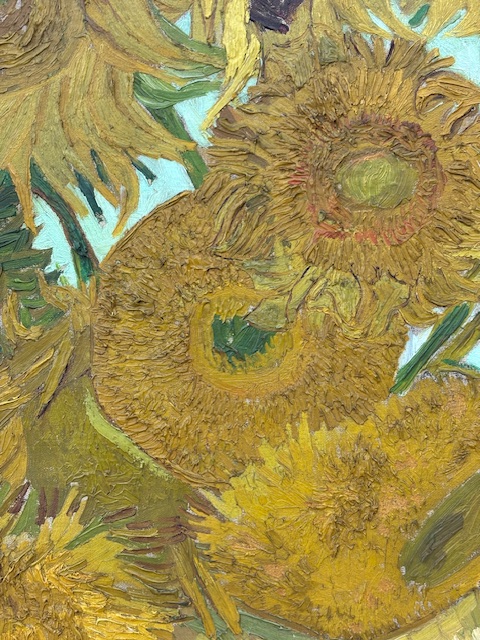
Friday, six-mile morning run to visit the expansive English Garden. Afterwards, visit Alte Pinakothek art museum, with large galleries of Peter Paul Rubens; spend most of the morning admiring van Gogh, Sunflowers (1888).
Explore old town, including the towering glockenspiel, and the Hofbräuhaus, which reminded me of Peter Sellers in the Revenge of the Pink Panther (1978). Weather is pock-marked by scattered rain. All too frequently, a bicycle near-miss; not sure if bicyclists ignore, or aim for pedestrians.
Munich resembles a state of deconstruction; road construction, blocked sidewalks, and buildings covered in scaffolding. Germany also appears to visibly struggle with its homeless population, with estimates as high as 750,000 people, due in part to the lack of affordable housing.
SAT 02 Aug: train to Stuttgart Germany; Stuttgart train station resembles a state of deconstruction; the 100-year old station is being demolished, for a new, underground station, with tracks rotated 90-degrees to allow for high-speed through trains. Construction began in 2010; the project is behind schedule, to be completed by 2027, and over budget, at a cost of $12-billion (USD).
Do not visit Mercedes-Benz or Porsche Museums; walk along Königstraße, pedestrian shopping mall; overwhelmed by the amount of commercialism and consumption, and a dramatic contrast the next day, Sunday, when most of the stores are closed.
Visit Kunst Museum (free) as part of its centennial, and surprised to see a portrait of Hitler on the wall. Captions are in German, and I do not understand its context. Maybe it was a paint-by-numbers kit; once finished, horrified by the visage, the aspiring painter gifted the painting to the museum.
Challenge with long-term travel, connecting the dots, is that there are more down days than up days, and sometimes, it is just a grind; in contrast to a two-week holiday, which is often the highlight reel of all the best places to visit.
MON 04 Aug: pleased to move on from Stuttgart, two-hour train to Cologne (Köln). More than 1,200 daily trains cross Hohenzollern Bridge which spans the Rhein River. Originally constructed between 1907-1911, German military engineers blew up the bridge in March 1945, when Allied troops began its assault on Cologne.
Transited Cologne in September 2010, train from Moscow to London (via Belarus, Warsaw, Cologne, Brussels), the year that I traveled from Beijing to London (via Mongolia and Russia) on the Trans-Siberian Railroad; 10,000-mile, four-week journey, before the ubiquitous iPhone and Google Translate.
Moscow departure was stressful; train destination was marked, Prague (Прага); no one at the train station spoke English to address my concern. I was racing the clock, with a strict-dated, Belarus transit visa stamped into my passport; briefly considered buying a last-minute plane ticket from Sheremetyevo to London.
Train departed Moscow at midnight; once on-board, the posted train schedule (platform stops) was also incorrect. The train conductor, reluctantly responded to my strenuous histrionics, and eventually posted the correct train schedule.
At Warsaw, the train de-coupled; forward cars onward to Prague, and aft cars onward to Cologne; mystery solved. At Cologne, I exited the train with great relief, changed trains to Brussels, and Eurostar to London; stressful 36-hours.
In 2025, exit Köln Hauptbahnhof, and the stunning, gothic architecture of Cologne Cathedral never disappoints. Walk past an axe-throwing beer bar; drink beer, and throw axes; in the United States, people thought that lawn darts were dangerous.
WED 06 Aug: departure board is choked with delayed trains; in my limited experience, German trains did not operate on time, often delayed 10-30 minutes; recommend a travel buffer, as train connections were not often held for late-arrivals.
More than pleased to depart Germany, all too frequently, greeted with rudeness and hostility, particularly by people working in travel-related service industries (ie. lodging, transportation, dining). Mind my own business, not looking for a friend, not looking for conversation, and fail to understand the basic lack of civility (in exchange for paid services). Traveled to 65 of 200 countries, the lack of decorum was palpable.
Four-hour train to Amsterdam, Netherlands; pass fields of sunflowers that belong in a van Gogh. Some deciduous trees were lazy, and begin to show signs of fall color.
Welcome to Amsterdam, greeted by the cloyingly-sweet smell of marijuana; I care not if a person chooses to smoke, but, I would prefer not to smell it, even out of doors.
Walk along the canals, and wonder if I could be cast as an extra in PBS Masterpiece, Van der Valk. Reminded of Bernard Haitink and the Royal Concertgebouw Orchestra, whose LP recordings, I oft enjoyed during high school, and reminded of my neighbor, Mr. Ten-Kate, from the Netherlands; I worked in his elaborate home gardens during high school; together we reclaimed land by filling in a large gulch with yard debris.
There are many canal boats, some are modern, with green “living” roofs, others are old and decrepit, and appear close to sinking. In hindsight, it would have been a more interesting experience to stay at an AirBnB house boat instead of the hostel.
Thursday, visit Rijksmuseum, it did not disappoint, given its steep $30 (USD) entrance fee, and exceeded my visit to the Louvre (October 2023). Museum is beautiful, following a ten-year restoration (2003-2013), featuring paintings, art, and antiquities. Three hours in the museum, and explore the Fiona Tan (b. 1966), Monomania exhibit, the museum’s first exhibition by a contemporary artist; Rembrandt’s Night Watch (1642), on display during its five-year restoration; van Gogh, self-portrait (1887), Wheatfield (1888); and Vermeer, Milkmaid (1660). Departed the museum, came across graffiti, skillfully painted in the Netherlands’ delft blue pottery style (Delfts blauw). Wanted to visit Anne Frank museum, but the museum books out six weeks in advance.
Friday, wake-up for morning run, as hostel roommate returns to the room from a night of drinking. Five-mile run along Amstel River, and wonder if Amsterdam is in competition with Paris, to be the most dirty city; rats scurry among garbage bags, seagulls peck through debris scattered on sidewalks, and pedestrian streets are littered with cigarette butts, as if there was a ticker-tape parade. Pass memorial for Alexei Navalny (d. 2024), best described as the one man feared by Vladimir Putin.
SAT 09 Aug: train to The Hague (Den Haag), home to the International Court of Justice, the principal judicial arm of the United Nations, funded in part by Andrew Carnegie, and where US attorney, Jack Smith, prosecuted Kosovo war crimes (2008-2010).
Sunday, morning run through the Hague forest, not just a park, but a densely wooded area. Mid-morning, brief tram ride to the Strand, who would guess that it would be such a wonderful morning at the beach, and soothing sounds of crashing surf.
MON 11 Aug: The Hague was mostly underwhelming; recommend as a day trip from Amsterdam. Brief train ride to Rotterdam, drop off backpack at hostel, and visit the historic UNESCO Kinderdjik windmills, which played a significant role in reclaiming land from flooding (polders), as 20% of the Netherlands is below sea level.
Combined entrance ticket with round-trip waterbus (40-minutes each way) cost $35, permits entry into the museum and windmill, both of which were underwhelming. One may visit the area, and see the windmills without the $20 entrance ticket. There are pedestrian and bicycle paths, and bicycles are allowed on-board the waterbus. Check the waterbus schedule in advance; on this day, the schedule was reduced by half, without explanation, operating every 90-minutes instead of every 45-minutes.
Tuesday, morning run, opportunity to take in the sights and sounds of Rotterdam. Running through the old harbor, sight the bright yellow, Kijk-Kubus (cube) houses (1984), designed by architect Piet Blom; and cross the distinctive Erasmus Bridge (Erasmusbrug), cable-stayed, bascule bridge, and re-cross the Maas River via the Maas tunnel (1942), with separate levels for vehicles, bicycles, and pedestrians.
Wednesday, another morning run, and another tour of Rotterdam’s many bridges, and an opportunity to explore the old neighborhood of Delftshaven. It is easier to just go out and go running, whether I want to or not; by the time that I finish, I feel fine, no aches, pains, or injuries, and the weather is dry and temperate.
Mid-morning, short train ride to nearby Delft, the town recognized by its blue and white ceramics and pottery, dating back to the 1600s. The Royal Delft Museum receives mixed reviews, so I punt. Scale of the town is small and intimate, and it makes a charming day trip with its narrow canals, and brick-paved streets. Riding back to Rotterdam, the Delft train station is decorated with shattered shards of blue and white ceramic tiles, and the light rail, was decorated in the grid-based style of Dutch painter, Piet Mondriaan (1872-1944).
THU 14 Aug: sometimes wonder if there is something wrong with me; there are very few places where I would ever want to stay long-term. Most of the time, I am ready to leave, ready to “run away” as if I am claustrophobic, and wonder if I will get “stuck.” I am ready to move on to a new destination, it will be different, but, it will not be better. One-hour train to Antwerp, Belgium (French: Anvers), where diamond’s are a girl’s best friend, and the city where 85% of the world’s rough diamonds pass. The sun is intense, and the weather is hot, almost 90-degrees (F).
I recall PBS Masterpiece, Professor T (2015), a drama about Jasper Teerlinck, an eccentric criminology professor at the University of Antwerp. The supporting characters, the Dean, the secretary, the accompanying music, are just splendid.
Friday, pre-dawn run, me and all the freaks, drunks, and drug users. Some take my picture, I do not know why; skinny American, pasty white, wearing huarache sandals and no t-shirt (I only have one t-shirt). It is one of the few times that I do not feel safe in Europe. Take deep escalator to run across St. Anna’s tunnel, that crosses below the Scheldt River. Once the sun rises (6:30am), it is a quiet and wonderful time to explore the city; flattering light; merchants set up their tables for the street market.
Visit Koninklijk Museum voor Schone Kunsten Antwerpen (KMSKA) Royal Museum of Fine Arts; while the Rijksmuseum (Amsterdam) focused on Dutch masters, the smaller KMSKA, focuses on Flemish masters. Captivated by René Magritte, Sixteenth of September (1956); Salvador Dali, Landscape with Girl Skipping Rope (1936); and Amadeo Modigliani, Seated Nude (1917). When I lived in the Montrose neighborhood of Houston, I often walked to the Menil Collection, which had a formidable collection of Magritte and Dali, and the other surrealist painters, including Max Ernst and Joan Miró.
SAT 16 Aug: pre-dawn train, and sunrise gives way to overcast sky, temperatures back to normal, wear windbreaker, at least 20-degrees (F) cooler. Maybe the landscape is tired, maybe I am tired, and may only recall the World War I poem, In Flanders Fields, written by Lieutenant Colonel, and Canadian physician, John McCrae.
Morning visit to Bruges, sometimes referred to as “the Venice of the north” with its canals and medieval architecture. Despite Belgium being occupied by Germany during World War I and II, somehow, Bruges escaped destruction. The town is quiet in the morning, and I have the streets to myself.
Brief train to Ghent; Gent Sint-Pieters station is located south of the city, and requires a short walk, or tram ride to its historic city center.
Sunday, dawn run, it is much cooler, 55-degrees; run along the canal that borders the University of Ghent, which keeps me away from vehicular traffic. After breakfast, explore the scenic town, sunshine, and 75-degrees.
MON 18 Aug: brief train ride to Brussels south station (French: Bruxelles-Midi | Dutch: Brussel-Zuid), even for an experienced traveler, the cacophony and volume of international passengers is overwhelming.
Brussels has a palpable Muslim presence, dress of men and women, Arabic signage, Arabic music plays in storefronts, and graffiti protests the war and famine in Gaza; indeed, 25% of the city, more than 160,000 people, are Muslim.
Maybe the train station is in a “bad” part of the city, maybe the hostel, too, it is all overwhelmingly dirty, trash and broken glass. Once inside the pentagon, the historic walled city, it is a much different tourist experience, and feels like a tale of two cities. The EU parliament is hosted in Brussels, with a visitor center free to the public.
Indeed, Brussels sprouts are named after Brussels, cultivated here since the 13th century; a cruciferous vegetable, suggested to have anti-cancer properties. French fries (frites), are popular, and often served with an overwhelming dollop of mayonnaise, or perhaps, a dollop of mayonnaise served with frites.
Wednesday, dawn run inside the pentagon, mainly, to avoid getting hit by a car. Instead, while performing pull-ups at the park, I get hit upon by a drunk Spaniard.
Mid-morning, visit Musées Royaux des Beaux-Arts de Belgique, which prominently displays works of the Dutch masters; one notable work, an original, is The Death of Marat (1793), by Jacques-Louis David; a replica of the work resides at the Louvre in Paris. Museum ticket also allows access to the Magritte Museum, which displays works of René Magritte, the Belgian artist and painter.
THU 21 Aug: four-hour train to Luxembourg, would be easier to skip Luxembourg, and travel high-speed train directly to Paris or London. Train, stops at small Belgium towns along the way, every ten to fifteen minutes. Tall, late-summer weeds grow along the tracks, unaware, that they will soon be zapped by the first frost of autumn.
Luxembourg resides at the convergence of the Alzette and Pétrusse river valley; deep gorges make it a challenging city to visit on foot. Plaza d’Armas is less interesting, overpriced restaurants and stores, make me feel poor. As it turns out, Luxembourg has the highest GDP per capita in the world, $140,000, driven by banking and finance, and also in part, because of its small population, fewer than 700,000 citizens.
Cross the Adolph Bridge, via the bicycle lane, which is suspended from the upper vehicle deck, and for a few moments, drop to my knees, struck by panic and fear, a sinking feeling that the deck will plunge into the deep gorge below, but it does not.
I learn that Luxembourg has “free” public transportation, does not require transit ticket, even for tourists. Intention is to reduce volume of cars. In reality, nothing is free.
American Cemetery in Luxembourg honors the American soldiers killed during World War II, Battle of the Bulge (Dec 1944 – Jan 1945), Germany’s final offensive in the nearby Ardennes Forest. United States is granted free land use in perpetuity.
There are more than 5,000 gleaming, white marble headstones, set against perfectly manicured, green grass. The experience, the sight, is emotionally overwhelming.
Buried here include five soldiers from the Band of Brothers, Echo Company, 101st Airborne, and 22 sets of brothers buried side by side, and General George Patton. Families selected the final resting place of the fallen, Luxembourg or the United States. If curious, the American Cemetery in Normandy, has more than 9,000 headstones.
FD Roosevelt Boulevard, major thoroughfare in Luxembourg, crosses the majestic Passerelle Viaduct, and many plaques throughout the city, express Luxembourg’s gratitude to the United States, for liberation from German occupation during World War II. Will decades of goodwill be forever tarnished by the United States.
SAT 23 Aug: public transportation is free, local bus to train station, and save myself the effort of climbing cobblestones out of the city center. Summer track repair, and no direct, high-speed train to Paris. Instead, there is connecting bus service to Thionville France (one-hour), to rendezvous with the high-speed train to Paris (two-hours).
Sunday, a glorious day if there was ever a glorious day; cloudless, blue sky; temperate, 75-degrees, the sky, marred only by scattered jet contrails. Only risk is that of being run over by runners along the Seine, out in frenzied, full force.
Notre Dame Cathedral, constructed between 1160 and 1260, suffered fire damage in April 2019, collapsing the wooden timber and lead-lined roof. Beneath, many of the stone-vaulted arches remained intact. Cathedral re-opened to the public in December 2024, although, scaffolding and construction cranes remain on-site to finish the restoration. Renovation costs $900-million; benefactors from the United States donated more than $62-million, the largest donor country after France. More than 14-million people visit Notre Dame each year (40,000 per day).
Consider for a moment, not just work, but, meaningful work, and consider the skilled artisans from around the world, that worked on this restoration. If I ever needed a reminder that my career was vacuous; one graduate school classmate likes to remind me that all I accomplished was to make rich people more rich.
Mid-morning, visit Musée d’Orsay, opened in 1986, in the former Gare d’Orsay train station. Museum arguably contains the greatest collection of impressionist and post-impressionist paintings in the world (more than 1,000 canvases), with notable works by Degas, Monet, Renoir, Seurat, and van Gogh. Most notable works are on the fifth floor, which was quite crowded, and at times, taxing to negotiate.
Monday, Metro day-pass ($14), solo walking tour, 13-miles on foot, and visit notable streets and sights of Paris. Spend most of the day on the Left Bank (Rive Gauche), south of the Seine. Considered half-day bike tour ($55), or half-day bike rental ($28), but there was no iPhone holder to negotiate turn-by-turn navigation.
Visit Shakespeare & Co (bookstore), not because it is trendy, I am not trendy, but because it has been difficult to find books in English. Store is overcrowded, to the limit of claustrophobia, there is little space to scan the stacks, and I exit without a book.
TUE 26 Aug: today is my last day inside the European Union; grateful to visit Northern Europe and the Baltic States, but I depart partly disappointed; I expected more from Europe’s progressive policies. The only region to which I would return is Iceland; unique landscape: volcano, tundra, fjords; clean countryside, and kind citizens.
Exit day counts against the 90-day Schengen limit. The calculation does not reset, but looks backwards 180-days, on a rolling basis. Overstay risks a financial penalty, not being re-admitted in the future, and could compromise entry to a non-EU country.
Walk to Gare du Nord, because I have time, temperate weather; occasionally pass a bakery, and enjoy the yeasty-smell of fresh baked bread and Viennoiserie. Arrive at the station early; there are Eurostar service disruptions, and moved to an earlier train.
Eurostar to London, and exit at 81-days, which includes an 8-day reduction when I visited Svalbard. Svalbard belongs to the Kingdom of Norway, but lies outside the European Union; I (conservatively) did not expect to be stamped out of the EU.
Lesson to the wise, recommend a travel buffer, as Eurostar trains get cancelled for a variety of reasons: unscheduled tunnel maintenance (July 2025), French labor strike (Dec 2023), or tunnel flooding (Dec 2023). Alternatively, London airports are not free from incident, either; Heathrow Airport shutdown in March 2025, and disrupted 1,300 flights due to a transformer fire, without a backup electrical system in-place.
As of January 2025, most visitors to the United Kingdom now require an Electronic Travel Authorization (ETA), which authorizes a person to travel to the UK, to curtail travelers who may pose a threat. ETA costs £16 and permits multiple journeys with stays of up to six months, for the shorter duration of two years, or passport expiry.
Travel Eurostar more times than I may remember; it feels surreal to be back in London, and in some ways, marks the second phase of this summer journey. Scenes of Ted Lasso drinking tea are stuck in my head. Visit Whole Foods Market and Boots (pharmacy), read labels in English, and stock up on vitamins and supplements.
Wednesday, visit Tate Modern, but quickly depart; it does not resemble art. Visited National Portrait Gallery in Washington DC (Sep 2024), so detour to the National Portrait Gallery outside Leicester Square, and visage: King George VI, Queen Elizabeth II, Neville Chamberlain, Winston Churchill, David Bowie, Elton John, David Beckham, Amy Winehouse, Judy Dench, and Maggie Smith. Later in the day, explore various markets that I have not previously explored: Spitalfields Market, Leadenhall Market, Borough Market, and Berwick Street Market. Dodge raindrops, after all, it is London.
THU 28 Aug: morning sun, walk down Oxford Street to Paddington Station, and surprised to meet Paddington Bear. 90-minute train west to Bath, known for its historic, Roman-built baths. Stonehenge and Avebury henge are nearby, but less accessible using public transportation. Dodge raindrops, and explore the town.
FRI 29 Aug: 30-minute train to Bristol; city is much less charming than Bath, much less compact, less easy to explore on foot. Do not remember why I decided to visit, reminder to keep better travel notes. There are eels in my hovercraft.
Bristol is tedious; too many coffee shops, pastry shops, vape shops; medicate the populous through shopping and consumption. Look for book to read, but titles seem to focus on how to maximize and optimize oneself; comes across as disingenuous, like a marketing gimmick. What about Japanese kintsugi, beauty in imperfection. Tried my entire life, to be the best version of myself, futile, to no avail. Maybe the best version of me is damaged and dented, and maybe, I am just overtired.
SAT 30 Aug: one-hour train to Cardiff Wales; exit train station, and note the departure board, with a train heading north to Merthyr Tydfil, also the name of an old Welsh hymn, used by composer Warren Benson, in The Passing Bell (1974). Performed the composition under Larry Rachleff at a 1986 music festival in Burlington Vermont.
Visit National Museum Cardiff, second floor features a wide genre of paintings, most notably, a collection by JMW Turner, in recognition of his 250th birthday. Explore the town until inclement weather forces me indoors.
Rain retreats, and treated to the most glorious, if fleeting sunset – as if – to make up for the miserable weather, before the sun, too, retreats behind the clouds.
Cost: cumulative travel costs, during past 95-days.
Lodging: $4,007 total | $42 day
Transport: $2,456 total | $26 day (plane | train | bus | ferry | taxi)
Food: $231 total | $2 day
Other: $5,041 total | $53 day (FX | ATM | visa | tourism | RV & motorbike)
– – Svalbard cruise ($4,400 | eight-day expedition)
Total: $11,735 total | $123 day | $45,000 annualized
– – Cash burn: $0 | $0 day (when credit card not accepted)
It would be all too easy to spend $50 per day on food ($10 coffee/muffin, $15 lunch, $25 dinner), perhaps more easy to justify on a brief, 10-day holiday. Over nine months, it would cost $15,000, but doubt that it would make me any more happy.
Conclusion: read the news to stay informed, but, what is an appropriate response, when almost every headline is an assault on (the norms of) democracy; never-ending tactics from the vengeance tour playbook.
Three months of travel, and often reminded of a quotation from the Best Exotic Marigold Hotel (2011), “have we traveled far enough that we may allow our tears to fall.” Too often, after too many underwhelming days, wonder if I have traveled far enough.
 garthmonroe