Introduction: summer in Scandinavia, Baltic Europe, and all corners of the United Kingdom. Perhaps more civil than South America; hopefully, dogs are more friendly.
This is my back-up travel itinerary; would still like to travel overland, 17-trains, Cairo to Cape Town, but two-year civil war in Sudan – besides destroying a nation and starving its people – keeps this journey on indefinite hold.
Ready your sunglasses for perpetual civil twilight, as I travel towards the north pole.
THU 29 May: stand on train platform, 26-liter, 15-pound backpack; reminded of Pico Iyer, “the Sufis say that you truly possess only what you cannot lose in a shipwreck.”
Wanted to travel to Greenland; there are no roads, difficult to connect the dots without back-tracking, cruise expeditions expensive; perhaps another time.
Recall April 2010 Eyjafjallajökull eruption, air traffic closed over much of Europe for one week. Volcanic ash, which contains silica, is harmful to jet engines; silica melts at high temperature in the combustor or turbine, and often leads to an inflight shutdown.
Five-hour flight, four-hour time zone change, three hours of sleep; flight lands 6am local time. Immigration agent confirms that I will not exceed 90-days in the Schengen area before s/he stamps my passport. One-hour bus to city center. It is 45-degrees, blustery walk to hostel, grateful for early check-in. Explore the city, temperature warms up to 50-degrees; muscle through the day, fatigued, and return to the hostel.
Rent car, Hyundai i20 coupled with manual gearbox, drive Iceland’s “golden circle” and visit Thingvellir National Park, Geysir Hot Springs, Gullfoss Falls, and Kerid Crater. Detour to Grindavik to visit Blue Lagoon. Local roads re-opened a month ago, following damage by volcanic lava in late 2023. Lunar landscape is surreal and extra-terrestrial.
Iceland lies below the Arctic Circle, and is mostly tundra. Island is sparsely populated, with fewer than 400,000 people. It is an expensive region to visit – and feels more expensive than Japan – gasoline costs $9 USD per gallon. There are few trees; building construction is corrugated steel or concrete, neighborhoods are neat and tidy.
Sunday, downtown Reykjavik walking tour; weather is cold and damp, wind and scattered showers. Republic of Iceland was recognized as a sovereign state in June 1944, following Denmark’s occupation by Germany during World War II. Following the end of the tour, tourist approaches me, and shares that she won’t remember anything from the tour, except that I wore sandals (without socks). Am I not Wim Hof; I am not.
Twenty-one hours of sunshine, and few visual queues for bedtime; sunset is almost midnight, and sunrise after 2am, the sky is never dark. Stark contrast to winter, with less than four-hours of sunshine; hours are inverted, 11am sunrise, 3pm sunset. I am mostly solar powered, and would be even more depressed.
MON 02 June: weather moves into the capital city, wind is howling mad, and snow in the northern highlands. Iceland Air changed Egilsstaðir flight, from Tuesday morning to Monday evening. Wanted to travel along the island’s ring highway, but, bus system does not have a reputation for reliability, and strangely, the flight was less expensive.
Less than one week into this journey, and unable to escape uncertainty. If I remained in the United States, I could build a protective bubble around my life, in a manner that is almost impossible while traveling overseas. I am reminded of a lifetime of sub-optimal decisions in my feeble attempt to mitigate the discomfort of uncertainty.
Early arrival at the airport does not guarantee that the flight will depart, but only wishful thinking. Reykjavik Domestic Airport (not Keflavík International Airport) supports only turbo-prop aircraft. It is a low-key operation, with no security screening; Rambo and the Terminator could have boarded the aircraft with a box of box-cutters. Skeljungur (Shell) truck pulls-up, and fuels the Bombardier Q400 (De Havilland Dash 8); 80 passengers board, full flight, in advance of the winter storm.
Dense clouds prevent any appreciation of Iceland’s landscape, but grateful to arrive. Walk to the hostel, cold and damp; all the stores are closed. As I enter the hostel, an unknown camper hugs me, s/he exclaims shouts of joy, grateful to step out of the rain.
TUE 03 June: rain changes to snow after midnight; all (twelve) domestic flights within Iceland cancelled. Roads cleared at Fjarðarheiði mountain pass (600-meter elevation), and take afternoon van to Seyðisfjörður. If you watched The Secret Life of Walter Mitty (2013), the longboard scene descends Route 93 in to the town.
Glimpse majestic fjords, shrouded behind fog and clouds; peaks dusted with snow, waterfalls cascade down the dramatic rock face, amidst green mosses and lichens, and purple lupine. Weather improves on Wednesday, domestic flights resume.
Iceland is safe, and Icelanders are friendly; its citizens are fluent in English (second language). People are thoughtful and considerate, but also un-hurried and calm. Contactless credit card widely accepted, did not exchange currency. Iceland is one of the strongest economies within the Schengen area, due in part to year-round tourism, yielding a comfortable standard of living for its citizens. I would return to Iceland, and despite the cost for fuel, rent a car and traverse the ring road, tourism by osmosis.
THU 05 June: some people struggle with parallel parking, but, it is art to observe the ferry, MS Norröna, 500-feet long and 150-feet wide, dock at the Seyðisfjörður pier.
Since 2003, MS Norröna serves up to 1,500 passengers and up to 800 passenger vehicles. I have an inexpensive, but windowless stateroom to myself. Following a week of perpetual civil twilight in Iceland, like a mushroom, I sleep better in darkness.
Friday, wake up 3am, prior to ship’s arrival at Torshavn, Faroe Islands, an autonomous territory of the Kingdom of Denmark. Islands are connected, not by bridges, but by underwater tunnels. Considered visiting, but lodging is prohibitively expensive.
Norwegian Sea and North Sea are calm, and skies offer the first glimpse of sunshine inside of a week. Slow travel, two days by ship, and appreciate the scale of the world.
Saturday, ferry arrives at Hirtshals, Denmark, small, sleepy port city, on the Jutland peninsula. Walk from ferry terminal to AirBnB, beneath a giant wind turbine, the sound is not frightening, but surreal, like a movie sound effect. Along the way, surprised to see warning signs for quicksand, and to remain on the sidewalk. Walk past mushroom-shaped, concrete bunkers, part of the German defense during World War II, and wonder, how much of Europe was senselessly destroyed.
SUN 08 June: closest distance between two points is a straight line; morning train to the port city of Frederikshavn, via Hjørring, and subsequent ferry, slow and tedious, to Göteborg Sweden. Walk from ferry terminal to city center, light rail to hostel.
Explore the city, walk ten miles; weather is dry, but windy, and it does not feel warm. Much of the city center is a deconstruction site, central train station and tunnel system expansion, and makes it difficult to explore on foot. Many people out on bicycles, nothing fancy; one basket, two wheels, and three speeds.
TUE 10 June: do not feel like walking to central station, but, I have time, so I walk. Morning train, four hours, to Oslo, Norway; noteworthy, is the abundance of white birch trees, the most common deciduous tree in Sweden. Train arrives at central station through a vast tunnel system. Hostel reviews are underwhelming, walk to AirBnB, weather remains damp and cold, stubborn temperature does not eclipse 50-degrees.
Oslo, Norway’s capital, is home to one-million people, 20% of the country’s population. Kingdom of Norway is a parliamentary constitutional monarchy, and a social welfare state, providing its citizens universal healthcare and education, funded by progressive taxation. GDP per capita is higher than the US, largely driven by petroleum exports.
Wednesday, wake up to morning sunshine; first time in two weeks, temperature breaks 50-degrees. Eight-mile walking tour of the city, highlighted by visit to Akershus Fortress, which was briefly occupied by Germany during World War II.
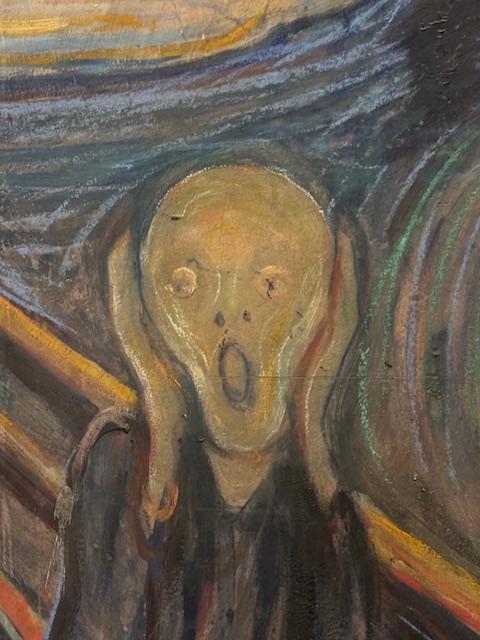
Thursday, glorious weather, sunshine, temperature breaks 60-degrees. People are out in force for the sublime weather. Visit the National Museum (Nasjonalmuseet), which offers a varied collection of artists and art. The Scream (1893), by Norwegian painter, Edvard Munch, is the museum’s most noted piece. In one corner of the painting, a penciled inscription reads, “could only have been painted by a madman.”
FRI 13 June: early-morning train departs Oslo, choked with tourists; transit the countryside, verdant green landscape, marked with lodgepole pines, and low-growing lupine and ferns, among tidy, low-slung, one-story homes.
Imperceptibly, train gains altitude, above the tree-line, at 1200-meters. Landscape is dotted with rock outcropping, scree slopes, and lazy pockets of snow that refuse to melt. There are few buildings, and even fewer appear inhabited in this desolate area.
Seven-hour journey calls at 22 stations, and transits 182 tunnels, the longest of which is 10-kilometers. Some tunnels are wooden trusses to minimize the risk of snow, ice, and avalanche during winter months, as the train operates year-round.
Train slowly descends to sea level, past undisturbed, happy fields of wildflowers, into the town of Bergen, Norway’s second largest city. It is a brief walk from the station to the hostel, the check-in is un-welcoming and underwhelming, almost hostile.
Saturday, the morning air is scented with the perfume of blooming rhododendron, and finally, t-shirt weather. Hike to Fløyen Mountain, which offers dramatic views of Bergen; trade the sound of traffic for birdsong, and trade cobblestones for dirt trails.
Visit Kode Museum, mesmerized by the paintings of Edvard Munch, Evening on Karl Johan (1892), and self-portrait (1909); remainder of the museum was underwhelming. Munch did not paint static images, but rather, the emotions of the human experience.
Sunday, the sky threatens rain; if I do not take photos, did I actually visit the place?
I do not like tours, but, signed up for Norway in a Nutshell. Some days, I have more money than common sense, and the last time that I rely on Lonely Planet. Locals prefer the following itinerary which offers better value: ferry from Bergen to Flåm; exit the valley on Flåmsbana, narrow gauge railway to Myrdal; and return train to Bergen.
TUE 17 June: one-mile Uber to ship terminal costs $20 USD. Hostel provides a large trash bag, shamelessly stomp through puddles, and march proudly in the rain.
Board Hurtigruten’s MS Trollfjord, for eight-day cruise to Svalbard; 450 passengers and 100 crew. Regulations require cold water immersion suits in case of emergency.
Svalbard is part of the Kingdom of Norway, but lies outside the Schengen area. Passengers disembarking at Svalbard go through passport control and are stamped out of Norway. I was unsure how this nuance would be handled; I will now exit the Schengen area with 82 (of 90) days, and a wider margin in the event of travel delay.
I have an interior, window-less stateroom, because not every stateroom may have a window. With perpetual civil twilight, room remains dark, and I sleep better.
Many of the guests are older and gray-haired; many appear limp and lame, with assistive devices, as if there was ever an argument to travel at a younger age.
Three meals per day, breakfast and lunch are buffet, and seated three-course dinner; all beverages are included. There is a small gym; I perform pull-ups all day until everything aches, calloused hands and sore arms. Two saunas offer panorama views.
Limited bandwidth WiFi is included. Stateroom television includes a variety of movies, similar to long-haul, international flights. There is also free, self-service guest laundry.
Wednesday, ship calls at Åndalsnes, the sky is overcast, the dampness is bone-chilling. The water is calm, and reflects the green hue of the steep-sloped fjord.
News report from the United Kingdom, 59-year old grandmother died of rabies. In February, she was scratched by a stray puppy on holiday in Morocco. Two weeks ago, she presented with a headache, before losing motor function, and death. Rabies is almost always fatal. I received (stray) dog bite in Quito Ecuador, grateful for post-exposure treatment in Bogota, Colombia – and as a keepsake – a permanent scar.
Thursday, sky is grey, masking the horizon; ship calls at Træna, small fishing village.
Friday, the sun makes a brief appearance, before ship calls at Reine.
Saturday, port call at Tromsø, sunshine and 50-degrees, as good as it gets. Town is buzzing with anticipation, to greet summer solstice with its “midnight marathon.”
Sunday, port call at Honningsvåg, northernmost town in mainland Norway; there are no trees, flat light, 40-degrees, windy, and wonder why people would choose to live here.
Monday, cross Barents Sea, the water is neither rough nor calm; stateroom is towards the bow of the ship, can feel swells, and hear waves crash against the hull.
TUE 24 June: MS Trollfjord arrives at Longyearbyen Svalbard, 78-degrees north latitude, 400-miles from the north pole, at the convergence of the Atlantic and Arctic Oceans. For several weeks during the summer, the sun neither sets nor rises – land of the midnight sun – but remains above the horizon, 24-hours per day.
Longyearbyen (Longyear) an industrial town, with its roots in coal mining, reminds me of the bleak oil fields of Prudhoe Bay, Deadhorse Alaska. Coal mining is long since past, and the town is now focused on weather research, and also maintains the Global Seed Vault, a backup facility for crop diversity. Indeed, the hostel where I stay, located at the end of the road, beneath Mine 2b (Santa Claus mine), used to serve as a barracks for the coal miners, up to ten miners stuffed into a room.
If I was not scheduled to stay overnight, I would run away. How do I end up in these remote corners of the world. What does it mean to know a place. What does it mean to know oneself, when there is no self to know. What is the Zen koan that suggests, not knowing is most intimate.
THU 26 June: three-hour flight, Scandinavian Airlines, Longyearbyen to Oslo. Re-admitted to Schengen area after immigration officer inspects passport photo with magnifying lens. Sometimes, I wonder what shows up on the computer screen when my passport is scanned. Does it show my travels to Cuba, Haiti, and Lebanon.
Nobel Peace Prize is awarded in Oslo on December 10th, the anniversary of Alfred Nobel’s death. The other prizes in chemistry, economics, literature, medicine, and physics are awarded in Stockholm. There is so much bitterness, divisiveness, and fighting, it is difficult to see a world that exists in peace, but rather, in pieces.
T-shirt weather, citizens and tourists are out in force. Stroll down Karl Johan Street, and treated to an amazing view of the Royal Palace. Visit the Botanical Garden, free to the public, and a break from the din of the city. Return to Grønland, a mostly Muslim neighborhood, and make friends with the local barber for a well-needed haircut.
SAT 28 June: there is weekend track repair, depart Oslo on four-hour bus, surprisingly, with little traffic. Transfer to three-hour train, likely, 1960’s rolling stock, with children running amok down the aisle. A young woman sits next to me and applies makeup for the duration. Arrive Stockholm, an archipelago of fourteen islands and 57 bridges. Walk from central station to hostel, located on Gamla Stan, the historic old town.
Forsmark nuclear power plant, located outside Stockholm, first detected nuclear radiation from the Chernobyl reactor explosion on 28 April 1986, two days after the accident, following radioisotope analysis. Russia initially denied, until Sweden warned that it was going to file an alert with the International Atomic Energy Authority.
Sunday, streaming rays of sunshine, and sound of distant church bells. Visit the city museum, and exit with the grim understanding that Stockholm was not a pleasant place to live prior to the 20th century. Walk ten miles along cobblestone-paved roads, and crisscross every corner of Södermalm Island, of what is a very photogenic city.
Monday, visit Liljevalchs Museum, the Lars Jonsson exhibit. His watercolors were noteworthy, along with his sketchbooks, in a world where often only masterworks are on display. Skip the ABBA museum and Dancing Queen – sorry Cathy – and return to the Royal Palace for changing of the guard. Walking or marching, and only suggest that it did not resemble a Friday night sunset parade at Marine Barracks Washington DC.
Cost: cumulative travel costs, during past 33-days.
Lodging: $1,251 total | $38 day
Transport: $1,420 total | $43 day (plane | train | bus | ferry | taxi)
– – Flight (NYC > Reykjavik): $470 (Iceland Air | $95 per flight hour)
– – Flight (Svalbard > Oslo): $215 (Scandinavian Airlines | $72 per flight hour)
Food: $60 total | $2 day
Other: $4,773 total | $145 day (FX | ATM | visa | tourism | RV & motorbike)
– – Svalbard cruise ($4,400 | eight-day expedition)
Total: $7,504 total | $227 day | $83,000 annualized
– – Cash burn: $0 | $0 day (when credit card not accepted)
US dollar declined 10% year-to-date, against a market basket of currencies (DXY), escalated by ongoing tariff threats, making this trip increasingly expensive.
Conclusion: Anthony Bourdain once suggested, I am certain of nothing. I share the sentiment, but unlike Tony, whom is dearly missed, I still have to exist in this world.
Did US citizens take democracy for granted. If the pendulum swings too far to the right, will it return to center, or will it break. Do we remain the United States of America, or worse, become the United States of Autocracy.
I should be happy, but I am not; I am healthy, financially independent, and travel the world. My happiness set point is long since beyond repair. In public, I laugh and smile out of politeness, but mostly, I fake it, an act that is difficult to maintain.
If I remained in the United States, I would risk entropy. So I travel the world, and do not mind discomfort along the way. Well, I mind, but, I do not let it stop me.
In July, onward to Finland and head south towards Baltic Europe.
 garthmonroe