Introduction: six, long weeks traversing the length of Chile, from Punta Arenas in the south, to Arica in the north. Travel 2,000 miles, fifteen bus trips along the Pan-American Highway; experience everyday life in Chile. Would have been a wonderful road trip – car or motorcycle – if one-way rentals were not prohibitively expensive.
Reach the Peru border, and quickly transit the country. There is too much heavy rain and mud to visit the highlands of Cusco and Machu Picchu, another time.
SAT 01 February: there is no direct bus from Antofagasta to San Pedro de Atacama, it is necessary to connect through Calama. Bus departs one hour late; exits Pan-American highway 5, to highway 25. Bus ride is overwhelmingly desolate and isolated. Bus is almost empty, only contributes to feeling vastly alone. Likely better to remain on highway 5 to Iquique, instead of this spur to the middle of nowhere. I am consumed by an overwhelming and sinking feeling of dread.
Bus arrives in three hours, and transit four bus stations in one day: Antofagasta departure station, Calama arrival station; third station for onward bus to San Pedro de Atacama (Sunday), and fourth station for onward bus to Iquique (Wednesday). Speak enough Spanish that I do not need to use Google translate at the bus station.
Calama is considered the mining capital of Chile, and produces almost 25% of the nation’s copper. City is high-elevation desert, 7000 feet, which explains my splitting headache. Take (generic) Diamox tablet after dinner to mitigate altitude sickness.
SUN 02 February: before midnight, I am awakened by nausea; make it to the bathroom in time to surrender dinner. Wake up in the morning; I move slower than dirt, and regret changing my bus ticket to the earlier 8am departure. 90-minute bus to San Pedro de Atacama, across a surreal, lunar landscape.
Atacama desert is considered the driest, non-polar desert in the world, 8000 feet, high altitude. Desert stretches 1,000-miles long, from Arica to La Serena, between the Pacific Coast Range and Andes Mountains, which create a two-sided rain shadow. Moisture in the region is provided not by rainfall, but by fog drip.
Morning and evening is the best time of day to explore the region, afternoon sun and heat is far too intense. Hostel has a swimming pool, and I’ve never seen so much exposed 25-year old skin at one time, except perhaps, beaches of Rio de Janeiro.
Depart hostel at 8am on rented mountain bike to visit Garganta del Diablo (Devil’s Throat Canyon). Most tourists visit Moon Valley, which becomes as crowded as a shopping mall. In contrast, the canyon receives few visitors (on bicycle or horse). I appreciate the quiet, the solitude, and the views; the only sound is that of sand crunching under the bicycle tires. Return to the hostel by mid-day, before the afternoon heat and sun become too intense.
TUE 04 February: return to Calama, as there is no long-distance bus service from San Pedro de Atacama. There is less blowing sand, and my contact lenses rejoice.
WED 05 February: wake-up early morning; hostel guest locks her key in the bedroom, before her early morning flight to Santiago. Hostel calls service provider to pry the door. She misses her flight; feel sorry for her; could happen to any of us.
Bus station is smaller than a two-car garage; it is disturbing, and wonder if I will be stranded in Calama. There is no waiting area, no seats; passengers wait outdoors in the brisk morning air. It is a five-hour bus north to Iquique. There is only desert. The bus makes no stops, because there is no place to stop. Bus descends the steep “dragon sand dunes” into the oceanfront city center. Evening, sun sets in the west, and reflects the most brilliant orange along the dunes.
Sunrise run, 5-miles, along the malecón; other citizens are out and about, running and walking. Surfers appear as small dots, riding large waves crash onto the beach.
FRI 07 February: for such a large city, Iquique’s bus station is small. It is teaming with people, crush of people, as if, it is swarming with insects. Proximity with other people is overwhelming, as crowded as a subway platform during rush hour.
Five-hour bus north to Arica departs late. Construction along Pan-American Highway diverts the bus onto crusty salt flats. Bus pulls into the frontier city three hours late. Only redemption was viewing the massive canyons outside Chiza and Cuya.
SUN 09 February: early morning, dark sky. Make strong cup of black coffee, the spoon runs away. Make breakfast sandwich, there is more cream cheese than bread, and topped with extra crispy fried egg. Lost at least seven pounds in four months.
Depart hostel, lazy sky remains dark. Local merchants set up tents for the weekend street market. Walk to international bus station, pay $4 USD for two-hour journey, via colectivo, from Arica Chile to Tacna Peru.
This is my penultimate land-border crossing for this six-month journey. There exists an element of uncertainty, which is never negotiable. I will fly from Peru to Ecuador to Columbia to Mexico. I will walk across the border from Nuevo Laredo (Mexico) to Laredo (United States), and yes, I am aware of the recent shootouts in Nuevo Laredo (receive warning emails from the US State Department). I have previously walked twice from Mexico to the United States (Tijuana > San Diego | Juarez > El Paso).
Border crossing is civil and easy. There is no exit tax or entry fee. Customs share the same building. On one side of the counter, exit Chile (passport stamp), and on the other side of the counter, enter Peru (passport stamp). Luggage and vehicles are inspected thoroughly, no organic material is allowed to cross the border.
Time zone retreats two hours, now on Eastern Standard Time. Walk to AirBnB, there is no hostel in this desert town. Host allows me to check-in early. There is a wash machine on the roof, but must be used before 2pm when the city water is turned off. My clothes rejoice, and they dry quickly in the intense afternoon sun.
Visit local barber shop. Old men provide less expensive haircut, versus an expensive gangster-fade haircut. I am often viewed as a curiosity in the barber shop. Skinny, gringo tourist shaved bald, always to the amusement of the barber, like somehow, I lost my mind. Barber speaks little English, I speak little Spanish, mostly smiles. Return to AirBnB, new razor blade, bathroom sink has hot water (pleasant surprise), and a mirror higher than my chest, allows me to carefully shave the remaining stubble off my head, without making the bathroom resemble a crime scene.
TUE 11 February: purchased bus ticket on-line, 30-days in advance, but, unable to obtain printed boarding pass at the bus station. Had to purchase new bus ticket, which is better than getting stranded in Tacna. Waiting for Visa to issue a refund.
Wake at 4am, walk to bus station. There is a cat on the sidewalk, its posture is abnormal. Maybe it was “clipped” by a car or motorcycle. It is wearing a collar, and will likely be missed by its owner, always heart-breaking.
Seven-hour bus from Tacna to Arequipa, through desolate desert; sand is various shades of red. There are few populated settlements, most appear poor and destitute.
Traveled more than three months, and three months often triggers the nadir of travel, the cost of long-term travel. In my experience, things will improve, but the nadir is impossible to avoid; getting kicked and bruised is part of the journey. Don’t need to wish it away, feeling is impermanent, and it will subside in time.
Arequipa, at 8000-feet elevation, is UNESCO world heritage city. Architecture of its historic buildings, museums, and cobblestone streets, all contribute to its charm. There are three Starbucks in the city, likely, no market research, simply place stores in UNESCO locations. It is cold and damp overnight, my body needs an extra blanket.
FRI 14 February: turns out to be an almost miserable day, and not because it is Valentine’s Day. Often travel outside the United States during this holiday. Young couples in love order holiday treats at Starbucks, with chocolates, balloons, and flowers in hand. Just a reminder that I fit nowhere in this world.
Wake up, pre-dawn, city bus doesn’t operate before 6am. Anticipate, 2-hour, 5-mile walk to the airport, but, it is raining, with no sign of letting up, and elect $5 Uber.
Arequipa airport operates only during daylight. When it rains, morning flights are delayed, and afternoon flights are cancelled. Quiet morning at the airport quickly turns into bedlam as flights are delayed and cancelled. I spend the morning like a mushroom – in the dark – before the flight is boarded following a four-hour delay.
Delayed flight is better than a cancelled flight, better than getting stranded in Arequipa, and better than taking 18-hour overnight bus to Lima. Why is it so difficult to accept a flight delay, so difficult to accept life when it goes sideways.
Step outside Lima airport, into the hot and humid air, far different from Arequipa’s chilly dampness. Walk past taxi stand towards a chaotic traffic corner. For less than $1 USD, take public bus to Lima’s city center. If I had more common sense, I would talk myself out of the bus, and elect the safety of $30 USD taxi. Bus is mostly surreal, provided that one is not robbed. Buses are not operated by the city, but rather, by individual operators; one step removed from the wild, wild west. Yeehaw.
I’m not a genius; Google maps loads the bus routes with useful detail. Buses travel through this intersection, blasting an air horn that could be heard by a deaf grandmother (abuela). I wave at the bus to signal that I want to board; when the bus doesn’t stop, I pound the glass door to get the driver’s attention. It is likely difficult, if not impossible to take the bus if you have a suitcase, better with a backpack, best with a small backpack. That which does not kill me, makes me stronger. Maybe.
Long day, tiring day; travel to Arequipa is difficult to justify. Collapse into bed at 8pm, body shuts down immediately; wake up the next morning after ten hours of sleep.
It is difficult to say anything nice about Lima – City of Kings – Peru’s capital. It is a transport hub, convenient location for onward travel. City is gritty, likely better than Port-au-Prince (2016), but that is not saying much. Despite a pronounced police presence, the city does not feel safe.
Barefoot run through nearby park; explore Chinatown (Barrio Chino), colorful Cerro San Cristobal, and centro historico. I may feel unsafe, but the exploration is not boring.
Walk down Avenue Arequipa the next morning. Street is closed to vehicular traffic, and open to runners and cyclists. It is five mile walk to the Miraflores malecón, an upscale neighborhood, no shortage of Starbucks, and easily makes me feel poor (pour). When I reach the coast, it is obscured by heavy fog. The walk is safe, and also boring.
Hostel is located across from Estadio Nacional del Peru; the area is congested and crowded, in anticipation of a Shakira concert, until, she announces that she is sick in hospital, and the concert is cancelled. Hope that her health quickly improves.
MON 17 February: if traveling through hell, don’t stop; oft attributed to Winston Churchill. Morning flight from Lima to Guayaquil Ecuador, which is a nice way of suggesting that things won’t get better anytime soon.
Guayaquil is the entry point for flights to the Galápagos Islands. Aircraft do not refuel on the islands; aircraft must tanker enough fuel for the round trip flight to and from the Ecuador mainland. Most flights, even if they originate from Quito, stop in Guayaquil, and continue to the islands. I don’t like connecting flights, so I purposely stay in this city. It was a grave mistake, as the city has a poor reputation for safety. Guayaquil’s reputation is similar to Tegucigalpa (Tegus), capital of Honduras (2023).
Morning is uneventful; $6 Uber to the airport, and flight departs on-time. Customs agent is pleasant, and it is a 30-minute walk to the hostel. It is hot and humid, a reminder that I am getting closer to the Equator (crosses near Quito). There is no foreign currency exchange, as Ecuador adopted the US dollar as its functional currency in September 2000, after defaulting on a $6-billion bond. By adopting the US dollar, Ecuador staved off inflation and stabilized its economy. For the first time in four months, grocery shopping is easier. Of all the countries visited thus far in South America, food prices might be the most reasonable in Ecuador.
Break in the weather provides an opportunity to visit the malecón in the city’s historic center. City bus loads on Google maps, and allow me to take #89 bus ($0.30) and shave off ten-miles of walking (round-trip). Get an early start, with the optimistic belief that maybe thieves and people with bad intentions sleep late.
THU 20 February: sky is dark, pouring rain, with no sign of letting up. By 9am, there is a break in the weather, an opportunity to walk to the airport. Print boarding pass and obtain $20 Galápagos transit card, which includes my round-trip flight information.
Two-hour LATAM flight to Puerto Baquerizo Moreno, San Cristobal Island, in the Galápagos. Foreigners pay the more expensive, non-Ecuadoran airfare, else risk being detained. After disembarking, pay $200 (cash), non-Ecuadoran National Park fee.
Heat and sun are intense, but only a short walk from airport to AirBnB. Drop off backpack, and explore the small town. Purchase onward ferry ticket, for travel to Santa Cruz Island (Saturday); ticket agent is slippery as a used-car salesman. Cash-based transaction, no recourse, and wonder if I will stand on the ferry pier stranded. Agent pressures me to buy $150 day trip, when I decline, s/he wants to know my profession.
I have dysfunctional eustachian tubes, countless ear infections as a child. Dived last year at Great Barrier Reef, painful, could not equalize ear pressure. Didn’t enjoy snorkeling; water in my ears for two weeks, despite using ear drops. No intention to dive or snorkel while I visit the islands. Would not have enjoyed one week on a sticky, sandy, sweaty, humid boat.
Depart on bicycle at sunrise, 6am, 80-degrees and feels like a sauna. Expected 10-mile ride to take one hour; what I didn’t expect was that I would gain 2000-vertical feet up a volcano, with only eight gears. Ride is steep and strenuous. Climb, climb steep, climb more. If I was less stubborn, would turn around and return the bicycle.
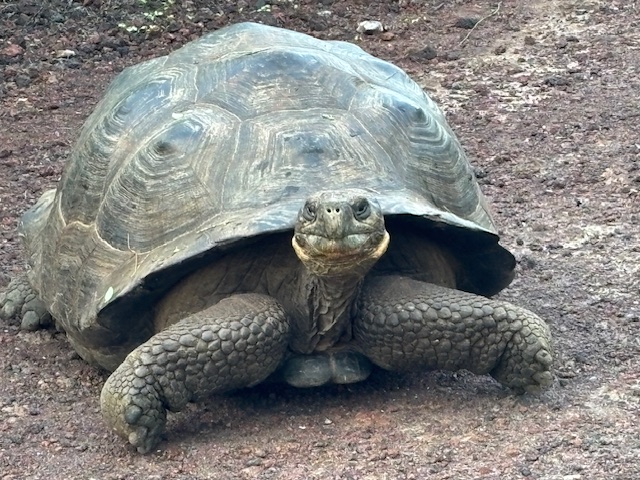
Hike to El Junco is short, and treated to wonderful views of the water-filled caldera; views are often obscured by fog. Continue on bicycle to Cerro Colorado Tortoise Reserve (La Galapaguera). One of the few natural sanctuaries and breeding areas for the endemic tortoise.
During the return bicycle trip, climb another 2000-vertical feet up the backside of the volcano; caught in a downpour, go from soaked in sweat, to just soaked. Keep Ziploc bag in my pocket, to secure the iPhone and keep it dry. Of the five-hour, 30-mile ride, likely pushed the bicycle uphill at least 5-miles. Exhausting ride, feel completely out-of-shape. Return the bicycle, and crunch on two green apples.
SAT 22 February: early morning, muster at the ferry pier at sunrise, for two-hour, fifty-mile journey to Puerto Ayora, Santa Cruz. Despite receiving LTE cell service on the island, cell service doesn’t work, and surprised that the boat has satellite WiFi. Drop off backpack at hostel, and explore the main island of the Galápagos archipelago.
Sunrise, morning run, 6-miles to Tortuga Bay. Gorgeous, talcum-powder, white sand beach; no debris, no rocks, just sun-bathing iguanas. After breakfast, visit Charles Darwin Research Center (signed in Spanish and English), and water taxi to Las Grietas, three natural pools sandwiched between vertical, volcanic cracks.
MON 24 February: awake before dawn, at the ferry pier for sunrise, early morning ferry to Puerto Villamil, Isabela Island, Galápagos. Ferries depart 7am or 3pm, I find it easier to get an early start to the day, allows time when things go sideways. Drop off backpack at AirBnB, and explore nearby lagoons to observe pink flamingos, before the afternoon sky opens to heavy rain.
Town isn’t much, streets are packed sand. There are no grocery stores, just a few mini markets, hope that you’re not hungry. Buildings look worn-out and run-down, there is nothing that resembles a tourist destination; not a place where I want to be stranded.
Sunrise run, magical morning light; advantage of being an early riser, there is no one on the 10-mile round-trip trail to Wall of Tears. Come across at least six “free range” giant tortoise. They live here, not in a reserve, but, in their natural environment; you can see their trails, as they “bulldoze” through the low-growth trees, bushes, and shrubs.
Isabela Island hosted a penitentiary between 1946-1959; erecting the enormous stone wall was an exercise in cruelty and torture. Radar Hill lies just above the wall; it was a US Army installation during World War II. After it was dismantled, the steel was used to erect the local church in town.
Don’t see another person until I exit the trail, and run on the beach back to town. A memorable morning, because, I don’t remember my last enjoyable morning.
WED 26 February: wake at 4am, for 6am return ferry to Puerto Ayora, Santa Cruz, in the Galápagos. Check-in for onward flight to Quito (mainland), Ecuador.
Wake up to the sound of heavy rain, an ominous forecast, only a brief, three-hour window free from rain. Wanted to hike, but, could not find clear guidance on trails.
Take local bus north to Bellavista; flag a passing motorcycle, driver stops to pick me up. There are no pillion handles or foot pegs. He throttles the motorbike and releases the clutch; nothing happens. Maybe 300-pounds of human is too much for 125cc engine. Motorbike gains momentum; my feet drag along the red gravel road.
Driver drops me off at El Trapiche Ecológico Galápagos, local farm in the highland foothills, that cultivates sugarcane, moonshine, coffee, and chocolate. I tip the driver one dollar (twice the bus fare), as karma may be a cruel mistress.
Owner of the farm, an older gentleman, think grandfather, greets me in Spanish. He speaks to me as if I am five-years old, and I am able to follow along. Together, we press sugarcane juice; it is flavorful, but not cloyingly sweet. Farm also ferments the sugarcane into moonshine. He adds a shot of moonshine to the sugarcane juice with a squeeze of lime, and then, after showing me the distilling process, offers a straight shot of anise-flavored moonshine.
We move on to coffee, and watch how red, ripe coffee cherries are split open, and then roasted. I am offered a cup of (drip) coffee, maybe not the best method to showcase the beans. It is not even 8am, I haven’t yet had breakfast; between two shots of moonshine and the coffee, I am plenty buzzed (my last alcohol was August).
It was a unique experience, different than a hike, better than a tour. Owner is quoted as “learn something new each day.” Walk three miles to the bus stop, local bus back to Puerto Ayora, and return to the hostel before the skies open up without warning.
FRI 28 February: I am ready to move on, ready to exit this island sauna, gentle reminder that I much prefer dry, desert heat. If I had to repeat, I would fly into Baltra Island and exit from San Cristobal, which is walking distance from the city center.
Elect $10 share taxi for 25-mile, one-hour drive to Itabasca Canal, followed by fifteen-minute ferry from Santa Cruz Island to Baltra Island, followed by fifteen-minute bus ride to the airport, which served as US military base during World War II.
LATAM flight to Quito (via Guayaquil); Quito airport is 25-miles from the city center, which requires two city buses; twelve-hour travel day, check into hostel by dinner.
Four nights on Easter Island (airfare, tour guide) $1,100. Eight nights on Galápagos Islands (airfare, national park fee) $900. Many places on the island require a guide, despite paying $200 national park fee. It would be easy to spend twice this amount in either location. Grateful for the opportunity to visit both regions, but would not revisit. Galápagos likely has more gems than Easter Island for the independent traveler.
Walking distance: walked more than 800-miles during past four months
Passport status: Peru and Ecuador both stamped endorsement upon entry
Cost: cumulative travel costs, during past 124-days.
Lodging: $1,772 total | $14 day
Transport: $4,050 total | $33 day (plane | train | bus | ferry | taxi)
— Flight | Ecuador > Galápagos Island: $330 ($60 per flight hour)
Food: $232 total | $2 day
Other: $9,089 total | $73 day (FX | ATM | visa | tourism | RV & motorbike)
— Antarctica expedition: $8,400 (ten nights)
Total: $15,143 total | $122 day | $44,600 annualized
— Cash burn $617 | $5 day (when credit card not accepted)
Galápagos Islands entirely cash-based economy; credit card accepted nowhere. Spend more cash during a week in Galápagos than the past four-months combined.
Conclusion: long-term overseas travel yields a cumulative, raw vulnerability not experienced previously. Travel is a study in human nature, a study in human behavior, or, at least to observe human nature and human behavior. Strangely, I observe more similarities among people and cultures than differences, people simply trying to exist, provide food for their families. Also recognize the delicate thread of life, how the world could quickly devolve into chaos, just one step from dangerous, thin ice.
You may notice that Bolivia is missing from this journey, particularly, given its proximity to northern Chile, when I crossed the border to Peru. Bolivia charges US citizens $160 tourist visa fee, all other countries in South America have been free to enter. United States charges $185 dollars for Bolivians to enter the United States. Quid pro quo.
This journey is mostly underwhelming, tiring, and tedious. Liberating to admit, as it frees me from the tyranny of expectations. Too many joyless days in a row; nothing is gained by being disingenuous. I shatter any illusion that long-term travel is glamorous. I am the Debbie Downer of long-term travel. I ruin everything that I touch. I am salt, and poison the continent. Perhaps this journey argues in favor of travel only to tourist destinations, and sip cocktails on the beach of a resort hotel. The risk for me, is that to remain in the United States, is to risk entropy and decay.
Six more weeks of travel before I return to the United States, via Texas. Two weeks in Ecuador, two weeks in Columbia, and two weeks in Mexico. I may do anything for six weeks. Marine Corps boot camp was 13 weeks, followed by 13 weeks of combat training at Marine Corps Base Camp Pendleton. I MAY DO ANYTHING.
 garthmonroe