Introduction: avoided South America travel for many years. Large continent; didn’t know where to start, didn’t know how to assemble travel itinerary for such a vast region. Continent likely requires at least one year to manage the various climate regions, alternatively, return in the future, as travel is iterative.
Six month journey, visit South America, Antarctica, Easter Island, Galápagos Islands, and Mexico. November, travel through Brazil, Paraguay, Uruguay, and Argentina. Will miss Brazil’s infamous Carnaval, which occurs the Friday before Ash Wednesday, and marks the beginning of Lent; one more reason to return to the region in the future.
WED 30 October: journey approaches, sinking feeling in my stomach, foreboding sense of dread. São Paulo and Rio de Janeiro don’t have the best reputation for tourist safety. Friends remind me that I have traveled to regions with similar risk, including Juarez Mexico, Port-au-Prince Haiti, and Beirut Lebanon. I have traveled to fifty countries, an exercise in discomfort, and wonder if the discomfort will ever abate.
Glorious sunshine, temperate, 75-degrees. Train to New York City, and contemplate if I have the stamina for international travel, when it is so easy to exist in United States.
Meet long-time friend, Davinder, for dinner, Korean bibimbap, before onward train to Newark Airport; midnight departure, and nine-hour flight on United Airlines. Dinner service after take-off, I’m lucky if I sleep three hours, maybe four, during the flight.
Flight lands mid-morning, and contemplate boarding return flight back to the United States. Customs agent asks if I will attend the Formula 1 race over the weekend. Subway to city center, and check into hostel at mid-day. Quiet afternoon, find razor blades, exchange currency, and purchase groceries.
Honda motorcycles are ubiquitous; single cylinder, 125-300cc engine displacement. Brazilian law requires helmets for motorcycle rider and pillion passenger, and scooter riders. However, some riders wear shorts, others wear flip flops, or, no shoes at all.
There are safety tips to manage the city. On subway, wear backpack in front of body, and avoid use of smart phone; thief may “snatch and grab” before the subway doors close. On sidewalk, situational awareness; it is beneficial to turn around periodically, to see who or what may be following behind. Sometimes there are more escape routes by walking in the street than on the sidewalk. Be mindful taking photos; also, use smart phone discreetly; thief may use bicycle or motorcycle to “snatch and grab.” Avoid wearing ear pods, smart watch, or flashy jewelry.
Brazil celebrated its independence from Portugal in 1822. São Paulo is Brazil’s largest city, 12-million residents. Scope out Tiete bus station and confirm onward bus ticket; visit Paulistano municipal market, appreciate gothic architecture of Catedral Metropolitana da Sé, and breath of fresh air at Ibirapuera Park; there is exercise equipment, and I rip out some pull-ups, bar dips, and push-ups.
SAT 02 November: subway to Tiete bus station. Subway car is crowded, but find a seat; place leg through backpack strap in case someone tries to “snatch and grab.” Bus station is large, with fifty departure gates, well-organized, and civil. Double-decker bus is full, and departs on time. At São José dos Campos, bus turns towards the coast, and hugs the stunning shoreline and beaches until arrive at Paraty. Hostel is underwhelming despite its on-line reviews. Purchase lozenges, I have a scorching sore throat, and wonder if I swallowed broken glass; frequent symptom when overtired.
One-mile barefoot run, dodge broken glass and bottlecaps. Explore historic town center, try not to trip over crooked cobblestones. Town is a break from the crush of people in São Paulo. Change to a different hostel; this one is more comfortable.
MON 04 November: depart Paraty in the morning, bus drives east to Rio de Janeiro; city hosted 2016 summer Olympics. Arrive at mid-day, and it is not an attractive approach to the city. Tram and subway to hostel. Wonder how the countries compare, GDP per capita; United States $78,000; Mexico $15,000; Brazil $10,000.
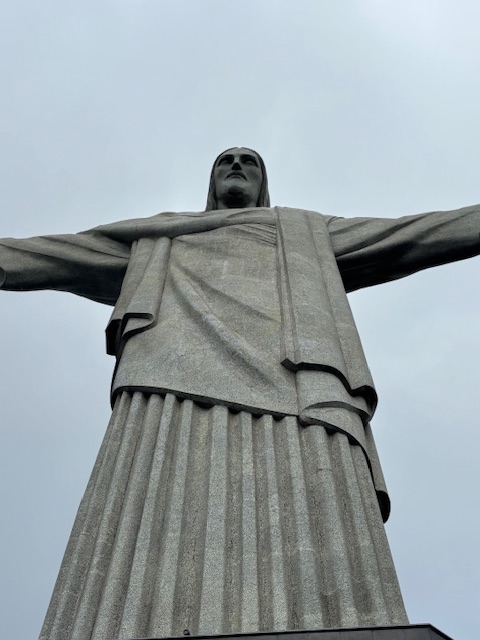
Wake up at sunrise, and walk to Parque Lage, to hike forest trail to the city’s iconic Christ the Redeemer (Cristo Redentor) monument completed in 1931. Hike takes at least one hour, through the shaded canopy, with the sound of birds, and the faint din of the city. Many poo-poo the idea of hiking due to risk of theft. In fairness, it must be easier to mug a tourist on the sidewalk than along a steep hiking trail. Many tourists reach the 2,300-foot summit via cog train ($50 USD) or shuttle van ($25); hike ($5).
Start the day with barefoot run, 2-miles, mixed surface, and try to avoid the dog poo. Visit Ipanema Beach, and with my eyes hidden behind sunglasses, stare at the long, tan legs. Women have long, tan legs, too. Continue on to Copacabana Beach, and for the life of me, can’t get Barry Manilow out of my head.
THU 07 November: planned on subway and express bus to airport, but, issue with the subway. Hail an Uber Moto ($5) and pillion to the airport. Yamaha 250cc, and nothing quite gets the heart racing as lane-splitting Rio traffic at six in the morning. Driver says goodbye with a handshake and fist bump.
Short flight to Belo Horizonte; bus ride to city center takes longer than the flight. State of Minas Gerais is pocked with pit mines; most of the iron ore is exported. State has the greatest concentration of tailing dams in the country; 20% are at risk of collapse.
FRI 08 November: it would have been easy to skip Belo Horizonte, but, if the flight was delayed or cancelled, there would be limited time to recover the travel schedule. Tourists don’t freely visit the city, but, enjoyed visiting the central market, and observing daily life. The scale of the city is walkable and manageable, and almost refreshing compared to the crush of people in São Paulo and Rio de Janeiro.
Bus station is well-organized and civil; ticket windows, small shops, free WiFi, and digital departure board. It is a slow ride, three hours, to Ouro Preto, ascend small hills and descend narrow valleys. It is a short walk from the bus station to the hostel, drop off backpack and explore the small town before it begins to rain.
Ouro Preto sits at 3,000-feet elevation, its name translates to, black gold, at a time when nearly 800 tons of gold were extracted and exported to Portugal during Brazil’s colonization. Town was named UNESCO world heritage site in 1980, with its colonial architecture, red tile roofs, and steep cobbled roads.
SUN 10 November: morning breaks with glorious sunrise and tolling of church bells, and if nothing else, lifts my spirits. Bus back to Belo Horizonte, purchase onward bus ticket to the airport, drop off backpack at hostel, and explore the large street festival adjacent to the municipal park.
Ouro Preto is charming, but travel logistics involve trade-offs. Overnight bus from Rio de Janeiro to Belo Horizonte is eight hours. Belo Horizonte has two airports, Pampulha airport, closer to the city, supports general aviation and small aircraft; local bus to city center ($2). Confins International airport, supports commercial aircraft, 90-minutes by bus to city center ($5). It is possible to rent a car and drive, but there is limited parking in Ouro Preto due to the steep terrain.
MON 11 November: pre-dawn bus from Belo Horizonte to airport; ride is longer than the flight to São Paulo. Arrive at Congonhas airport. Google maps shows city bus routes, and I take local bus to hostel, rather than walk three miles.
TUE 12 November: early morning, subway to train station, express train to Guarulhos airport, flight to Foz do Iguaçu. Flight lands, airport is eerily deserted, greeted with a sinking feeling of dread, and wonder if I made a mistake to visit the region. Google maps doesn’t load any public transport, take local bus to city center. Road between the airport and the city center resembles a state of deconstruction.
Drop off backpack at hostel, stumble across small laundromat built inside converted shipping container. No one inside, facility is clean, machines accept credit card. Wasn’t planning on laundry day, but, strip off my clothes. Only thing I have to wear is my wind-breaker, good thing that I’m skinny, better yet, that there is no one else inside the laundromat. Don’t try this at home, unless of course, you have no shame.
Bright sunshine, local bus, and arrive at Foz do Iguaçu National Park. Purchased entrance ticket on-line. It is likely that the view is more dramatic from the Argentina side of the park. Park is mostly underwhelming, along with the town itself. Return to hostel, and go for barefoot run, and pay the price, with hot asphalt underfoot.
Had an extra day in town, allocated to visit the Argentina side of the falls, but, lose interest. Walk to bus station, to visit Itaipu Dam and powerplant, but, find most tours underwhelming. Explore various stores in town, motorcycle shop has triple black BMW R 1250 GS motorcycle. Exchange remaining Brazilian Real (BRL) to Paraguay Guarani (PGY). At 8,000 Guarani to the dollar, it is one of the weakest currencies in the world.
FRI 15 November: did I made an error in judgment; today is Republic Day, federal holiday in Brazil; will it impede crossing Friendship Bridge from Brazil to Paraguay.
Depart hostel after sunrise, and walk to the bridge; as I approach “la frontera” there are honking car horns, squealing motorcycle brakes, people shouting, and at the pedestrian crossing, a crush of people. Wonder what hell realm I entered.
It is Republic Day in Brazil, and the weekend is advertised as Black Friday, with a weekend shopping frenzy. I exit Brazilian customs, walk across the bridge, and enter Paraguay customs at Ciudad del Este without issue. Different, but not better.
Walk to the bus station, and get bus ticket printed out for Saturday, chance to re-confirm that I am at the correct bus station, too. Walk to hostel, and appreciate opportunity to check-in early, and drop off backpack. Logged in six miles already.
Return to the street markets; it is an overwhelming crush of people. I am claustrophobic and uncomfortable. There is loud, pounding music, and wonder if my bodily organs are going to explode in rhythm. Pick up a few groceries for dinner. There is a plastic produce bag sliding across the floor from a light breeze. Young kitten chases after, and catches its prey with great delight. Back at the hostel, there is artwork in the lobby; upon close inspection, they are iconic pencil sketches of New Orleans French Quarter, by Don Davey (1927-2014).
Could have taken Friday afternoon bus to Asunción, but would otherwise miss the charm of Ciudad del Este. Also, it would have placed pressure on the travel schedule, if there was an issue or delay crossing the border.
Meet lovely woman from the Netherlands, she wraps up nine months of travel in South America at the end of November. She traveled from Bolivia to Paraguay via overnight bus. Her laptop was stolen despite keeping the backpack at her feet.
SAT 16 November: hostel has AirCon in the dorm, but, it blows on me, and with only a thin sheet, I sleep poorly. Wake before dawn, coffee, and walk to bus station, six-hour ride to Asunción. Couldn’t purchase bus ticket on-line, foreign credit card not accepted, but, I was able to purchase by coordinating with a ticket agent on WhatsApp. Go figure. Bus is double-decker coach, it looks and smells brand new, nice seats. AirCon is on full blast; feel like an ice cube.
Ride is un-remarkable, four-lane divided highway, except perhaps, color of bright red clay soil, or, uniform sight of poured concrete utility poles. Arrive at the central bus terminal, there is little – no – tourism here, and I can’t make sense of the public bus.
Four miles to the hostel, 100-degrees under the mid-day sun; it’s a miserable walk. Question my intention to visit Paraguay; city center appears all but deserted. Just because it is possible to visit a place, doesn’t mean that a place should be visited. Could have skipped Paraguay, and traveled onward to Argentina, but, it seemed like a good idea at the time. By sunset, completely exhausted and spent, I crash.
Sunrise, contemplate not running, due to shattered sidewalks littered with broken glass. Two-mile barefoot run, in the street; some people stare at me and point, other people laugh. Crazy perhaps, but, no aches, pains, or injuries; run gently, no heel strike. After the run, bottom of my feet are black, requires flexibility to wash them in the sink.
Paraguay has only been a democracy since 1992, following a 1989 military coup. Asunción is Paraguay’s capital and largest city, with a metro area population of 2.3-million people. GDP per capita is $6,000, buildings are crumbling or shuttered, and there are few signs of economic progress following 35-years of dictatorship (1954-1989) under Alfredo Stroessner. I wonder how I would exist if I hailed from Paraguay.
MON 18 November: early morning, contemplate taking Bolt to the airport, given the 30-minute ride, but select Bolt Moto ($3). 125cc motorcycle; under-powered between the driver, me, and my backpack, likely tip the scales at 300-pounds. Shocks, if there are any, fully compressed, making it a stiff ride. Driver hands me a helmet; there is no chin strap or padding, maybe it was a football helmet, can’t really tell in the darkness of early morning. He offers me neon-yellow safety vest, which I decline. If we go down, I’m going to need more than a safety vest. He fills up the fuel tank ($4), which costs more than the fare. Motorcycle stalls at red lights. Once moving, I have white-knuckle grip on the pillion handle, for the death-defying ride to the airport, and wonder if I am going to pull the handle off the motorbike. For some reason, Sanctus from Faure’s Requiem is stuck in my head. I observe the modern side of the city, glass, steel, and lights. This self-inflicted motorbike ride is over by sunrise. I step off the motorbike and check-in for the flight to Buenos Aires, Argentina.
The Sunday flight to Buenos Aires departs at 2am, and arrives at 4am; incredibly awkward, which reminds me why I scheduled the extra day in Foz do Iguaçu.
Public bus to city center, drop off backpack at hostel. During COVID, US Government injected five-trillion dollars — $5,000,000,000,000 — of stimulus into the economy, to prop up families and small business. The hangover was worse, as Americans grew weary of 8% inflation. Hold on to your hats, because Argentina is subject to 200% inflation. I recall a line of dialogue from The Shining (1980), “Your money is no good here, Mr. Torrance.” Makes it difficult to be a tourist; some stores slap 15% surcharge on to credit card transactions, otherwise, walk around with fistful of Argentinian pesos.
Argentina’s inflation is exacerbated by its failure to balance its budget. Argentina quadrupled its money supply in a thirty-year period to continue spending. Further, Argentina has defaulted on its sovereign debt nine times in its history, and defaulted three times since the new century ($93-billion in 2001 | $29-billion in 2014 | $145-billion in 2020). Argentina makes Greece look an economic powerhouse.
Buenos Aires Ciudad is the capital of the Republic of Argentina, and an autonomous city, with independent powers. Metro area is home to more than 13-million people. Argentina GDP per capita is $13,000, less than Mexico, more than Brazil.
Wake up with headache, skip barefoot run. Slow start to the day, lean on a macchiato for a jump start, served with a side of sparkling water. Purchase SUBE card so that I may use city bus. Bus routes available on Google maps, and bus stops well-marked.
Visit the Museo Nacional de Bellas Artes, it is free to the public, and a “right-sized” museum. Not too large (risk fatigue), not to small (wasted effort), and spans a wide-range of art periods. Particularly enjoy works by Degas and Modigliani.
WED 20 November: early morning, walk to Buquebus ferry terminal, clear Argentina and Uruguay customs. Twin-hull catamaran, HSC Francisco, powered by liquified natural gas, completed the 270-mile trip to Montevideo in less than three hours.
Uruguay is considered the most democratic country in South America, it also boasts the highest GDP per capita, $20,000. Uruguay GDP per capita ranks fourth in the Americas: United States, Canada, Panama, Uruguay, and Mexico.
Awake at sunrise, chigger bite on left knee, and the knee is red, hot, angry, and swollen. Doesn’t stop me from running barefoot along the malecón. My feet are not yet all-terrain, gravel underfoot is still quite tender, so, not likely to run Memorial Park (Houston Texas) anytime soon. Explore the city on foot, 20-miles over two days.
FRI 22 November: three-mile walk to bus station. Station is located on the bottom floor of a large shopping mall. Station is clean, well-organized, free WiFi, with places to buy food and drink. Departure screen platforms are well-marked, don’t have to worry about head-exploding anxiety. Ride to Colonia del Sacramento is unremarkable; four-lane divided highway, rolling fields, no surprise, given the agriculture export-heavy economy. Arrive mid-day; Colonia is a small town in comparison to Montevideo.
Morning run, five-miles, with shoes. By the end of this journey, would like to be able to run this distance without shoes. Explore the small, charming town, quickly on foot. Appreciate the low-key, un-hurried nature, and ability to hear bird song.
Meet James, from Seattle; travel through South America on BMW 1200 GS motorcycle. He is 70-years, retired emergency room nurse and Army veteran; gentle and wise soul.
SUN 24 November: mid-morning ferry from Colonia to Buenos Aires; subway to hostel. Subway “feels” sketchy; people with strange behavior wait for the train; I watch them board, and then board a different car. Drop off backpack at hostel, and visit San Telmo mercado and antique flea market. Pick-up groceries, and witness an un-varnished Buenos Aires Ciudad that feels less safe compared to my experience last week.
Start day with three-mile barefoot run, before the city wakes up. Rain overnight, left the sidewalks slippery, and littered with the La Tipa tree’s bright yellow flowers.
Walk to Plaza Constitution train station, south of the city. Station is congested, and board light rail to La Plata, the capital of Buenos Aires province. Ninety-minute ride south, mostly unremarkable. Hawkers step on the train, selling everything from ham sandwiches to candy bars. La Plata is a planned city, with a grid layout superimposed over two main diagonal boulevards. Cathedral of the Immaculate Conception is one of the largest in the world. Most of the parks were closed in a state of deconstruction.
TUE 26 November: 1:00am bus to airport; arrive 1:45am. Bus is on-time; driver is pleasant and helpful. Witching hour brings out the freaks; try not to make eye contact. Aerolineas Argentinas recommends that domestic passengers arrive three hours early, but, don’t know why. Two-hour flight lands at Mendoza at 6:45am. Wait for local bus to city center, and observe snow-capped foothills of the Andes Mountains. Bus accepts SUBE pass; public transportation uses unified payment card across Argentina.
Drop off backpack at hostel, and invited for breakfast and coffee. If hostel ($20/night) is not your taste, could certainly stay at the Park Hyatt ($250/night). Mendoza has semi-arid climate, with scant rainfall, and is temperate year-round, which supports the region’s well-known wine industry, and the fine Argentinian Malbec.
Walk to bus station and confirm onward ticket. Get haircut, and observe lapful of grey hair. Barber appears surprised when I ask him to cut off my hair. Shave my head in the afternoon with double-edge razor, added bonus of not cutting myself. Some barbers don’t trim short enough, and shaving allows six weeks between haircuts. With smooth, shaved head, and weight loss while traveling, resemble a monk on pilgrimage.
13 October 1972, Uruguay Air Force flight 571 departed Mendoza Argentina enroute to Santiago Chile, with members of the local rugby team. Flight crashed into the Andes Mountains, controlled flight into terrain, due to pilot error. Of the 45 passengers and crew, only 16 survive, upon rescue, 23 December 1972. Survival is memorialized in the book (1974) and movie (1993), titled, Alive. Collapse in bed before sunset, exhausted.
WED 27 November: wake up before my alarm, with the added bonus of feeling human. Morning is overcast, no need for a hat, and feel cool breeze across my bald pate.
Scenic, two-hour bus ride to Uspallata. Highway 7 stretches from Buenos Aires in the east, through the Andes Mountains, to Santiago Chile in the west. Seated in the front of the bus, scenery along the Mendoza River valley does not disappoint.
THU 28 November: Happy Thanksgiving. Uspallata is a quiet village at 6,000 feet elevation, 40-degrees at sunrise. Wake up with pounding headache, likely due to altitude sickness. Can barely think in English, let alone, think in English and speak in Spanish. Altitude sickness often develops 6-12 hours after reaching high altitude.
Return bus to Mendoza, 2000-feet elevation. Exit the bus, clutching my stomach. Police officer pulls me aside, and asks if I am okay. Check into hostel, and almost immediately, sprint to the toilet to puke out my guts.
Sleep for two hours, condition doesn’t improve, and out of modicum of safety, visit walk-in clinic. Spanish-speaking nurse takes my vitals; doctor completes physical exam, and speaks some English. I am fine, it may take up to 24-hours to recover from altitude sickness. Purchase bottle of Gatorade, and able to sip without getting sick.
FRI 29 November: slow morning, head is still pounding; take Excedrin without getting sick, and slowly, start to feel better. Able to eat small amount of breakfast. Travel is hard, even more hard, when ill.
There is no departure board at the bus terminal; wait on the platform, and observe the chaos. Bus to San Juan departs 30-minutes late, better late than never. Highway 40 is mostly a two-lane road, and mostly, in need of repair.
Wanted to visit Talampaya National Park, but the park requires $50 tour guide. Checked the on-line reviews, and most are underwhelming. Quite unfortunate.
During the past month, average 7-miles per day on foot, 230-miles to date.
Extended passport, 50-pages, 43-pages available for visas. To date, 30-pages remain unused; passport expires October 2032. State Department now has on-line renewal.
Cost:
Cumulative travel costs, during past 32-days.
Lodging: $417 total | $13 day
Transport: $1,215 total | $38 day (plane | train | bus | ferry | taxi)
– Flight | New York > São Paulo: $533 ($60 per flight hour, non-stop)
Food: $56 total | $2 day
Other: $42 total | $1 day (FX | ATM | visa | tourism | RV & motorbike)
Total: $1,730 total | $54 day | $19,700 annualized
Cruise to Antarctica, mid-December, is the largest extravagance on this journey.
Conclusion: I was intimidated by this journey before departing the United States. Many people intimated that São Paulo and Rio de Janeiro were not safe for tourists. I found that both cities were manageable, with vigilant precautions, consistent with my previous travels to Central America.
Large cities are useful travel hubs; smaller towns and villages are often more fascinating to visit and explore.
Only two weeks in Brazil, not enough time, and it is rainy season for the Amazon; will need to return in the future.
Looking ahead to December, wrap-up desert region of Argentina, and fly south to Ushuaia, southernmost city in the world, before departure on astral summer cruise to Antarctica. Will it be the Drake Lake or Drake Shake.
Slow travel breaks a person down, how can it not. Have we traveled long enough to allow our tears to fall (Deborah Moggach).
 garthmonroe