South Korea, formally, the Republic of Korea. Not to be confused with North Korea, formally, the Democratic People’s Republic of Korea. What’s in a name.
One month in Korea; Busan, Jeju Island, Seoul, and everything in between. Korea exceeded all expectations, pleasant surprise. Many people visit Korea from Japan, and may draw an unfair comparison; Korea is not Japan.
Some elements of the trip appear in “The Daily” including a mishmash of topics. Photo gallery has trip images, captions available when viewed in slide show mode.
SAT 01 June: travel long enough, even the best made plans go sideways. Fast ferry (3-hours), Fukukoa to Busan, cancelled twelve-hours prior to departure due to hull damage. There is a slow ferry (6-hours), but can’t book on-line within 48-hours.
Google flights, purchase plane ticket, marginally more expensive than ferry, but can’t check-in on-line because ticket purchased less than 24-hours prior to departure.
One-hour flight, clear customs, K-ETA requirement waived through year-end. Google maps isn’t working, re-start iPhone three times, public transportation begins to cooperate. However, because Google (and Apple maps) don’t meet South Korea’s data requirements, driving and walking directions are not available. Two subway transfers to Busan station; drop-off backpack at hostel before mid-day. Pusan became Busan in 2000, when the country adopted modern Romanization.
Wander around the city, try to understand what is available, how things work, what things cost; where credit card may or may not be used. Korean Won (KRW) introduced in 1962, pegged to US dollar. Transitioned to floating exchange rate in 1997; Won was devalued almost 50% following 1997 Asian financial crisis. Often take for granted that US dollar is one of the easiest currencies to exchange world-wide.
Wander through the public markets; experience suggests that Saturday is the “big day” as many vendors don’t set-up shop on Sunday, or, close early. There are an overwhelming number of coffee venues in the city; I could be jacked-up all day.
Not the day that I wanted, but, at least it’s not raining. Build buffer days into the travel schedule, to absorb travel disruptions. Uncomfortable for most of the day, wonder how long the sensation will last before it subsides, as, it never really goes away.
Ferry company sends email; credit card fare refunded, but, proceed to Busan ferry terminal, to receive additional 100,000 Won ($72 USD) for cancellation inconvenience.
Busy day, despite using subway, 15-miles on foot, including hike to Seokbulsa Temple. Temple is built into sandstone cliff on Mt. Geumjeong, highest mountain in Busan, with Buddha reliefs carved into the narrow cliff walls. Subway from Busan Station to Oncheonjang Station; walk to Geumgang Park; cable car towards summit. Had to follow another traveler’s blog to not miss landmarks, as the hike isn’t well marked for tourists (more signs in Korean than English). After reaching the temple, it is easier to hike down to Mandeok Station (1-mile) than to hike back to the cable car.
South Korea is 14th largest world economy, $1.7-trillion GDP. Korea has made dramatic economic transformation in 75-years since Korean War, investing in research and development; Korea will likely be top ten economy within my lifetime. $33,000 GDP per capita consistent with Japan. Korea is home to 52-million people; Seoul (10-million) and Busan (4-million), are its two largest cities.
Traffic drives on the right, similar to United States; steering wheel on the left. Popular car brands include Hyundai, Kia, and Genesis (luxury brand of Hyundai). Mercedes and BMW seen less frequently; Honda and Toyota, non-existent.
MON 03 June: one hour flight from Busan to Jeju Island, land before mid-day; bus to city center, drop off backpack at hostel. Guidebooks rave about Jeju Island, and compare it to Hawaii. Don’t see it, mostly underwhelmed.
Visit Seongsan Ilchulbong, tuff cone volcano, formed by underwater eruption. Hike Saryeoni Forest, in the shadow of Mt Hallasan. Its dense cedar groves were planted as wind break to protect nearby tangerine groves. Visit Seogwipo, island’s second largest city; four-hour round-trip, provided opportunity to appreciate island’s geography. Thursday was Memorial Day; veterans wear ribbons and medals, lest we forget. Island has good bus service; frequent, inexpensive ($1 USD), and WiFi.
FRI 07 June: ready to move on. Wait at bus stand. Will 6am bus depart on time. Will it be late. Did I read the bus schedule correctly. Am I waiting at the correct bus stand. Never really sure. Arrive in Busan, drop off backpack at hostel. Explore BIFF (Busan International Film Festival) Street food stalls, Youngdusan Park, and Jalgachi (seafood) market. Really need to like seafood to enter the market; it doesn’t smell fresh, it just smells. Floor is wet. What am I walking through. Will I need to burn my shoes.
Dodged raindrops, explored Jeoryeong coastal walk, Huinnyeoul coastal tunnel, and Huinnyeoul Culture Village, sometimes referred to as Korea’s Santorini. Coastal village and art community, located along steep cliff in Yeongdo, with views of freighters queuing to enter the Port of Busan, Korea’s largest port, and sixth largest in the world.
SUN 09 June: Korea Train Express (KTX), Busan to Gyeongju. High-speed train 300 km/h (180 mph), based on France TGV; arrived in 30-minutes, local bus to city center.
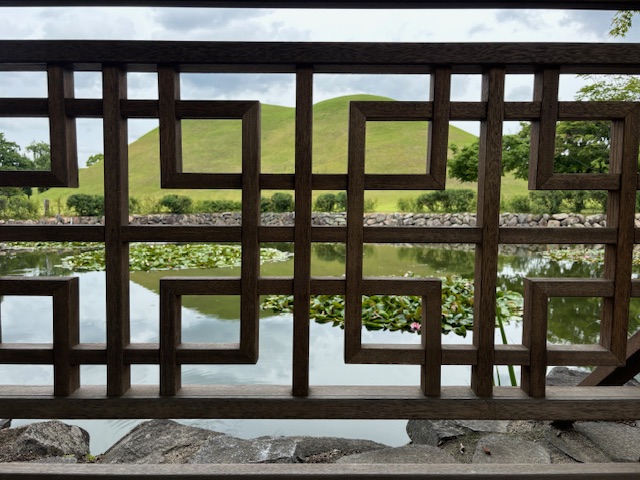
Gyeongju is described as museum without walls. including the Royal Tombs, ancient burial mounds, Silla Kingdom ruins, National Museum, and the National Park. The park, south of the city, is easily accessed by public bus; offers great hiking, challenging and steep, with no shortage of historical remnants, and respite from the din of the city.
Local train stations are confusing. KTX arrived at Singyeongju Station. Old station not equipped to handle KTX, subsequently closed, but still appears on Google maps. Onward train, Mugunghwa, provides local service, and arrives at new Andong Terminal. Old station not equipped to handle KTX, subsequently closed, but still appears on Google maps. Unsuspecting tourist could easily go to the wrong station. In hindsight, would have been easier to travel Busan to Gyeongju to Andong via bus.
WED 12 June: wait at Gyeongju train station; iPhone alert, 4.8-magnitude earthquake in Buan, no damage reported, does not impact conventional train to Andong. Landscape is vibrant and green, steep rolling hills; pass rice fields and fruit orchards.
Start the day early, to beat intense sun and heat. Nakdonggang River is enshrouded in mist; Woryeonggyo Bridge appears to float in the air. Explore historic folk village in Andong. Lie down on park bench to rest; head is throbbing, bench is spinning. Several Koreans approach with great concern. Use Google Translate, explain that I have a migraine and need a few minutes to rest. Get to my feet, and stagger to quiet corner of the park. Find storm drain, get down on hands and knees, and get sick. For a few minutes, feel better, and walk back to town on tree-shaded boardwalk along the river.
Feel better the next day; early start to beat the heat and intense sun. Borrow bicycle from hostel, and ride to Icheondong Seokbulsung, unique Buddha statue carved into the nearby rock formation. Bicycle only has three gears, which is a workout climbing the long hill, but, grateful that the brakes work for downhill ride back into town. Too long to walk, too short for bus, bicycle, just right.
Most sublime site, Woryeonggyo Bridge, with the reflection of lanterns reflected in the river, after sunset, with ambient light still illuminating the horizon; never expected.
SAT 15 June: train from Andong to Seoul, KTX high speed service commenced in 2021. Seoul is sleek and modern; wonder if I am in New York City. Visited local markets, Saturday is often busiest day of the week, with merchants, locals, and tourists.
Purchase T-Money card at subway station ($3 USD); load with Korean Won (not credit card); infinitely easier to travel on subway or bus. Local bus does not make change, so often have to travel around with wad of 1,000 Won notes and 100 Won coins.
SUN 16 June: wake up to bright sunshine. Seoul station is modern and clean; train departures are well-signed in Korean and English. KTX from Seoul to Gwangju; when train passes through extended tunnels at high speed, there is pressure on the eardrum, consistent with flying in an airplane; not uncomfortable, but, noticeable.
KTX arrives on-time at Gwangju Songjeong Station; subway to Gwangju city center. Five foreign workers from Timor sit next to me. They take great interest in me, which is often cause for concern. Wonder if there is some type of nefarious intention, as, I am not that interesting. Strangely, people want to know my age; do I look young, old, or, just look odd. They take their picture with me, and depart the subway car without incident. Sometimes, the best thing that I may do is to smile, laugh, and cooperate, and hopefully, disarm any potential threat. Wanted only to mind my own business; subway stops were in Korean; count to thirteen, and get off at the correct stop.
Weather is overcast, 80-degrees; good day to hike Mudeungsan National Park. Many of South Korea’s national parks are accessible by local bus; trade traffic noise for bird song. Hike 10-miles, loop trail, gain 3,000-feet elevation, good workout. Korea’s national parks are well-maintained, well-signed, and free of charge. It’s nice to see the parks well-visited by its citizens; Koreans take hiking quite seriously; decked out in modern equipment: shoes, pants, shells, hats, backpacks, gloves, and hiking poles.
Body is sore; mind is fatigued. Vietnamese coffee doesn’t help, no superheroes today. Walking tour of the city; finish before mid-day; intense sun and 90-degrees.
WED 19 June: Gwangju subway station lies beneath five-one-eight democracy square, where an uprising took place in 1980, to protest a double coup d’état, that placed a military dictator and enforced martial law. Korea has been a democracy since 1987.
KTX train from Gwangju to Iksan, and connection to Jeonju. Local bus to hostel. Jeonju is referred to as Korea’s cultural capitol, its Hanok Village is the largest concentration of traditional homes, and does not disappoint. Visit Martyr’s Tomb, in the foothills outside the city; appreciate the stunning artisan mosaics and stained-glass windows.
SAT 22 June: arrive at Jeonju station before it begins to rain; Intercity Train Express (ITX), arrive at Seodaejeon station. Set iPhone (vibrate) alarm 15-minutes before scheduled arrival, in case I doze off. Explore city center and dodge raindrops.
Eating in Korea was a challenge; few English menus or kiosks. Many dishes are meat intensive. Don’t mind fish sauce, or meat as a condiment, but, don’t want plateful of animal product. On travel days, lunch was often, inexpensive onigiri (rice ball).
MON 24 June: KTX from Daejeon to Seoul; city tagline, “Seoul my Soul.” Visit National Hangeul Museum, National Museum of Korea, and War Memorial of Korea. Museums are free to the public, modern, and well-signed. Hangeul Museum is testament to the Korean language. National Museum, well-curated collection of art and antiquities. At the War Museum, patrons are asked to write post cards to veterans.
Korea was ruled by Japan (1910-1945), and liberated, following Japan’s surrender in World War II. Japan defaced and damaged many historical sites and antiquities; also restricted use of Korean language and customs. Korea was divided at the 38th parallel into two occupation zones, controlled by Soviet Union and United States, with the intention to form a unified state. Each zone formed its own government (1948), but failed to reach agreement. Hostilities escalated, and led to the Korean War (1950); ended with armistice (1953). Day trip to Demilitarized Zone (DMZ), via tour guide; Joint Security Area (JSA) remains closed for past year after US Army soldier ran across the JSA into North Korea; subsequently repatriated back to United States.
Enjoyed hiking Namsan Mountain, oasis of green space, with fantastic views of Seoul. Gyeongbokgung Palace is most celebrated; many Koreans wear hanbok, and appear festive in traditional clothing. Day trip to Suwon, visit historic Hwaseong Fortress.
Enjoyed Korea, exceeded expectations. No shortage of things to see and do, modern, safe; effective tourist infrastructure. Lots of walking, 1,250 miles over six months.
MON 01 July: airport express train to Seoul Incheon; non-stop flight to New York, 14-hours, 7,000-miles. Alternate between coffee and water, muscle through the long day, and 13-hour time zone change. Long afternoon, Long Island Railroad to Grand Central Station, Metro North to New Haven, Shoreline East to Old Saybrook. United States is not without flaws, but, nowhere else I would rather live. Prodigal son returns home.
Cost:
Cumulative travel costs, during past 189-days; no Uber or taxi for six-months.
Lodging: $4,697 total | $25 day
Transport: $7,508 total | $40 day (plane | train | bus | ferry | taxi)
– Flight | Seoul > New York: $995 ($71 per flight hour, non-stop)
Food: $535 total | $3 day
Other: $7,138 total | $38 day (FX | ATM | visa | tourism | RV & motorbike)
Total: $19,878 total | $105 day | $38,400 annualized
Total cost would be $6,420 less without two motorbike and two campervan rentals.
Conclusion:
Travel the world; what destinations make me choke up: Treasury at Petra (Jordan), Dome of the Rock (Jerusalem), Pyramids of Giza (Cairo), Uluru (Australian Outback), Atomic bomb dome (Hiroshima), and never get tired hiking Grand Canyon National Park (planning another 20-hour, rim-to rim-to rim hike).
Reflect on past six-months, definitely return to Tasmania, not less than two weeks. Also open to travel the Ghan (train), south from Darwin to Alice Springs (non-summer). Also plan to return to Japan, Hokkaido to Okinawa, late summer into fall.
Thank you for following along during this six-month journey to New Zealand, Australia, Japan, and South Korea. Visit with family and friends over the summer. Next journey departs October 30th to South America, Antarctica, Easter Island, and the Galápagos.
 garthmonroe