Following the first month in Japan, visited enough castles, temples, and shrines; consumed enough noodles and ramen. Downside to the Shinkansen, is that it disgorges its passengers in large cities, after time, it becomes soul-crushing. During this second month in Japan, visit Hiroshima, Kyūshū, Okinawa, Japan’s southernmost prefectural island, and Hokkaido, Japan’s northernmost prefectural island.
Some elements of the trip appear in “The Daily” including a mishmash of topics. Photo gallery has trip images, captions available when viewed in slide show mode.
WED 01 May: half-day trip to Saijo, thirty minutes east of Hiroshima; lush, green mountains provide respite from the bustling city. Saijo is famed for its sake (rice wine), rice fermented with koji spores. Visited Kamotsuru Sake Brewing; displays and videos explain the production process in Japanese and English; product samples available for tasting. Also visited Fuju-in Entsu-ji, stone garden adjacent to modest Zen temple.
Visited Iwakuni in 1996, and visited its famed five-arch, wood span, Kintaikyo Bridge, on bicycle, but elected not to return. Wanted to visit Mazda, for factory tour and car museum, but, closed due to Golden Week. One of my favorite cars is the two-seat Miata roadster (targa top); great fun at legal speeds.
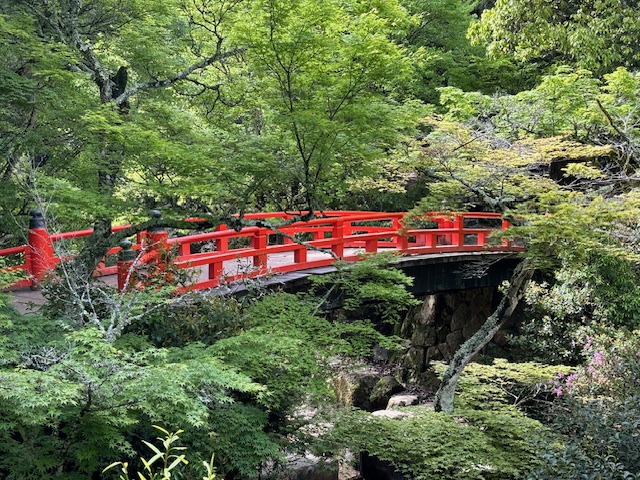
Day trip to Miyajima Island, nothing short of spectacular, finally, trade three days of showers for sunshine. Travel options include high-speed ferry from Hiroshima Port ($25 round-trip), or streetcar & ferry ($6). On the island, no need for transportation, everything is walk-able. There is a tram to summit 1,800-foot Mount Misen, but, elected to hike the wooded trails, five-mile round-trip Stairmaster, of sorts. Island is part of Setonaikai National Park, and grateful to trade the concrete jungle for dirt, trees, streams, and birdsong. Pass about a dozen hikers on my way to the summit.
Hiking down, hear Bonshō bell in the distance, and visit Daisho-in, Shingon Buddhist Temple. Return to the ferry terminal, walk through the crowded shopping streets, which serve all manner of wonderful foods, and, the ubiquitous Starbucks. If you travel to Japan, perhaps stay overnight on Miyajima. After the hordes disappear in the afternoon, the island’s famed vermillion Tori gate is illuminated, along with stone lanterns along the footpath. Had a good day, felt good, quite rare. My last good day was so long ago, don’t remember.
Ferry from Hiroshima Port to Matsuyama, on Shikoku. Expensive ferry ticket, had concerns, but, didn’t want to waste sunny day. Lacks charm and natural beauty of Miyajima. Perhaps, would have enjoyed if remained on the island overnight. Walking back to ferry terminal, fishing villages along the coastline, while not a tourist sight, were far more interesting. If nothing else, appreciated the geography of the islands and coastal terrain during the two-hour round trip.
Clear blue skies, bright sunshine, 70-degrees by mid-day. Local train to Kure, one-hour east of Hiroshima, scenic ride along the coast. City continues its tradition in ship building; built Battleship Yamato (1941), largest battleship at the time, later sunk by the United States (1945), prior to the Battle of Okinawa. Climb 200-steps of Ryojo, and enjoy Fukuzumi Fried Cake, filled with sweet bean paste, along with a shot of real coffee. For a few hours, at least, feel like a superhero. Return to Hiroshima; trains are filled with baseball fans, wearing Hiroshima Carp jerseys, for today’s game. Walk back to hostel, and explore Flower Festival street fair surrounding Hiroshima Peace Museum.
MON 06 May: another 50-mile week on foot, ready to move on. Early morning Shinkansen departure, to avoid crowds on the final day of Golden Week. Arrive in Fukuoka in northern Kyūshū; rain in Hiroshima gives way to cloudy skies. Drop off backpack at hostel, and explore city on foot. No pressing reason to visit Fukuoka, simply working my way south towards Kagoshima and Okinawa.
Visit Big Up, small bar with no seats; bar is smaller than the average bathroom. Intention is to sample shōchū, distilled, silver spirit produced from leftover harvest products, such as rice, barley, or sweet potato. Most production occurs in Kyūshū, where the spirit is more popular than sake. Shōchū is served straight-up, on ice. It has higher ABV than sake, but lower ABV than vodka or tequila. If you are keeping score at home, it is my fourth cocktail in five months.
Local train, east of the city, into the wooded foothills, to visit Nanzo-in, Shingon Buddhist Temple, noted for its statue of reclining Buddha. It is suggested that the interior of the bronze statue holds the ashes of Ānanda, Buddha’s attendant.
WED 08 May: get breakfast before going to train station; onigiri, Spam and egg sandwiched between two rice balls; far better than any McMuffin. Shinkansen, 30-minutes south to Kumamoto. City itself, like many cities, is underwhelming. Drop off backpack at hostel, explore city on foot; dodge raindrops.
Kumamoto Castle is popular destination with tourists; reconstructed in 1960, and undergoing repairs following 7.0-magnitude earthquake in 2016. Suizenji Jojuen Garden, south of the city, is also popular tourist site. Skip both; purchase streetcar day pass, so that I may explore the far corners of the city, people watch, and observe locals go about their day.
FRI 10 May: Shinkansen to Kagoshima, one-hour south. Hostel is un-locked, but, no staff in sight. Concerned about leaving backpack unattended, don’t wish to have laptop stolen. One of the few times that I am un-nerved in Japan, and for a moment, consider getting a hotel. After traveling several months, sometimes, it gets tiring.
Day is mostly underwhelming; scope out ferry terminal to visit Sakurajima Volcano on Saturday, and scope out bus terminal for ride to airport Sunday morning. Bus terminals are almost never intuitive, and, stressful to try to find the correct platform at 5am, when the city is still asleep. There are 22 bus stands stretched out over a city block. Otherwise, comfortable day, sunshine, 75-degrees, and ocean breeze.
Wake up before sunrise, 6am ferry to Sakurajima Volcano, the most active volcano in Japan, spewing steam and black ash daily, coating city streets and sidewalks. Stratovolcano’s most recent eruption was in February. Hike itself was underwhelming, despite map indications, there was no nature trail, only a bicycle lane to climb 3,000 feet. Views from the observation platform were underwhelming, too. Grateful to Japanese tourists who offered me a ride back to the ferry terminal; they took great humor, in my decision to hike to the top.
SUN 12 May: prefer ground travel; wanted to take 26-hour ferry from Kagoshima to Okinawa. Couldn’t purchase ticket on-line; travel agencies not helpful. Purchased airline ticket, strangely, less expensive than ferry. Wanted to rent a car, circumnavigate the island; international driver license expired at the end of April.
Sunrise bus to airport, located 20-miles outside Kagoshima; 90-minute flight, and monorail to Naha city center. Stationed in Okinawa during my last year in the Marine Corps (1996). Suggested more than once, can never go back, and for short period of time, it stings to be back. “A man may not step into the same river twice, because it is not the same river, and he is not same man (Heraclitus).”
No trains on Okinawa; monorail runs only ten miles; limited bus network. Considered taking tour guide day trip; often, long tedious days that end in disappointment.
Visit Kinjo Stone Road, old neighborhood, with steep road surface paved with cut limestone. Nearby, there are six large Akagi trees in Shuri Kinjo neighborhood, 20-meters tall; few trees survived the Battle of Okinawa. Continue climbing uphill, and visit Shuri Castle, destroyed by fire in 2019; castle scheduled to re-open in 2026. Finish the day with visit to Prefectural Art Museum, small but thoughtful display.
Buy 24-hour monorail pass; opportunity to see other neighborhoods, en route to Urasoe Park, which offers expansive views of the island. Known to Japanese as Maeda Escarpment, and to Americans as Hacksaw Ridge, it is the location where Army medic, Desmond Doss, saved more than 75 soldiers. For his gallantry, he was the first conscientious objector to be awarded the Medal of Honor.
Return to Naha and visit Tsuboya Yachimun, known for its cobblestone streets, pottery museum, and pottery artisans, who demonstrate sacred level of care dedicated to their craft. Okinawa is culturally unique, given its distance from mainland Japan; it is also one of the world’s “Blue Zones” with higher than average life expectancy.
Southern island is architecturally bland; buildings are typhoon-grade, industrial concrete. Northern island is un-developed, due in part to Yanbaru National Park. Following World War II, Okinawa was under United States jurisdiction, until 1972, when control of the island reverted to Japan. United States maintains strong military presence on the island with more than 30,000 service members; point of frustration for locals. Military personnel are slowly being transferred to bases in Guam.
THU 16 May: it was not the Okinawa experience that I wanted; while I am ready to move on, disappointed that I didn’t experience the island more thoughtfully. Monorail to Okinawa airport, two-hour flight to Tokyo Haneda; one-hour train to Tokyo station. Hostel located behind Senso-ji Temple in Asakusa neighborhood.
Purchase 24-hour metro pass; visit local neighborhoods, Nakameguro, Ebisu, and Monzennakacho, in search of intimate corners of the city, traditional mokumitsu neighborhoods, with tight warrens of traditional, wood-structure buildings. It is difficult, as most of Tokyo was firebombed during World War II; most buildings and neighborhoods are modern, industrial concrete. In the Daikanyama neighborhood, find Kyu Asakura house (1919), traditional wooden home, Taisho-era architecture, which survived Great Kanto Earthquake (1923) and World War II firebombing.
SAT 18 May: subway to Tokyo station; Shinkansen to Hokkaido, four hours. Flight is faster and less expensive, but, less interesting; enjoy seeing the landscape, rice fields and snow-capped mountains.
Shinkansen service to Hokkaido began in 2016. Cross 34-mile Seikan Tunnel, 800-feet below Tsugaru Strait. Tunnel completed in 1988, after 27-years and cost $7-billion USD. Shinkansen terminates at Shin-Hakodate-Hokuto; onward Shinkansen service to Sapporo won’t begin until 2030.
Local train stops at Hakodate, third largest city in Hokkaido. Commodore Perry opened Hakodate to international trade in 1854. City feels distinctly different than other parts of Japan, cross between the wild west and Alaska. City is low-key, almost thread-bare along the edges, refreshing change. Unlike other parts of Japan, historic, wood structure buildings still exist, even a Russian Orthodox Church, respite from industrial concrete. Ride streetcar to visit star-shaped Goryōkaku fortress, and hike 1,100-foot Mt Hakodate, with fantastic views of the city and harbor below.
MON 20 May: four-hour train, Hakodate to Sapporo. Travel along coastline; view is unremarkable; sleepy, derelict fishing villages; a few farms, some with horses; and undeveloped land, bit of a surprise in Japan. Arrive Sapporo station, mostly grumpy.
TUE 21 May: overnight rain gives way to cloudy skies, 50-degrees. Bus to Noboribetsu; many people only visit this thread-bare, small town as day trip from Sapporo.
Beautiful day, clear blue sky, 65-degrees, no wind. Visit Shikotsu-Tōya National Park, and enjoy hiking through the hot sulfur springs of Jigokudani (Hell Valley). Lake Kuttara (sunken caldera) is nearby, but, not within reasonable hiking distance.
Many tourists visit onsen at Dai-ichi Takimotokan ($15 USD); I visit local onsen at Yumoto Sagiriyu ($3 USD), with dry sauna and four baths (hot sulfur spring, medium sulfur spring, jacuzzi, cold plunge). There are separate facilities for male and female; no swimsuits or tattoos allowed; there is only one gringo tourist. Make friends with the cold plunge, and lose count, alternating between hot sulfur spring and dry sauna.
THU 23 May: morning bus to Sapporo, explore Hokkaido’s largest city. Odori Park, features multiple fountains and the iconic Sapporo TV tower. City’s wooden clock tower (1878), one of the few wood-structures to survive earthquake or fire. Nakajima Park, beautiful in springtime, with flowering azalea, lilac, and wisteria; it’s formal garden preserves a ceremonial tea house. Stroll along seven-block covered shopping arcade on Tanukikoji Shopping Street, and Pole Town, underground shopping mall that runs between Odori Park and the rocking night life on Susukino Street.
FRI 24 May: arrive Asahikawa, via bus; consolation prize of sorts. Wonder if I made an error in judgment; should I return to Sapporo. Wanted to visit Daisetsuzan National Park, in nearby Asahidake, but closes after ski season for annual maintenance. Main street is lined, not with deciduous trees, but rather, conifers and evergreens. Appears that the city settles in for a long, bleak winter, and up to 25-feet of snow.
Don’t subscribe to the idea that travel is glamorous; open to the possibility that travel may be quite ordinary. As I move from tourist centers, more Japanese, less English; get by with a smile and a bow. Visit Asahikawa Design Center, part museum, part furniture store, which highlights the work of skilled craftsmen and artists, sculpting beautiful furniture, to be handed down to future generations. Experience is touching and soulful, which echoes emptiness, to live in a disposable, throw-away world.
In a country that prides itself on conformity (nail that sticks out may be hammered down), observe Japanese at Asahikawa train station, protest the war in Gaza.
SUN 26 May: morning bus to Sapporo; en route to hostel, visit Nijo Market, similar scale as Tsukiji Fish Market in Tokyo, for those who enjoy seafood. Along the way, stop at 7-Eleven for coffee jello, what is not to like about coffee and whipped cream.
MON 27 May: train to Otaru; many people visit as day trip from Sapporo. Iconic steam clock, located outside Music Box Museum. With music boxes playing simultaneously, the museum sounds creepy, like a bad horror movie. Second-floor of the museum has many Tiffany-style lamps. City is known for its canal, completed in 1923, and lined with Meiji-era stone warehouses; in the evening, area is illuminated by gas lamp.
WED 29 May: train back to Sapporo, it’s cold, 50-degrees; grateful for underground shopping arcades. Exchange remaining Japanese Yen (¥) to Korean Won (KRW | ₩).
Enjoyed Hokkaido, definitely plan to return, with international driver license, so that I may rent a car, and explore the island’s remote corners, national parks, and sublime beauty. Learned that Japan’s snow monkeys, Japanese Macaques (saru) are located not in Hokkaido, but outside Nagano, at Jigokudani Monkey Park, where they may be observed, soaking in the hot springs (onsen). Just another reason to return to Japan.
THU 30 May: express bus to New Chitose Airport, 75-minutes. Two-hour flight to Fukuoka, subway to city center. 78-degrees, grateful for t-shirt weather. Final day in Japan, visit Hakata old town, and its many temples and shrines. Saturday June 1st, travel on JR Beetle, three-hour, high-speed ferry, 150-miles to Busan, South Korea.
Cost:
Cumulative travel costs, during past 158-days. Spend $350 USD cash over two months, credit card is not universal.
Lodging: $4,084 total | $26 day
Transport: $6,168 total | $39 day (plane | train | bus | ferry | taxi)
– Train | Tokyo > Hokkaido: $160 ($40 per hour | Shinkansen)
Food: $447 total | $3 day
Other: $7,035 total | $44 day (FX | ATM | visa | tourism | RV & motorbike)
Total: $17,734 total | $112 day | $40,900 annualized
Conclusion:
Enjoyed traveling through Japan, in particular, Hakone, Miyajima, and Noboribetsu. Experience feels safe, something exotic around every corner; while more expensive than other regions, still affordable with strong US dollar (155 yen). Anticipate returning to Japan in the future, likely for three months, maximum duration of tourist visa. Visit in late summer or early autumn; travel south from Hokkaido to Okinawa. After visiting most of the tourist sights, would like to follow the path less traveled – no Shinkansen – local bus or train to visit the country’s more remote corners, and explore the country’s hidden gems, including Honshu, north of Tokyo, and entire island of Shikoku.
 garthmonroe