Introduction:
When Cameron was in Egypt’s land.
Ferris Bueller’s Day Off (1986)
Let my Cameron go.
Conclude three weeks in Egypt, continue onwards to Tunisia for two weeks, and arrive in Morocco before end of month, following aftermath of Marrakesh–Safi earthquake
Some elements of the trip appear in “The Daily” including a mishmash of topics. Photo gallery has trip images, captions available when viewed in slide show mode.
FRI 01 Sep: driver picks me up at hostel in Aswan; picks up another couple, and drops us off at the boat landing. Riverboat resembles boxy house boat, floating hotel, three stories above the water line. Riverboats have a poor reputation for being over-priced and shabby. Difficult to reserve directly, coordinate through a tour agency, which obfuscates pricing. Check-in at the reception desk, staff appears indifferent, as if, guests are a grave inconvenience. Surprised that the cruise wasn’t cancelled; August is hot, the nadir of the low season; peak season is October through February.
There are fewer than 50 guests on board; depart 2:00pm. Temperature is 105-degrees; most guests are on the shaded sun deck, in lounge chairs and watch the scenery pass by. River valley is green, lush, and vibrant, groves of date palms along the shore. Felucca sailboats zig zag along the river, children play in the water along the beach, and just beyond, dry, arid desert, stretching far across the horizon.
Riverboat traverses Esna locks, and arrives in Luxor before sunset the next day. Walk through town, and check into hostel. Purchase drinking water at nearby bodega; asked if I want to buy marijuana or hash; merchant appears vexed when I decline.
Next morning, visit Karnak Temple, its Great Hypostyle Hall, forest of 134 sandstone columns. Continue along Avenue of the Sphinx, towards Luxor Temple. Take short ferry ride across the river, and taxi, to visit Valley of the Kings, which contains 65 tombs of Pharaohs, carved deep into the subterranean limestone.
SUN 03Sep: tongue twister stuck in my head, Luxor Lex Luthor. Depart 9:00am on train from Luxor to Cairo, intention is to witness the landscape that I didn’t see on the overnight train from Cairo to Aswan. Train window is covered in dirt and sand, difficult to see anything outside. Trip is tedious, 12-hours, 400-miles. Should have taken overnight train, by the time that I arrive in Cairo, irritable and fatigued.
Region is poor, lower standard of living than Cairo. Trash everywhere, glass and plastic doesn’t break down, often times, dumped into Nile River irrigation canal. Considering travel Cairo to Cape Town via train (2025). It’s possible to travel by train about 70%; remainder is some type of ground transportation. Recognize that I need to do this trip sooner than later; as I grow older, may lack the tolerance for discomfort.
There is a subset of Egyptians, not representative of the country, who target tourists, and want money or food. If they talk with you, walk with you, provide directions, or take a photo, it’s not out of kindness, but driven by money. It’s taxing and tiring, and doesn’t reflect well on the country.
Next morning, takes an hour to get out of bed (5am not 4am), fatigued from the day before, didn’t get to bed until midnight. Early morning run, and need to run before sunrise, less risk of being hit by a car; run 3-miles, not 5-miles, better than nothing.
TUE 05Sep: overnight bus from Cairo, street crossing is worse at night, and wonder if I’m going to be killed, so, en masse, “walk like an Egyptian.” Cairo bus depot is not centralized, but an amalgamation of sorts, long-distance bus, local bus, and mini-bus. It’s difficult to tease out any sense of order from the carnage and chaos, and wonder instead, if I descended into one of the hell realms. Passenger van isn’t at prescribed pick-up location; three tourists, including me, almost miss the 11pm departure; arrive the following morning, at Siwa Oasis, 30-miles east of Libya border.
Five-mile sunrise run to Fatnas Island, and pleased to not get bitten by a stray dog. After breakfast, 7-mile hike to explore: Shali Fortress, Gabal al-Mawta, Oracle Temple, Temple of Umm Ubayd, Cleopatra’s Pool, and Gabal Dakrur. Siwa is mostly underwhelming, low-point of travel this summer, swing and a miss. In hindsight, should have allocated additional time at Aswan, to explore Abu Simbel Temple.
FRI 08Sep: overnight bus from Siwa Oasis, seated in front of the bus to facilitate passport check-points. Only tourist on-board, object of curiosity; some of the Egyptians on-board demonstrate genuine kindness. Tarmac road out of Siwa not built until 1985, previously, the route was nothing more than a camel path. Arabic music played at loud volume on the bus, little hope of sleeping. Arrive mid-morning at Alexandria, on the Mediterranean coast; feels like I’ve been on a red-eye flight.
Visit Citadel of Qaitbay, nicely restored, located at the end of the corniche. En route, bathers enjoy the beach and the ocean; women swim fully clothed, including the hajib. Stumble upon a run-down barber shop, and spend remaining Egyptian pounds on a haircut. Barber is an older gentleman, he doesn’t speak a word of English, but we manage to laugh and smile, and I look younger without grey hair.
SUN 10Sep: morning train from Alexandria to Cairo, not confident that I boarded correct train; ask several people, and receive different response each time. Four hours to travel 150-miles south, metro to hostel; pick-up groceries at local market.
Wake-up early, 3-mile morning run, check-in for tomorrow’s flight, low-key day. Pleased to be moving on, public transportation in Egypt constantly un-nerving, no confidence that it would arrive, depart, or, if I even boarded the correct train, bus, van, or boat. Fatigued of air pollution, wildfire smoke, blowing sand, and tourist touts.
TUE 12Sep: Cairo hostel has affectionate, orange and white striped kitten; if not traveling on-ward, would likely have kit-napped. Early morning, Uber to airport. Aircraft travels over Mediterranean Sea and does not enter Libyan airspace. Flight serves full breakfast, including tea and coffee. Seat-back entertainment, watch John Wick: Chapter 4, three-hours of gratuitous violence.
Arrive in Tunis, Tunisia, no visa required. Many of the Tatooine scenes from Star Wars were filmed in Tunisia. Primary languages include Arabic, French, and English. Locals are polite, stark contrast to Egypt. Before leaving the airport, exchange dollars into dinars; Tunisia has closed currency system, dinars may not be imported or exported into the country; closed currency is designed to protect emerging economies.
Dorm room has ceiling fan, but no air/con. In the morning, forehead swollen from insect (midge) bites, resemble Frankenstein. Stopped at train station, and purchased onward ticket. Visit local market (medina); one section is so crowded, people can’t move; it’s disturbing; if there was a fire, people would likely die. Walk 10-miles, return to hostel; cold shower, quiet afternoon. Temperature below 100-degrees Fahrenheit (38 Celsius) for the first time in two months; notable relief, still in the 90s, still hot and humid, afternoon sun still intense, but an improvement.
Travel light rail to Sidi bou Said – blue city – outside Carthage, reminiscent of southern California, with Bougainvillea, Eucalyptus trees, Cypress trees, and prickly pear cactus. Enjoy that Tunisia is not a tourist destination, per se; no airs or pretenses; observe its citizens going about their daily lives. Graffiti on wall: a bad day is only 24-hours.
FRI 15Sep: awake at 3am, coffee, walk three miles to train station. Second class train, no air/con, to Gabès, southern terminus of Tunisia’s train system. Landscape is demoralizing, except perhaps, groves of pistachio trees. Train arrives ninety minutes late, 9-hours, 250-miles. When do I become resilient. AirBnB host picks me up from train station, experience traditional Tunisie guest house, located within Chenini Oasis; open courtyard, thick plaster walls, and mosaic tiles.
There are few scooters and motorcycles, mostly 1970’s Peugeot mopeds. Saturday is market day, locals buy fruit and vegetables, stock up for the week. Gabès is an unattractive, industrial, port city, with the exception of the oasis.
SUN 17Sep: AirBnB guests share breakfast together, coffee, warm baguette, butter and jam. Languages spoken at the table include: Arabic, French, English, and sometimes Spanish, when gringo tourist fouls his French. After breakfast, AirBnB host drops guests off at the louage station. Louage is shared taxi van, seats nine people including the driver, similar to colectivo in Mexico. Louage replaces dysfunctional long-distance bus and train system. Government sets the fare, posted at the ticket window; I am neither mis-charged or short-changed. After enduring the train, elect to travel by louage from Gabès to Sfax. Once the van is full, it departs for two-hour ride.
Reluctantly go running in the morning, some people stop what they are doing and stare, which is unsettling. Explore the walled city and medina. Sfax is as unattractive as Gabès, but provides an opportunity to witness an un-varnished Tunisia, and in all likelihood, there is no amount of varnish that would improve local conditions.
TUE 19Sep: intention is to take first louage from Sfax to Monastir, takes an hour to fill the louage; sit next to the driver. Every yellow warning light is lit up on the dashboard like a Christmas tree – gratitude – at least they are not red warning lights. Two-hour ride to Monastir; pass tidal ponds and salt flats, and dozens of white flamingos.
Considered bypassing Monastir and travel onward to Sousse, but instead, stared down my discomfort. However, “Spidey” intuition was accurate. Arrive at AirBnB, and it’s underwhelming. It’s not dirty or dangerous, but, host is creepy, in a Stephen King kind of way, and I don’t want to stay. Check AirBnB and Booking, there is no place else to stay in town. Stay one night, and travel onward to Sousse the next morning. AirBnB overseas are below North American standards. AirBnB in Sfax didn’t have toilet paper, and had to use the “hose” to clean up after using the toilet; all I can think of is, Silence of the Lambs, “It rubs the lotion on its skin or else it gets the hose again.”
WED 20Sep: wake up without alarm, coffee, 6am light rail from Monastir to Sousse, walk past quiet medina, to hostel; owner greets me with coffee and cinnamon roll. Explore Hammam-Sousse neighborhood; several afternoon phone calls for work.
Early morning, shared taxi to louage terminal, arrive 6:30am at Kairouan. Town is quiet, and permeated by wildfire smoke; merchants set up shop, I have the city to myself. Kairouan is considered one of the important cities for Muslims, but, if I didn’t know, I wouldn’t suspect. With no disrespect intended, medina isn’t different than any other medina, and mosque isn’t different than any other mosque. Return to Sousse, and explore its medina, fort, and beach as I return to Hammam-Sousse.
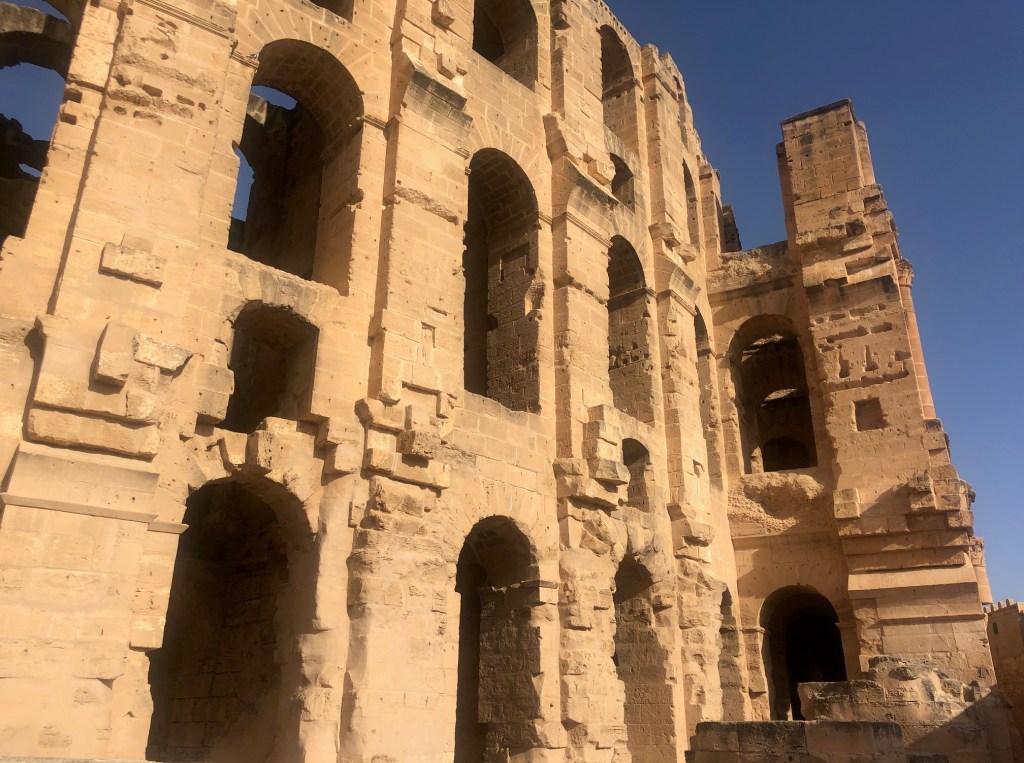
Louage to El Jem, visit well-preserved colosseum; first time I’ve seen any concentration of tourists, likely, via tour bus. Louage to Mahdia, sleepy fishing village, and light rail to Sousse via Monastir.
Five-mile loop run through Hammam-Sousse, intention is to run at least once a week, but, grow tired of running on hard surface. Walking tour of the neighborhood with hostel owner; often can’t use sidewalks, damaged, blocked by cars, construction material or debris; often walk in the street, and try not to be hit by passing cars.
SUN 24Sep: early morning louage from Sousse to Tunis, drop off backpack at hostel. Tram to Bardo Museum, tram direction not marked, get spun around at the terminal, and head in the wrong direction. Museum housed in the previous Bardo Palace, re-opened to the public two weeks ago, following two-year renovation; simply stunning, exceeds all expectations; one of the greatest mosaic collections in the world.
Cold front passes through over the weekend, fall weather; morning temperature 65-degrees, cold in a t-shirt, but, comfortable during the day, 85-degrees. Take tram to Tunis louage terminal, it is complete chaos, feels like the wild west. Louage to Bizerte, driver plays morning prayers on the radio, for the duration of the one-hour drive. Bizerte is on the north coast of Tunisia, rolling hills, trees, and grassland for agriculture, and grazing sheep and goats. Sunrise over the walled medina and old port.
Return tram to Tunis; tram cars are packed with people, shoulder to shoulder; no need to hold onto handrails. At risk of pick-pocket, my hands are in my pockets, one hand on iPhone, other hand on passport and currency. Tram cars appear fifty years old, filthy; many exit doors don’t work, other doors are missing windows. Tram fare is half dinar ($0.15 USD), no one inspects tickets, so many people don’t buy tickets, and ride for free. As Warren Buffet suggests, “price is what you pay, value is what you get.”
Tunis exceeded all expectations; definitely wish to return in the future, for three to four weeks. Tunisia has not yet been adulterated by tourism; it’s people are kind and honest; refreshing and humbling. Next time, intention is to visit Le Kef, Tozeur, Djerba, and Tataouine, likely when I return to Africa for Cairo to Cape Town train journey. While I could rent a car, louage is affordable and functional, and with enough time, it’s possible to link an itinerary through the remote northwest and southeast corners.
TUE 26Sep: shared taxi to Tunis airport, morning flight to Casablanca Morocco, no visa required. Overfly Algeria, would have liked to visit, given how much I enjoy reading Albert Camus, but, visa requires submitting passport to its embassy for approval, and not able to coordinate. Train from airport to city center, check into local hostel. Early morning, long day, dull headache.
Seven-mile walking tour of Casablanca, visit Habbous neighborhood, and the city’s Central Market. Fish monger places crate of sardines on the ground, and I watch three cats each “steal” a sardine, and run off to enjoy its breakfast. Visit Villa of Arts, small art museum, before taking the tram back to the hostel.
Tram in Casablanca couldn’t be more different than tram in Tunis. Tram cars are modern and clean; platforms well-marked; ticket kiosk in multiple language, and allow credit card payment. Employees ensure that passengers are ticketed.
Some people wonder why I schedule three nights in Casablanca, a large city, which primarily serves as transport hub. First night followed full day of travel; I was tired and saw no part of the city. Second night serves as buffer, in case of delayed or cancelled flight, this way, subsequent journey is not negatively impacted. Worst case, this leaves one day to explore, and just because Casablanca is not a tourist destination, per se, doesn’t mean that there isn’t value to visiting and exploring.
Take tram to the corniche; en route, witness modern Casablanca; soaring apartment buildings and office towers, and also pass construction site for the new US State Department, Consulate General, scheduled for completion in 2024.
Enjoyed visiting the beach at Casablanca; extreme low-tide; young adults play soccer, and the beach is dotted with umbrellas and chairs, horses and camels. I’m beating back a migraine; if I felt better, would have been a wonderful place for soft-surface run. Sound of the pounding surf, white noise, is infinitely soothing.
FRI 29Sep: three weeks ago, September 8th, 7.2-magnitude earthquake occurred in Atlas Mountains, 45-miles southwest of Marrakesh, resulting in 3,000 deaths. Airport and trains continued to operate. Contacted local hostel, and it confirmed that it was not impacted by the earthquake, so, morning train from Casablanca to Marrakesh.
Train platforms are well-signed in Arabic and French. Don’t be late to the platform, train waits less than two-minutes. Second class ticket, eight people in the compartment; air/con struggles to keep up with desert heat and intense sun. Journey takes two and a half hours, 150-miles, and arrive to a modern train station, all the while, Crosby, Stills, and Nash, Marrakesh Express (1969), rings in my ears. City’s concrete buildings are shaded to resemble the red sand desert. Check into hostel, located inside the Kasbah, and note an overwhelming number of tourists.
Visit Jemaa el-Fnaa, public square and marketplace; area comes alive in the evening, with food stalls, story-tellers, magicians, dancers, and snake-charmers. Modern buildings appear impervious to recent earthquake, most damage located within the walled medina. Rubble removed, scaffolding erected, swift efforts to repair, likely motivated by World Bank IMF conference scheduled for October in Marrakesh. Temperatures are hot, reach 100-degrees (F) by mid-day, time to go indoors.
Cost:
Track cumulative travel costs, 159-days.
Lodging: $3,500 total | $22 day
Transport: $4,902 total | $31 day (plane | train | bus | ferry | taxi)
Food: $365 total | $2 day
Other: $1,616 total | $10 day (FX | ATM | visa | tourism | other)
Total: $10,383 total | $65 day | $23,835 annualized
Conclusion:
Look ahead, ferry from Tangier, cross Strait of Gibraltar; train to Madrid; visit Lisbon Portugal, high-speed train to Barcelona, high-speed train to Paris, Eurostar to London.
If I travel long enough, reminded of the illusion – and fallacy – of control. I control and influence very little. Airports are civil and organized, an Uber, at the click of a button.
Cairo train station wasn’t civil, and Cairo bus depot was somewhere between bedlam and chaos. Rely on help from others, from strangers, to find my way and not get lost.
Just one step from the dangerous thin ice. Civility and order held together by a delicate thread, fragile and tenuous. Its uncomfortable and unsettling when staring into the dark abyss. When I rail against reality, it becomes infinitely stronger. Is it possible to breathe into this space, to accept, to not reject.
 garthmonroe