Introduction:
Three weeks to explore the Middle East: Lebanon, Jordan, Israel, and Palestine. Earlier this summer, rocket attacks punctuated the region, among Israel, Palestine, and Hezbollah in southern Lebanon, humans behaving poorly. It’s difficult to visit the region without forming an opinion, and at the risk of offending readers, if the impressions below are misguided, the fault is entirely mine.
Some elements of the trip appear in “The Daily” including a mishmash of topics. Photo gallery has trip images, captions available when viewed in slide show mode.
SAT 01 July: Göreme Turkey, is located in the Cappadocia region, where soft volcanic rock is eroded into towers, cones, valleys, and caves. Awake at 3am, shuttle pickup at 4am, hot air balloon lifts off at 5am. Calm wind, clear skies; quietly soar over the region’s picturesque valleys. Female pilot skillfully lands the 20-person basket on to its tow trailer, and on the ground at 6am. Ground crew deflate and re-pack the balloon; champagne toast, and back to the hostel by 7am.
After breakfast, visit Open Air Museum, collection of churches and caves, carved into the soft, volcanic rock. It’s mostly underwhelming, my breath shortens, and feel claustrophobic entering the small caverns. As the four-day Eid al-Adha holiday draws to a close, many Turks return home; Göreme becomes eerily quiet.
My life resembles riding in a hot air balloon, ride high for an hour, not a care in the world (except anxious about dropping iPhone). Back on the ground, the balloon sags and deflates, and dysthymia descends, too. Likely overtired – two early mornings, two long days – doesn’t help. Quotation on hostel wall: “feelings are like waves, we can’t stop them from coming, but, we may choose which ones we surf.”
In the middle of the night, hear a cat crying in the dorm room. Wonder if someone is traveling with a cat. In the dim light, and without my contact lenses, see the silhouette of the cat’s tail, like a whip antenna. Get out of bed, and let the cat outside.
Coffee in the morning on hostel rooftop deck. Sky is streaming with hot air balloons; they drift effortlessly, and almost silently, through the valley.
It’s early morning, walk out of the village, wear running shorts and tank top. Approached by a local man, he shakes my hand, and gives cheek-to-cheek bear hug; his friends take our picture. No words are exchanged, just a smile and a handshake.
Reach the trail head, run south on Love Valley trail towards town of Uçhisar, and run north on Pigeon Valley trail. There is little shade; the sun is intense in this arid, desert-like environment. Treated to close-up views of the region’s unique geography. Some parts of the trail are steep, other parts are dusty and slippery, and parts of the valley basin are muddy following brief thunderstorms last week. After completing the 8-mile run, treat myself to cold shower and hot coffee.
TUE 04 July: last bus of the day, Göreme to Kayseri, 9:00-10:00pm. No mini bus; walk 6-miles from otogar to train station; lightening flashes in the sky, there is no shelter if the sky opens up. Arrive Boğazköprü station at 11:30pm, less of a train station, and more of a station stop; train staff is surprised. Staff are kind, and point out a long couch. 1:00am, thunderstorms pass overhead. In the morning light, spy Mount Erciyes, at 4,000-meters, its peak remains snow-covered year-round; this now dormant volcano gave rise to Cappadocia’s fairy chimneys.
Train dispatcher wishes me well, shakes my hand, and I stand on the tracks, so that the train knows to stop and pick me up. Train from Kayseri to Adana is named, the Erciyes Express, but it’s hardly express; takes six hours to travel 200-miles south. Pass rugged mountains and snow-covered peaks, and fields of smiling, golden sunflowers. Ambient temperature is 92-degrees; air conditioning stops working; train car becomes uncomfortably hot. Short walk, and check into AirBnB.
Next morning, walk 4-miles to otogar, 1-hour bus to Mersin, on Mediterranean coast. AirBnB host picks me up at the bus station. Weather is hot and humid, makes it difficult to go out during the day; morning or evening is best.
Coffee in the morning, stand on tenth floor balcony of the apartment building; some residents sleep outdoors, on their balconies. Morning temperature 74-degrees (F), dew point 74-degrees (F); five mile run along the water front, miserable experience.
Find local barber shop; experience is a rich, cultural exchange. Waiting for the “master” barber, assistant brings hot tea, provides back massage, and cracks my knuckles – although – it felt like he was breaking my fingers. Barber spoke functional English, well-traveled, and shared his photos. Barber is surprised that I want my hair shaved off, but, it hides the gray. Barber and his assistant treat me like a rock star, they appear to be pleased to have an “Amerikan” tourist in their shop; before departing, I shake both of their hands. Turkey exceeded any and all expectations; its citizens were consistently kind, generous, and helpful during my month-long visit.
SAT 08 July: short, 2-mile walk to Adana airport; it’s underwhelming, doesn’t resemble any airport in my previous travels. It is air conditioned, and no cigarette smoking; pleasant surprise. Use restroom, there are squat toilets, smell is overpowering, begin to gag. Children run around un-attended, screaming, like it’s a day care; its either a form of hell, or, hell of an argument for birth control.
It used to be possible to drive from Turkey, through Syria, to Lebanon. Pre-COVID, there was a ferry from Turkey to Lebanon. Resigned to fly, Turkish Airlines, one-hour. Share flight information with twin brother, and emergency number for US State Department (888.407.4747); coordinate with local consulate if there is an incident.
There is only one, pasty tourist on-board the flight; clear customs by 9:00pm, but not before customs reviewed my passport, likely looking for evidence of travel to Israel. There is no public transportation; begin walking to hostel (6-miles). Exit the airport, and asked if I want a taxi (should cost $20 USD); quoted $35, than $20, than $15. Counter with $10, he argues, I tell him that I’m stubborn and don’t mind walking. He relents, first taxi since arriving in London (4/25).
Welcome to the Republic of Lebanon, and welcome to a cash-based economy. Travelers are advised not to use credit or debit cards. Cash is king – specifically – the US dollar. Lebanon has faced economic and currency instability since 2019, after defaulting on Eurobond debt. At the time, government-mandated exchange rate was 1,500 lira. Parallel “black market” (street) exchange rate ensued. In February 2023, government revised exchange rate to 15,000 lira, at the same time, black market exchange rate is 90,000 lira. Create an account with Western Union – locations around the world – and transfer $500 from debit card and receive US dollars in Lebanon. Transaction takes minutes, first transfer is free, except for 2% commission. Last year, US inflation peaked at 9% prior to the Federal Reserve increasing interest rates. At the same time, inflation in Turkey peaked at 40%. Inflation in Lebanon is a scorching 200%. Am I not privileged to have been randomly born in the United States.
It’s impossible to not feel sympathy for people that can’t escape endemic turmoil. Lebanon is a region known to strife, including 1975-1990 Civil War, and fighting among Syria and Israel. October 1983 – forty years ago – the Marine Barracks located at the airport was detonated by a Hezbollah suicide truck bomb that killed 220 Marines. Beirut is known as a food oasis; Anthony Bourdain visited the region in July 2006, and evacuated, with all Americans, by the US Navy and US Marines to the island of Cyprus, following the Israel-Hezbollah War.
Travel isn’t always pretty, it isn’t always comfortable. Sometimes it hurts, it even breaks your heart. But that’s okay. The journey changes you, it should change you. It leaves marks on your memory, on your consciousness, on your heart, and on your body. You take something with you. Hopefully you leave something good behind.
– Anthony Bourdain
There are rolling blackouts in the city, and even with a diesel generator on the street, the hostel has only 15-18 hours of electricity per day. Walk through the city, explore historic neighborhoods of Hamra, Mar Mikhael, and Gemmayzeh; the nice parts of Beirut don’t make up for the unsavory parts of Beirut, but, simply magnify the difference between the haves and have nots. Walk past more gutted store fronts than I can count on my fingers, and often re-directed by bands of concertina wire that aren’t marked on Google maps.
Visit Nicolas Sursock art museum, which re-opened in May 2023, following the August 2020 port of Beirut explosion – largest non-nuclear blast in history – caused by 1,500 tons of improperly stored ammonium nitrate. Shock wave blew out the front of the museum, and destroyed many of its art pieces. Wonder if my high school history teacher, Elias “Lou” Hage, born in the United States to Lebanese immigrants, had the privilege to return to his family’s homeland, I hope so.
Small group tour to visit sites outside the city, including: Jeita Grotto, Harissa, and Byblos. Day trip included ground transportation, entrance fees, and lunch ($85 USD); couldn’t travel independently for any less. One guest visited family in Damascus Syria, and shared that travel risks are overexaggerated, although visa required six weeks.
THU 13 July: tuk tuk to the airport ($5 USD), overnight at the airport, and brief, one-hour flight to Amman Jordan. Prior to entering the Kingdom of Jordan, purchase Jordan Pass on-line ($100 USD); cost includes visa on arrival, and entry to most museums and sites of interest. Flight serves light breakfast, but no coffee; after clearing customs, purchase small coffee at Starbucks, first since my birthday. Caffeine hit is palpable; I feel like a superhero.
Difficult to coordinate public transportation, and didn’t want to take a tour, so pick-up a rental car, Hyundai sub-compact with manual gearbox. Intention is to pick-up any stray backpackers, to repay any travel karma debts. Exit highway towards Wadi Musa, and stop for a western-dressed hitchhiker in the 104-degree sun. His name is Mohamed; he’s grateful for the ride, and grateful for the air conditioner.
Wake early the next morning, enter Petra when it opens at 6am; sandstone is still warm from the prior day. Through the narrow slot canyon, spy the iconic Treasury, and continue hiking to see the Monastery and Lion Triclinium. Sun crests the canyon wall, and the temperature increases. There are horses and mules; manure attracts black flies, and stray dogs are a nuisance. Hike 8-miles; finish at the museum by 10am.
Arrive at Wadi Rum Protected Area the following morning, for desert jeep tour and overnight camp with the Bedouin. Magic of the desert doesn’t present itself until after sunset. There is no light pollution, and the stars shine bright. There is no noise pollution, and the silence is deafening, my ears ring. 24-hours with iPhone turned off, a welcome break from email, text, phone calls, podcasts, and the internet.
Following morning, drive south to Aqaba on the Red Sea; it’s an industrial port city. Is it possible to spy Egypt and Saudi Arabia through the 105-degree hazy sky. Next day, drive four hours north, back to Amman, return rental car.
WED 19 July: one-hour bus from Amman, cross border into Israel at King Hussein (Allenby) Bridge, and shared van to Jerusalem. Neither Jordan nor Israel stamp my passport, which would preclude entry into almost every Arab nation. Need to plan ahead; border is closed from sunset Friday through sunset Saturday, for Shabbat.
Hostilities among Israel, Palestine, and Hezbollah are more aggressive and more frequent than in prior years; an eye for an eye makes the entire world blind,
Hour train to Tel Aviv, a modern, cosmopolitan city, with glass and steel skyscrapers rising from the beach; old section of the city, Jaffa, feels like stepping back in time.
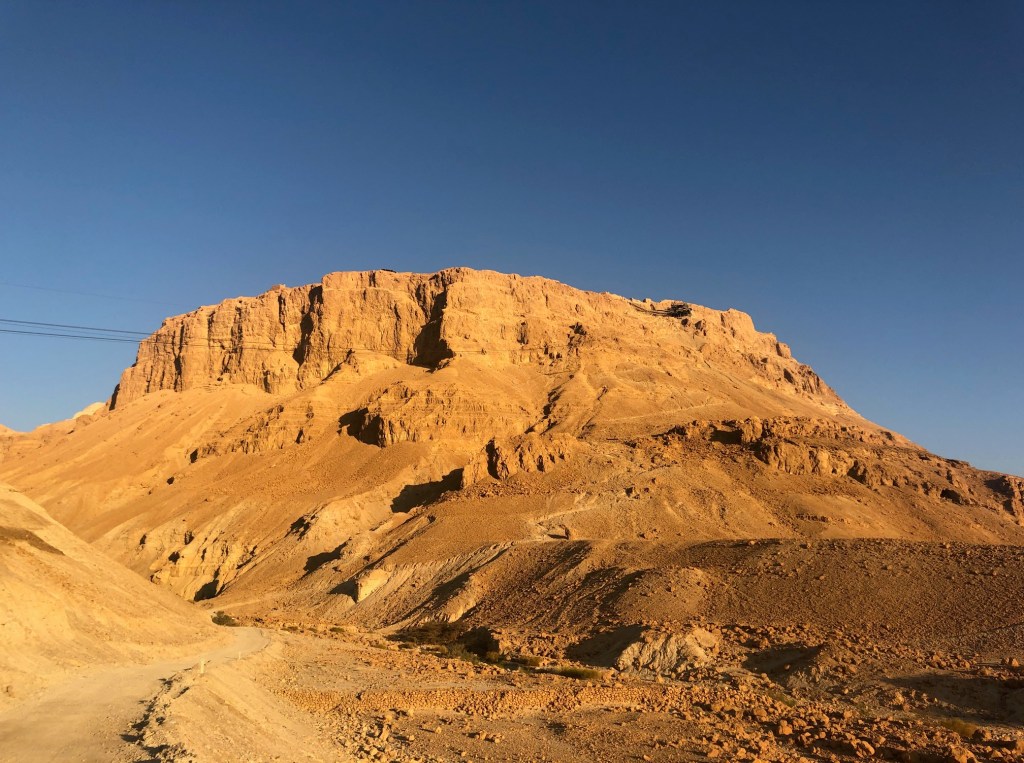
Day trip from Jerusalem, sunrise Masada hike; van pick-up at 3:30am, arrive 4:45am. It’s good that the sky remains dark, and can’t see the peak, elevation climbs 400-meters (to sea level) in the span of 1.5-miles; I’m competitive – Marines lead from the front – and I’m the first person to the summit in the 85-degree heat.
Continue to Ein Gedi National Park, a wildlife desert oasis in the Judaean Desert. Mid-morning, head to the Dead Sea, at 400-meters below sea level, it’s the lowest point on earth. Salinity is 35% versus 3% for the world’s oceans; it’s impossible not to float in the water. During the past century, water surface area reduced 50%, from 1,050 km2 to 500 km2. Dead Sea region is ugly, and not dissimilar to the Salton Sea located south of Palm Springs, California, and east of Anza-Borrego Desert State Park.
West Bank, one of two Palestinian territories (second is Gaza Strip), runs along West Bank of the Jordan River, and marks the boundary with Jordan, following the six-day Arab-Israeli War of 1967. Palestinian-occupied cities include: Hebron, Ramallah, Bethlehem, and Jericho, among others. Cities are identified as Zone A, B, or C, which indicate responsibility for security or infrastructure. Hebron is unique, and divided into Palestine-occupied H1 zone (80%) and Israel-settler H2 zone (20%); Israel controls all security access points, including Palestinian access to Ibrahimi Mosque.
Passed through Israeli-controlled checkpoints, and visited both H1 and H2 regions. Palestinians are human – no different than you or me – going about their lives. Extremists on the margin – Hamas – give rise to violence and terrorism. Border wall between Israel and Palestine is far more intimidating than any portion of the border between United States and Mexico.
Palestinian treatment is northing short of apartheid, policy of segregation and discrimination. Of 193 members of the United Nations, 139 recognize Palestine. United States does not recognize Palestine, and provides almost $4-billion in annual aid to Israel, largely in the form of military aid and missile defense; to what extent does this aid perpetuate apartheid. It’s difficult to not view Israel as anything other than a school-yard bully, with the United States in its back pocket.
State of Israel formed in 1948, following World War II, and extermination of six-million Jews during the holocaust. State of Israel is 75-years old; region is marked with political and religious conflict; it’s difficult to see any path to peace. While responsibility doesn’t rest entirely with Israel – United States plays a role, and Arabs, too – fail to understand how apartheid is perpetuated; do we not learn from history.
THU 27 July: shared taxi from Damascus Gate to King Hussein (Allenby) Bridge at the Jordan border. Israelis are not permitted to cross at this border. Palestinians are not allowed to fly through Ben Gurion Airport in Tel Aviv; many Palestinians cross at Allenby Bridge to fly through Queen Alia Airport in Amman. Contrary to on-line travel reports, there was no mini bus to Amman; Canadian traveler was picked up by friends from Amman – travel karma – they had space in their car, and drove me into the city.
Cost:
Cumulative travel costs, during the past 98-days.
Lodging: $2,246 total | $23 day
Transport: $2,122 total | $22 day (plane | train | bus | ferry | taxi)
Food: $199 total | $2 day
Other: $1,343 total | $14 day (FX | ATM | visa | tourism | other)
Total: $5,910 total | $61 day | $22,300 annualized
Conclusion:
Don’t anticipate returning to Lebanon or Jordan, but, there is more to uncover, learn, and discover in Israel and Palestine. In hindsight, should have stayed longer in Israel, likely, four weeks; time to explore Gaza border region in the west, Eilat in the south, Palestine in the east, and Golan Heights in the north. Golan is recognized by the international community as Syrian territory, illegally annexed and occupied by Israel. United States, in 2019, is the only country in the world to recognize Israel sovereignty, a decision denounced by the United Nations. It’s often suggested that Israel is “America’s aircraft carrier to the Middle East.”
Traveling overseas, American tourists become the face of United States foreign policy, often viewed as aggressive and heavy-handed; I become the ugly American.
Fires burn on the Greek island of Rhodes; central part of the island, home to the butterfly sanctuary; with its pine forests and winding roads, enjoyed traveling this region on motorcycle; it’s likely that my travels would have been impacted.
August 1st, onward flight to Kuwait, visit Arabian Peninsula. Plan to visit my niece, Samantha, who lives and works in Dubai. Saudi Arabia, used to be a “closed” nation, is now open to tourists. Weather will be hot, 115 (F) in Kuwait; will do the best that I can.
Three months have quickly passed, three months remain; nine countries visited, eleven countries remain. Travel is neither good or bad, but thinking makes it so. Travel often includes a certain amount of friction, credit card or ATM not working, public transportation going sideways, getting short-changed at the market, it’s just the cost of travel; but also recognize that I’m quite privileged.
 garthmonroe