1. Introduction:
I don’t like pictures of myself, one of the reasons that I don’t have an Instagram feed. Don’t take pictures of myself when traveling, and don’t like posting pictures of myself on the blog.
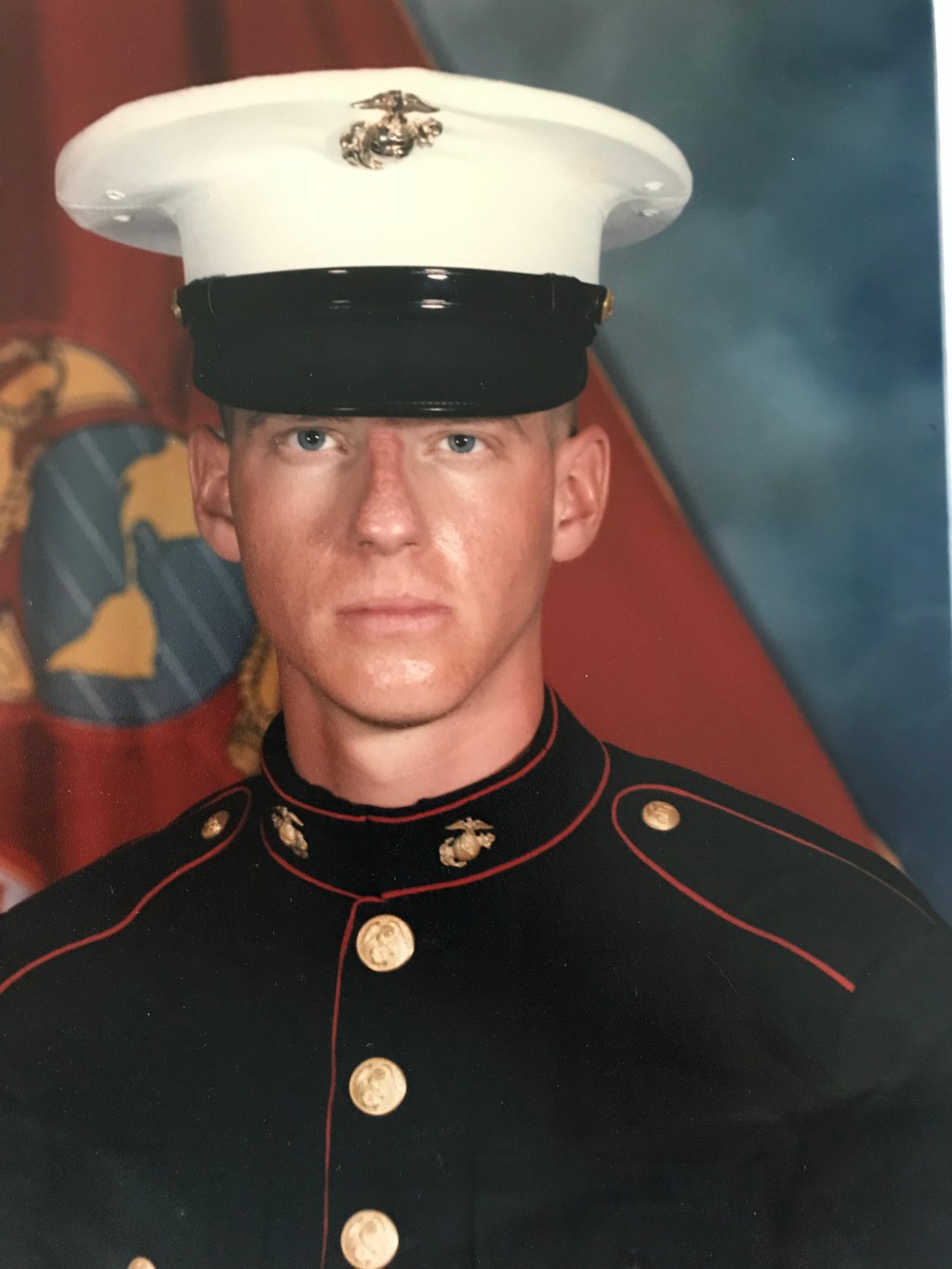
This 29-year old picture is the exception. For the people that find it hard to believe that I served in the Marine Corps, here ya go.
It’s a bit of a classic picture. Whenever a former Marine commits a crime, newspaper editors often locate this boot camp picture, as it makes its way into the newspapers.
The picture has a funny backstory; before taking the picture, me, and 89 other recruits were training in hand-to-hand combat, fighting with pugil sticks beating the tar out of each other.
The other, is that in this picture the dress blue jacket only covers my chest and shoulders.
When I enlisted, I went to the recruiting office, shared by the Army, Navy, Marines, and Air Force. The Marine recruiter was away; I waited for his return, and ignored the other recruiters. Completed the physical, signed-up, and shipped off to boot camp six weeks later. I didn’t tell my family and friends that I enlisted until after I signed-up; I didn’t seek anyone’s permission; I didn’t ask for anyone’s opinion. Oh, may I get a ride to the airport?
If you ask my high school graduating class, I was probably the least likely person to enlist in the Marines, but no regrets. I have made many mistakes in life, enlisting wasn’t one of them.
2. Boot camp:
I enlisted from Michigan, and was shipped off to Marine Corps Recruit Depot (MCRD) San Diego, located adjacent to the airport. The drill instructors pick up the recruits at the airport, which was a surreal experience. Given the presence of civilians, the drill instructors were almost polite, but, with a foreboding sense of dread, like that of an approaching hurricane.
After arriving, the physical exam was repeated, perhaps, to keep everyone honest. I’m very near-sighted, and I failed the eye exam. The eye doctor stood up to leave, and told me that he would return in five minutes. I got up and memorized the eye chart on back of the door. When he returned, I simply regurgitated the letters that I memorized. He kicked me out of the exam room, and I continued on with my military indoctrination.
My civilian eyeglasses were replaced by military eyeglasses, commonly referred to as birth-control glasses because the eyeglasses are so ugly, there is no chance that a person would hook-up with a romantic partner.
I kept a pair of contact lenses with me, and put them in the night before graduation. The morning of graduation, my drill instructors wanted to know why I wasn’t wearing my glasses.
Boot camp was physically and mentally challenging. The platoon had 90 recruits and six drill instructors, so there was no shortage of “wrath.” I don’t like heights, which made the “slide for life” a challenging experience. There was a lot of hand-to-hand combat training; boxing opponents squared off in a space no larger than a stand-up shower. The intention is to eliminate “dancing in the ring” and to encourage punching. Hand-to-hand combat included a series of throws and blows to disable an opponent; the training took place in large sawdust pits. I must have been paired up with a recruit twice my size, who tossed me around like a child’s stuffed animal.
Recruits endured “island hopping” campaigns, not dissimilar from World War II. These were sand pits, named after the same islands during the war; Tarawa, Guadalcanal, Iwo Jima. Drill instructors would “punish” recruits in these pits with extra physical training. After getting hot and sweaty, drill instructors would order recruits to “shake and bake” which means, dropping to the ground, and rolling in the sand so that it sticks to one’s body. At other times, drill instructors would order recruits to “make it rain” which means, grabbing handfuls of sand, and throwing it in the air, so that when it lands, it sticks to one’s body. Good times.
Every Marine is a rifleman. I never touched a weapon until I enlisted. I was taught safe weapons handling, and the fundamentals of marksmanship. The M16A2 service rifle is designed for right-handed shooters. The rifle’s ejection port, that ejects the hot, brass cartridge casing, is on the right side of the weapon. For a left-handed shooter, like me, this means that the hot brass is ejected across my body. Shooting in the prone position, it was not uncommon for the hot brass to land down my shirt, where it would stick to the skin and burn. Often times, you would see left-handed shooters on the firing line, jittering like a crab, much to the amusement of other Marines.
I was never fantastic on the rifle range; I qualified, but I wasn’t going to impress anyone, firing at a man-sized target at the 200 (seated, kneeling, standing), 300 (seated, kneeling), and 500-yard line (prone). At the 500 yard line, I swore that other people were shooting at my target, to ensure that I scored enough points to qualify each year. One of the challenges was firing with eyeglasses, which adds a third focal point, in addition to the front and rear sight apertures (target | front sight | rear sight | eyeglasses). By my fourth year, I found that I fired with greater accuracy wearing contact lenses, which was generally discouraged.
Stanley Kubrick’s, war drama film, Full Metal Jacket (1987), paints an interesting portrait of Marine Corps boot camp, and was certainly a breakout role for actor Vincent D’Onofrio.
3. Combat training:
After graduating from boot camp, I had two weeks off to visit my family, before returning to Marine Corps Base Camp Pendleton for a month of combat training.
Instead of getting assigned to a training platoon, I was assigned a month of mess duty in the kitchen, working 16-hour days, six days a week (2:00am – 6:00pm). I was assigned to the salad room, to prep vegetables for cooking. I got in trouble, along with several other privates, for playing with the sharp kitchen knives. We were re-creating the infamous shower scene, from the movie, Psycho, by Alfred Hitchcock. We were assigned a double shift (day and night) due to our misguided sense of humor.
After completing a month of mess duty, I was assigned to my combat platoon for training. I wasn’t feeling well, but didn’t want to be further delayed in my training, so I said nothing.
I was standing in formation, at attention, and I became incredibly nauseous. As carefully as possible, I puked in front of me, trying not to spray the Marines to my left or right. At this point, the troop handlers recognized that I was indeed sick, and I was allowed to return to the barracks early. For the duration of training, I was nicknamed “old faithful.”
It was a dry, hot fall in October 1993 in southern California, exacerbated by the strong Santa Ana winds. Laguna Beach was ravaged by fire, and the smoke would drift over the Marine base. During the evening, the sky was lit by burning flames. We didn’t have access to news, and the young Marines would often yell out “fire fire” quoting the animated cartoon, Beavis and Butt-head, for which, we would often get into trouble.
When the troop handlers were displeased with the platoon, we would often be punished with bloody knuckle push-ups. Instead of doing push-ups with palms down, make a fist, and push the knuckles of your hand into the ground. The troop handlers would lead us to a gravel pit, or, have us perform push-ups by placing our knuckles into our M16A2 rifles.
One day – maybe the troop handler was having a bad day – we were on our faces, doing bloody knuckle push-ups. A Kevlar helmet fell loose and started to roll away. The troop handler picked-up the helmet and threw it in anger. The helmet hit a young private in the head, and started to bleed profusely. He was taken to sick bay, and returned later in the day. We never again saw that troop handler.
4. New Orleans:
My first duty station was NSA New Orleans, arriving in fall 1993, when the weather is reasonable; a break from the heat and humidity.
We had physical training almost every morning. Some of my initial opportunities to lead the platoon was during physical training, where I learned to project my voice and develop command presence. We would either do formation runs or individual, best effort runs. On the individual runs, I was usually one of the “rabbits” that the rest of the platoon would chase. I usually ran 3-miles in 19-minutes. During the formation runs, I would get called out last to “sing” cadence. I made sure that I had some “colorful” cadence that would motivate and entertain the Marines. I recall that more than one Marine fell out of formation from laughing so hard. Once, my commanding officer pulled me aside because my cadence was a bit too ribald.
I was promoted to corporal, a non-commissioned officer (NCO), in December 1994, after only 18-months of service. The promotion is a big deal, and adds the “blood stripe” on the trousers of the dress blue uniform.
My colleagues took me down to Bourbon Street to celebrate. I was pretty sick by the time that I returned to the barracks, and likely woke up many people getting sick afterwards.
5. Okinawa Japan:
While stationed in New Orleans, I applied for embassy duty, to serve as an embassy guard overseas. My application was denied, and instead, I received orders to Okinawa Japan, the southernmost prefectural island. I was stationed at Camp Foster, and subsequently promoted to sergeant.
One morning, the platoon played football in lieu of physical training. During one play, I jumped to catch the football. Another Marine jumped higher and caught the ball. When he came down, his elbow landed in my eye, sending me to the ground. By the time that I got to my feet, the eye was swollen shut.
I walked to base medical. I was admitted with little concern until I informed the corpsman that I was wearing contact lenses. The doctor wanted to remove the contact lense. I didn’t want him touching my eye, so I removed the lense, patiently. The eye was fine, no permanent damage, other than a splitting headache.
I had a bicycle with me on Okinawa; it was a great form of public transportation. It wasn’t fancy, a heavy, old Diamond Back. I could ride into Naha, the capital city, faster than a car or bus, due to the traffic congestion. I took great pleasure in passing vehicular traffic.
During the summer, the platoon deployed on the USS Belleau Wood (LHA-3), an amphibious assault ship, with 2,000 sailors and Marines, for training exercises off Vladivostok Russia. We were transported to the ship via the twin rotor helicopter, CH-46 Sea Knight. On board the ship, it was always best to stay out of sight from the Chief of the Boat (COB), or else, get assigned to mess duty, laundry detail, or scraping and painting.
We also deployed to Australia, flying 18-hours south to Darwin, and continuing on to Perth, on board the C-130 Hercules, a four-engine turboprop. There are no seats on the aircraft, you strap yourself into a nylon cargo net. There’s not much for temperature control either, the aircraft is either scorching hot, wreaking of jet fuel, or freezing cold.
As my enlistment came to an end, I was flown back to Los Angeles, to be honorably discharged from Camp Pendleton. I was jet-lagged. Marines honorably discharged receive a plane ticket to their home of record. Marines dishonorably discharged, receive a bus ticket, adding insult to injury.
6. Conclusion:
I worked with some good people during my four-year enlistment in the Marine Corps. It was before the days of email and smart phones, and fell out of touch with many. I stayed in touch with my commanding officer, Robert, until his death from leukemia. He wrote my recommendation letter to attend university. I stay in touch with my friend, Grady; we visited together in spring 2019, outside of Kansas City Missouri.
The Marine Corps is a physically demanding experience, I’m not confident that my body would have sustained a twenty or thirty year military career. I wonder if I would have enjoyed a career in the Navy. Perhaps I would have become bored, or fatigued of the bureaucracy.
My enlistment occurred during a relatively peaceful period, 1993-1997, with the exception of Mogadishu Somalia (ie. Blackhawk Down). We cleaned our weapons or physical training.
When I pass through the airport, and see 20-year old men and women in a service uniform, it’s hard not to feel a sense of compassion for what they may experience; multiple combat tours in a single enlistment, and the threat of being killed, maimed, or suffer post-traumatic stress disorder (PTSD). Wouldn’t wish this on another human, but, freedom isn’t free.
Semper Fidelis
 garthmonroe