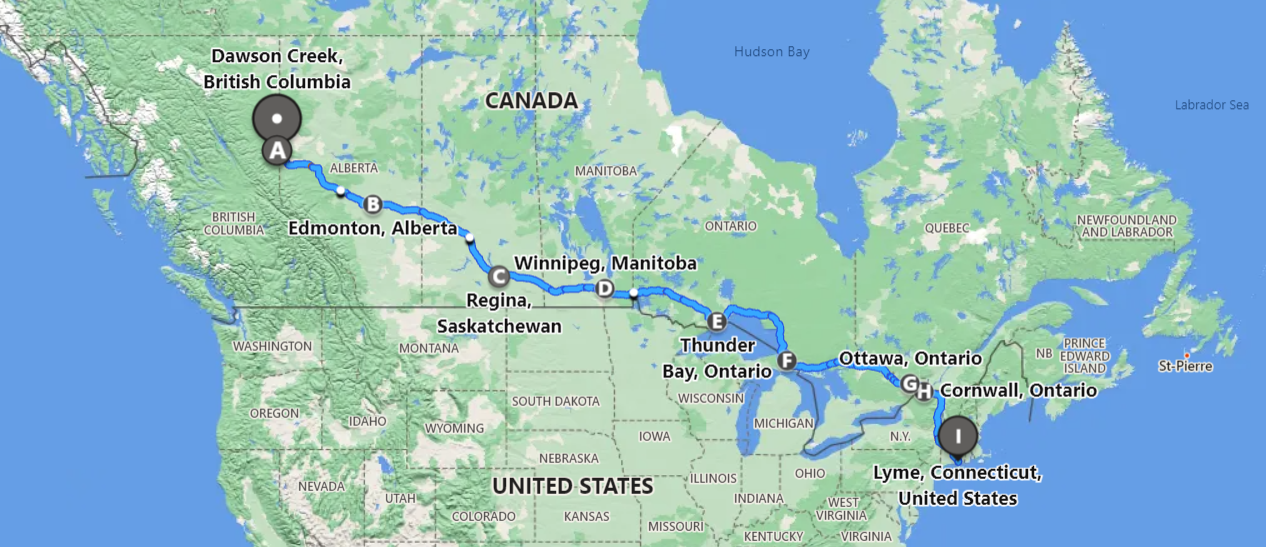
Monday (August 1st), drove seven hours, 375-miles along Highway 16, from Dawson Creek, British Columbia to Edmonton, Alberta; heavy morning fog, due to overnight thunderstorms. Edmonton is the provincial capital, population of 1-million; economy is driven by oil and gas.
Arrived in the city center before mid-day, laptop work at local Starbucks; local library was closed, due to Civic (federal) Holiday. Checked into HI Edmonton, large hostel in the city center; the hostel appeared to host more than a dozen refugees from Ukraine.
Town of Red Deer lies between Edmonton and Calgary. The region had thunderstorms Monday night, with baseball-sized hail, that smashed out the windows of at least 50 cars on the highway. Could have been me; just one step from the dangerous thin ice.
Driving south, its worth noting that gas stations don’t resemble those in the lower 48. In several locations, gas stations didn’t have concrete pads, but rather, some form of dirt, gravel, or mud; for example, in Coldfoot AK, Deadhorse AK, Dawson City YT, Watson Lake YT, and even along the Trans-Canada Highway.
Tuesday (August 2nd), drove nine hours, 500-miles along Highway 16 to Regina, Saskatchewan, provincial capital with 250,000 people. The area is a treeless plain; economy is driven by oil and gas. Local library was located inside a nearby shopping mall; worked on laptop before checking into AirBnB.
As I was driving east, Pope was finishing his week-long trip to Canada; first papal visit since 2002; Pope apologized for the Church’s treatment of Canada’s Indigenous people.
Canada’s Truth and Reconciliation Commission issued a 2015 report documenting that the nation’s policy toward Indigenous peoples amounted to cultural genocide, through the use of residential schools, 70% operated by the Catholic Church, and attended by more than 150,000 children; the last residential school was closed in the 1990s.
Children were banned from speaking their own language, and Indigenous spiritual practices were prohibited. The schools were designed not to educate, but rather, to break cultural traditions, under the assumption that European civilization, and Christian religion, were superior to Indigenous culture.
Canada has paid billions of dollars to Indigenous communities as part of a settlement with some 90,000 survivors of the residential schools. Canada’s Catholic Church says its dioceses have paid $50 million to the tribes and expects another $30 million in coming years.
Wednesday (August 3rd), drove 6-hours, 375-miles, along Highway 1, to Winnipeg, Manitoba, provincial capital with 750,000 people. Passed enormous fields of yellow flowers, which I learned was canola, which will be harvested and converted into canola oil. Laptop work at the local library; one patron came in and wanted to know who was from driving from Texas, a long way from home. I had an AirBnB reservation; the host cancelled, with no explanation; AirBnB provided a $25 credit, so that I could re-book.
Thursday (August 4th), drove 450-miles to Thunder Bay Ontario, on the north side of Lake Superior. Passed through the small town of Redditt, Ontario, no relationship to the Reddit discussion board.
Should note that driving across Canada, that the highway does not resemble the interstate highway in the lower 48; it’s often a two-lane undivided highway, with many tractor trailers. There are few rest stops, and few gas stations, so it’s important to invoke the half-tank rule. The drive is tiring; 5,000-miles from Alaska to Connecticut, averaging 400-miles per day.
Stayed at Haven Hostel, a re-purposed industrial building, with a fantastic sense of community; enjoyed talking with the owner, Holly; would have enjoyed staying several days.
Friday (August 5th), drove 425-miles to Sault Ste Marie, Ontario, city of 75,000 people. It used to be one city, with Sault Ste Marie, Michigan; following the War of 1812, the city was split into two, joined by the International Bridge. The drive hugged the coast of Lake Superior, the largest of the Great Lakes. The freighter Edmund Fitzgerald, sunk in Lake Superior during a winter storm in November 1975, in Canadian waters near Whitefish Point.
Saturday (August 6th), drove 500-miles, nine hours, to Ottawa, Ontario; first time that I returned to Ottawa in eleven years. Met my friend Cindy for brunch, and enjoyed meeting her husband and daughter. Cindy used to work for me at Epocal; she was responsible for ERP cost accounting, ensuring that inventory quantities and costs were correct, a challenging role for an early-stage, commercial company.
In the afternoon, met up with my friends, Les and Emma; Emma made a wonderful dinner. Les and I lived in the same house when I worked for Epocal; grateful to have stayed in touch all these years. He was one of the best parts of living in Ottawa – like family – it was a wonderful day to catch up.
Sunday (August 7th) drove 500-miles south to Connecticut, through Montreal and Vermont, and stopping at the local Whole Foods Market, before arriving at my parents home in Lyme Connecticut, at mid-day. Unpacked the car, cleaned the car, and did some yard work. The day was hot and humid, likely the hottest day that I experienced all summer.
US has an area of 3.8-million square miles; population density of 87 people per square mile. Canada has an area of 3.9-million square miles; population density of 11 people per square mile; 90% of Canada’s population lies within 150-miles of US-Canada border.
Canada
Population: 39-million
Economy: $2-trillion
Toronto: 5.7-million
Montreal: 3.7-million
Vancouver: 2.4-million
Calgary: 1.3-million
Edmonton: 1.2-million
Ottawa: 1.0-million
Sub-total: 15.3-million
United States
Population: 330-million
Economy: $25-trillion
New York City: 8.5-million
Los Angeles: 3.8-million
Chicago: 2.7-million
Houston: 2.3-million
Phoenix: 1.6-million
Philadelphia: 1.6-million
Sub-total: 20.5-million
Monday (August 8th), flattened by a migraine; likely sleep deprived – 15 to 20 hours – over the course of driving from Alaska to Connecticut. I was getting up between midnight and 3am to finish driving by mid-day; allowing time to do several hours of laptop work before checking into AirBnB or hostel. Woke up Tuesday (August 9th) feeling better.
Travel costs:
Traveled for 90-days (May 9th – August 8th); trip cost $11,067 ($122 per day); likely the most expensive travel in my lifetime; $45,000 annualized basis; $60,000 pre-tax basis.
Lodging: $3,814 | $42 per night
Ferry: $2,557 | Seattle > Haines | Homer > Dutch Harbor
Gasoline: $1,954 | Details below
SUV: $1,280 | Fairbanks > Prudhoe Bay, round-trip
Charter: $750 | Dutch Harbor > Anchorage
Other: $591 | Shuttle to Wrangell; flight to Homer; tours
Food: $121 | $1 per day
Total: $11,067 | $122 per day
Gasoline:
Sharing additional commentary, given high gasoline price this summer. Drove 15,812 miles, averaging 40.2 miles per gallon (2.49 gallons per hundred miles); used 394 gallons of gasoline, at an average price of $4.96, and median price of $5.05. Likely paid a gasoline premium of $800; more than I would have preferred, but not material to overall trip cost.
Commentary:
Four months in Mexico cost $2,000; three months in Alaska cost $11,000. Alaska’s physical isolation makes it more expensive, but it was a great experience; I feel that I have a greater perspective for its people and geography, and appreciated a trip that wasn’t hurried.
It was an easier trip, speaking English; my Spanish skills (in Mexico) are functional at best.
It was also beneficial being able to use my own car, versus public bus. I saw many people in Alaska using Turo, a peer-to-peer car rental service, not unlike AirBnB for lodging.
Enjoyed staying in hostels rather than AirBnB; appreciated the sense of community and social interaction. In Mexico, used AirBnB, out of an abundance of caution, due to the surge in Omicron at the time. Stayed at a few AirBnB driving the Trans-Canada Highway, when hostels weren’t available. After checking-in with the host, there was very little interaction.
Lastly, while food is 35% more expensive in Alaska than the lower 48, I had better access to food and healthy fats, so pleased to share that I didn’t lose any weight in Alaska.
Other thoughts:
A critic is someone who enters the battlefield after the war is over and shoots the wounded. – Murray Kempton (journalist)
Hating ourselves is the easy bit. Learning to give ourselves a break is the true, rare, and proper adult achievement. – Alain de Botton (School of Life)
 garthmonroe