
Monday (July 18th), six-mile trail run along Chester Creek Trail in Anchorage, followed by laptop work at local Starbucks. After a break in the rain, hiked Flat Top Mountain (4-miles round-trip, 2000-feet elevation gain), outside the city, and one of the most frequently climbed mountains in Alaska, which provides views of Anchorage and Cook Inlet.
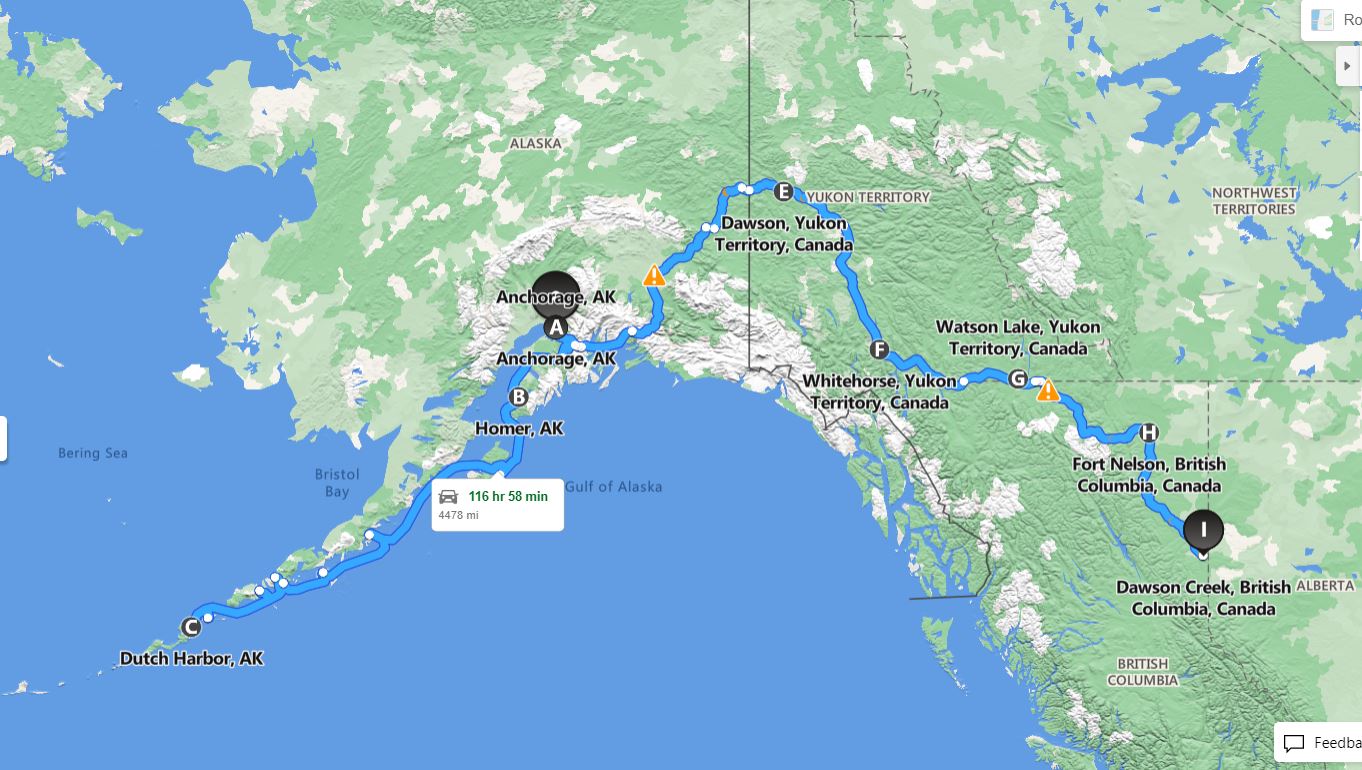
Tuesday (July 19th), woke up early, drove to Anchorage International Airport, for 40-minute flight to Homer, on Kenai Peninsula. RAVN Airlines operates a fleet of ten De Havilland Dash-8 (DHC-8-100) turbo prop aircraft, configured for thirty passengers. RAVN operates out of terminal A; there was no TSA security screening before boarding the flight.
After arriving in Homer, walked to local McDonalds for laptop work, and to Safeway (grocery store). Grocery prices were high; out of stubbornness, I walked out empty-handed. Walked five-miles along the Homer spit, which extends into Kachemak Bay, from where the ferry departs. There are various restaurants along the boardwalk, serving seafood and ice cream.
Ferry terminal opened at 6:00pm, checked-in and received my boarding pass, for the four-day trip to Dutch Harbor, aboard M/V Tustumena (aka “Trusty Tusty”). Tustumena came out of winter maintenance, and resumed service July 16th. The vessel is 58-years old, and is scheduled to be replaced within the next five years. Vessel accommodates 150-passengers, 35-vehicles, 25 staterooms, and a cafeteria; its max cruise speed is 15 miles per hour. Vessel is one of two ocean-rated ferries in the Alaska Marine Highway System (AMHS) fleet, and is equipped with gyroscopic fin stabilizers to reduce rolling in rough seas.
Tustumena is a roll-on, roll-off (RORO) ferry, loading vehicles onto the vehicle deck via an aft elevator, and accommodates vehicles up to 40-feet in length. Elevator allows vehicle loading and unloading without a ramp, regardless of tide level. Tustumena sails to the Aleutian Islands eight times a year – just once a month – but not in winter, when weather is too severe.
Passengers and vehicles began boarding at 8:00pm, and the vessel departed on-time at 10:30pm. Found a long, padded bench, and went to bed; used a lightweight sleeping bag liner to stay warm; it’s compact, and rolls-up to the size of a 12-oz soda can.
Forward observation lounge was cold, between 50 – 60 degrees (F). Asked the purser, and he explained that there are many windows, lots of steel, and that the ship heads into the wind. There was no sunshine to warm-up the deck during the day, and the lounge cooled off considerably at night. Used to a desert environment, almost never wear socks. Sleeping at night on board the ferry, my feet become very cold, and I was likely losing a lot of heat.
Wednesday (July 20th), ferry arrived on Kodiak Island at 8:00am. Walked to local coffee shop, and did some laptop work. Visited Kodiak National Wildlife Refuge Visitor Center in town, along with the Holy Resurrection Russian Orthodox Church, with its blue-painted onion domes. In the afternoon, hiked five miles in nearby North End Park.
Ferry departed at 4:00pm; before going to bed, finished reading Flags of Our Fathers (2000), a book written by James Bradley and Ron Powers, which documents the 1945 World War II battle of Iwo Jima, and Joe Rosenthal’s infamous flag raising photo. The book was later released as a film, directed by Clint Eastwood (2006). Iwo Jima was considered critical for both the (fire) bombing campaign of mainland Japan, and to support a subsequent invasion, had the two atomic bombs not stopped the war. More than 27,000 Marines and sailors were killed or wounded on Iwo Jima. The Medal of Honor, the nation’s highest military honor, was awarded to 27 Marines and sailors following the battle.
Thursday (July 21st), arrived mid-day at Chignik, along the Alaska peninsula, a native village of less than 100 people. There are no restaurants or stores in town; locals came aboard the vessel to purchase burgers and sandwiches “to go.” Per capita income is $16,000; I’m told that people live here due to family, culture, and livelihood (fishing).
At midnight, ferry arrived at Sand Point, along the Alaska peninsula, a mixed native and non-native community, with fewer than 1,000 people. Per capita income is $22,000 and the economy is supported by fishing and fish processing.
Early Friday morning (July 22nd), ferry stopped at King Cove, along the Alaska peninsula, a village of fewer than 1,000 people, supported by fishing and fish processing; per capita income is $18,000. At mid-morning, ferry stopped at Cold Bay, the last harbor on the Alaska peninsula, and the end of North America; the harbor shelters a large, migratory bird population at Izembek National Wildlife Refuge. In the afternoon, ferry arrived at False Pass, on Unimak Island, marking the first harbor in the Aleutian Island chain.
Early Saturday morning (July 23rd), ferry arrived at Akutan; sky was pitch black, heavy rain, coming down sideways, cold. Ferry arrived on-time at Dutch Harbor (Unalaska) at 9:00am.
Aleutian Islands is a chain of fourteen large volcanic islands, part of the Pacific Ring of Fire. Attu Island, marks the westernmost island, and the boundary for the international date line. Attu was occupied briefly by the Japanese during World War II. Climate is marked by frequent, year-round rain and fog. The land is devoid of trees, instead, the islands are covered, by vibrant, dense green shrubbery.
Dutch Harbor is the largest community in the Aleutian Islands, and is the largest fisheries port in the United States, by volume, including the Bering Sea king crab fisheries. The town was attacked in June 1942, by the Japanese during World War II. The Army Corps of Engineers built steel, reinforced concrete bunkers and observation posts into the hillsides on the island, to withstand both earthquake and gale force winds. The bunkers remain largely in-tact today, outlasting earlier wooden bunkers. Mean annual temperature is 40-degrees (F), with more than 225 days of rain. Population is 5,000 people, and Unisea Corporation operates the fish processing plant; many of its employees are non-US citizens, with H-2B non-immigrant work permits, because there are not enough US citizens available to work.
I allowed a buffer in my travel schedule in case the ferry was late, or if there were flight delays; up to 20% of the flights to and from Dutch Harbor are cancelled due to inclement weather. After departing the ferry, walked to the airport, to check-in for the Saturday evening flight to Anchorage. During the course of the day, RAVN Airlines cancelled all three of its scheduled flights, displacing more than 120-passengers. RAVN only flies 90-seats per day (3 flights x 30 seats). Charter flights continued to fly in to and out of Dutch Harbor. The airline re-booked me for the next available flight, three days later, on Tuesday evening, and was placed 60th on the stand-by list for an earlier flight.
I stood near the ticket counters, the charter desk was located next to RAVN Airlines. Several commercial fishermen were trying to get home, too. The charter desk, Grant Aviation, had an in-bound aircraft scheduled for the next day, in order to deliver parts for an aircraft on the ground. The charter had eight seats returning to Anchorage. I stepped up to the counter, and got my name on that list. We were told to report back the next morning at 9:00am for an update. I’ve got enough grey air to know that events like this, are sometimes nothing more than wishful thinking, and often fall through.
With my new found free time, I toured the island, with my friend, Alex, whom I met on the ferry. The local hotel was full; I slept on a bench at the airport; not much different than sleeping on a bench on the ferry. Sleeping on hard surfaces is one of my super powers.
Saturday was uncomfortable, obviously, very isolated at Dutch Harbor. There was no cell phone service; purchased a short-term WiFi plan to use my iPhone. I wrote a few notes in my journal, that I share below, because I wasn’t sure how or when I would get back to civilization. I was planning to drive out of Alaska early Wednesday morning (July 27th).
Waited in the airport, 10:00am – 5:00pm.
Forced out of my comfort zone.
Uncertainty.
No control.
Carefully made plans don’t matter, in an indifferent world.
Everything is made to be broken.
What is the purpose of today.
What is this experience trying to teach me.
What haven’t I yet learned, that I am supposed to learn.
Am I too rigid, too inflexible.
Reflection of an ugly person.
Reflection of an ugly human being.
Karma, what am I sowing.
Payback is a bitch.
Lesson in humility.
May I find my breath.
Breath-in.
Breath-out.
May I find equanimity.
Temporary feelings, emotions, thoughts, opinions.
Observe, and let go.
Don’t cling.
May I find gratitude (for something, for anything).
May I be grateful for the good fortune of others.
Don’t judge others; don’t judge self.
Don’t judge self; don’t judge others.
Sunday (July 24th), proceeded to the charter aviation desk at 9:00am. There was some initial uncertainty about the charter flight, but at 10:00am the aircraft departed Anchorage. I was the first person to purchase the $750 ticket; likely the best $750 I’ve ever spent.
Spent the morning talking with the commercial fishermen returning on the charter flight. They were nice people; educated, well-spoken, good company. One was a fishing boat captain, for a small boat with five crew; he shared iPhone pictures, and I was amazed by the radar and technology on the boat. He was 63 years old, and lived in Seattle. He earned $500,000 per year for five-months work. He said that he has waited up to six days to get out of Dutch Harbor, and that it often takes 2-4 days, on average, to get off the island.
Charter aircraft arrived at 2:00pm, later than expected, due to a strong head-wind. We boarded the King Air 200, twin-engine turbo prop, and departed by 2:30pm. Cruised at 25,000 feet; 150 knot air speed, but due to the strong tail wind, 325 knot ground speed, and arrived in Anchorage by 5:00pm. Landed at Anchorage International Airport, rather than the regional airport, Merrill Field. There was no cockpit door; I was seated behind the pilot, and was able to look out his windscreen towards the approaching runway. The descent was turbulent; there were no armrests, and I had to hold on to the bottom of the seat with both hands. Pilot taxied us to the main terminal; we must have looked like a mosquito compared to the wide-body jet aircraft (Boeing 747 and 777) on the taxiway. Checked-in at the local hostel at 5:30pm; grateful for a shower, shave, warm dinner, and clean laundry.
In hindsight, Sunday was a great experience, and a far better experience than I ever could have on the RAVN commercial flight. Learned a lot from the fishermen, learned more about myself, and learned about traveling in remote and isolated areas. I would like to travel to Nepal and Tibet in the future; both are remote, and subject to violent weather; so will need to better plan for potential travel disruptions.
In hindsight, if I were to travel the Aleutian Islands again, I would likely fly round-trip (jet service) from Anchorage to Kodiak on Alaska Airlines, and take the round-trip ferry from Kodiak to Dutch Harbor (three nights out, three nights back). This allows a full-day in Dutch Harbor, without the risk of flight cancellation. For reference, the table below shows that RAVN cancelled 30% of its flights from Dutch Harbor to Anchorage during the past week.

Monday (July 25th), spent catching up, given that I didn’t have cell service or WiFi for almost a week; also getting ready to depart Alaska, and return to the lower-48. Called RAVN Airlines, and it issued a full $650 refund for the cancelled flight, no questions asked. I expected that the airline would challenge the refund, and was surprised that it was effortless.
Tuesday (July 26th), woke up early to catch up on writing; followed by a short trail run along Westchester Lagoon. Met up with Jesse, for coffee; he is the brother of my good friend, Cathy, and works in downtown Anchorage, at the twenty-story, Robert B. Atwood building, which provides wonderful views of the city, the international airport, and Cook Inlet.
Stayed at Base Camp Anchorage three separate times, for a total duration of ten nights. Hostels are best when staying more than one night, and getting to know the other guests. The hostel truly understands the value of community, both its guests and employees. Last night, one of the guests baked a lovely peach cobbler in a cast iron pan; there must have been a dozen guests around the dinner table, sharing warm peach cobbler, and sharing stories. If you ever pass through Anchorage for summer tourist season, be sure to stay.
Wednesday (July 27th), woke up early, got some laptop work done before hitting the road.
Drove 500-miles, 12-hours (3am AKDT – 4pm PDT). Driving east on Glenn Highway is slow; lots of twists and turns, and uphill driving. Stopped for gasoline in Tok, before driving north along Taylor Highway; road conditions change without notice from paved, to paved with potholes, graded dirt, and gravel; the road surface is mostly free of washboard, with the exception of sharp curves. Looking out my rear-view mirror, there was a cloud of dust behind the car, not dissimilar from the smoke screen on the Spy Hunter video game that I frequently played as a teenager.
US and Canada share one building for customs, at the Poker Creek – Little Gold Creek border; understand that there is a line painted on the floor that delineates the US – Canada border. Border station is only open during the summer, and only open 12-hours per day (8am-8pm), so drivers need to plan ahead, and also complete the ArriveCAN app with vaccination information and estimated arrival time. Border station is remote; there is no cell service. After clearing customs, drove “Top of the World Highway” into Dawson City, and took the local ferry across the fast-flowing, Yukon River into town.
I was tired from driving; likely should have split the drive; driving 300-miles to Tok, and driving 200-miles to Dawson City the next day. Stayed overnight at the Bunkhouse in the center of town, and appreciated having a private room. There is a $20 hostel, on the west side of the river; there is no electricity; it was too rustic for me, after a hard day of driving.
The scale of Alaska’s geography and scenery is mind-blowing. Montana is called “big sky country” but likely describes, Alaska, too. The Alaska-Canada Highway (the ALCAN) was completed in 1942, with the concern that a Japanese attack on Alaska could prevent access to the state. The highway was opened to the public in 1948, and has been improved year-over-year. The highway is 1,187-miles long, and continues to “shrink” as sections of the road are improved and straightened.
On Thursday (July 28th), drove south to Whitehorse, Yukon Territory. Large sections of the road were being improved, and built up with almost five to six feet of gravel and rock, to reduce winter frost heaves; there are large cleared sections of trees on both sides of the highway, likely to serve as a wildfire break, as burn scars are visible throughout the drive, and to improve wildlife visibility. Roads are ravaged by potholes, and vigilance is required to not risk hitting a deep pothole and blowing out a tire, or two. Could see where the recent Klondike wildfire burned near Stewart Crossing, which closed the ALCAN for several days in early July. Limited use of cruise control, speeds limited to 40 – 50mph; there are few amenities or services on the road. Drove 325-miles, and quite fatigued, taking almost eight hours (4am – 12pm PDT). Worked at the local library before checking-in at the local hostel.
Met my friend, Kim, for dinner at Woodcutter’s Blanket, in the center of town, walking distance from the hostel. Kim and I worked together at Epocal in Ottawa, and grateful for the opportunity to reconnect; she’s outgoing, fun, and a joyful person.
Friday (July 29th), drove south to Watson Lake, Yukon Territory, 275-miles (4am – 10am PDT); pleased to report that the road was in good condition; few potholes and no road construction. There wasn’t much available in town; filled-up the car with gasoline, and stopped at the local library to get some work done, before checking-in at AirBnB.
Driving the ALCAN is not like driving the interstate. There are limited resources between towns; no McDonalds, no Subway, no gas stations, no bathrooms. It’s important to utilize the “half-tank” rule, and fill-up whenever reasonably possible, as some remote gas stations periodically run out of fuel.
Saturday (July 30th), drove southeast towards Fort Nelson, British Columbia, 325-miles, 7-hours (4am – 11am PDT); was surprised to see several herd of bison. There was a detour on the ALCAN, where a beaver dam caused a section of the ALCAN to wash out following heavy rains. The highway was closed for three days, until road crews restored an old section of the ALCAN, and re-opened the highway, to divert the damaged section of road; repair estimate is eight weeks. It seems that in the battle between mother nature and man, mother nature always wins; wind, water, and time are powerful elements.
Drove 300-miles without any cellphone service, and no communities, either, which got me thinking about comparisons. US population is 330-million people, $64,000 GDP per capita; Canada population is 38-million, $58,000 GDP per capita.
More resources in town than yesterday; and more asphalt than mud, too. Worked on laptop at local library before checking-in at AirBnB. The host was nice; she was baking sourdough bread, and we had the opportunity to compare technique.
Sunday (July 31st), drove 300-miles southeast towards Dawson Creek, British Columbia, marking the end of the 1,200-mile Alaska-Canada highway; most signs in Canada refer to it simply as the Alaska Highway; saw a lot of deer on today’s drive. Worked on laptop at local Starbucks (library closed on Sunday), before checking into local AirBnB.
Other thoughts:
While staying at the Anchorage hostel, walked across the street to the used book store, Tidal Wave Books, purchased a book on writing by Anne Lamott, Bird by Bird. I’ve always enjoyed her writing, and her straight-forward advice to aspiring writers, shared with you below.
If you write, you’re a writer. Don’t seek an agent; don’t seek to be published. To write, is to view the world through a one-inch picture frame. Maybe you can’t see everything, but you can see in front of you, and it’s possible to travel the world, long-distance, in such a manner.
Write shitty first drafts that no one will ever see. The writing that may be interesting, may be the last line on page four, go with that, delete the rest. Good writing is re-writing. Good writing is to show, don’t tell. Be willing to write terribly. Be willing to write every day.
I’m traveling the world.
I’m writing every day.
Thank you for reading.
 garthmonroe