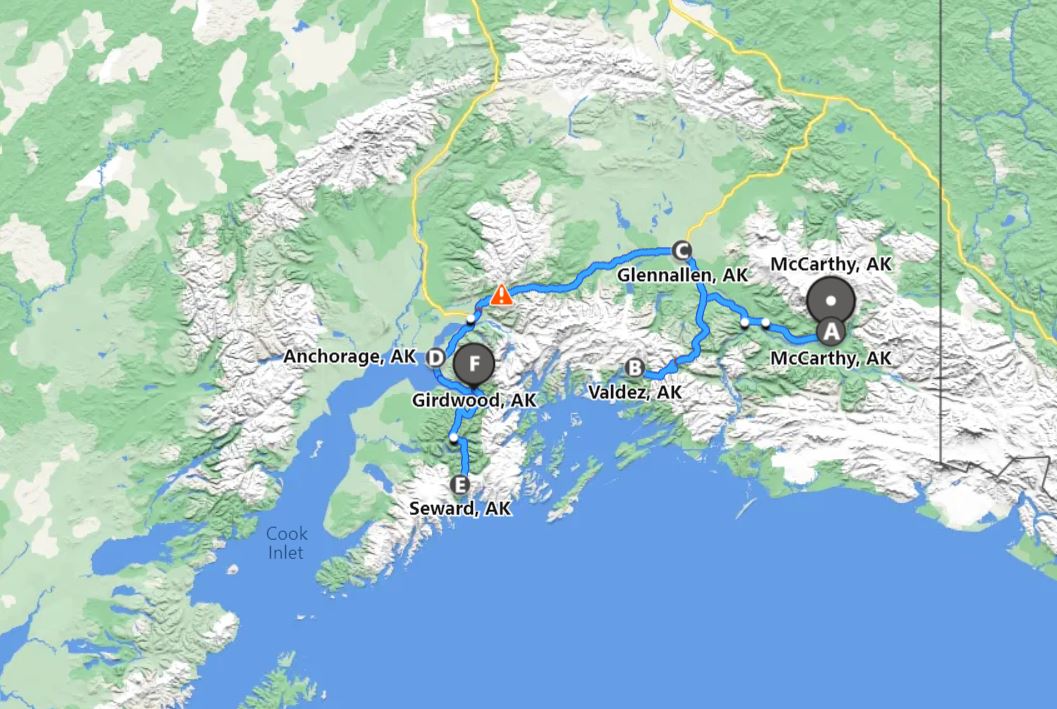
Saturday (July 2nd), departed Denali National Park, drove southeast, along Parks Highway and Glenn Highway, towards Glennallen and Copper Center. Enjoyed seeing Denali at sunrise, for the first time, given the prevalence of wildfire smoke. Visited Matanuska Glacier, en route, before stopping at the National Park Visitor Center. Was going to car camp in the evening, but given the mosquito density, it would not have been a pleasant evening. Stumbled on local hostel, Uncle Nicolai’s Inn & Hostel; clean, WiFi, hot shower.
Sunday morning (July 3rd), drove south, towards Chitina (gravel) airfield; took 8:00am shuttle to McCarthy. Road to McCarthy was an old railroad bed, and some of the wood ties and steel spikes pop out of the ground from time to time. There is no cell phone coverage, and didn’t want to risk blowing a tire. Shuttle driver commented that he blows one to three heavy-gauge tires per week. Driver was an experienced outdoorsman; asked him what he does for bear safety. He commented that bear bells and bear spray are mostly useless. He said that a (mini) air horn is useful to ward off a bear, and also suggested that the best defense for a bear attack is a pistol, recommending either the 357 or 44 Magnum.
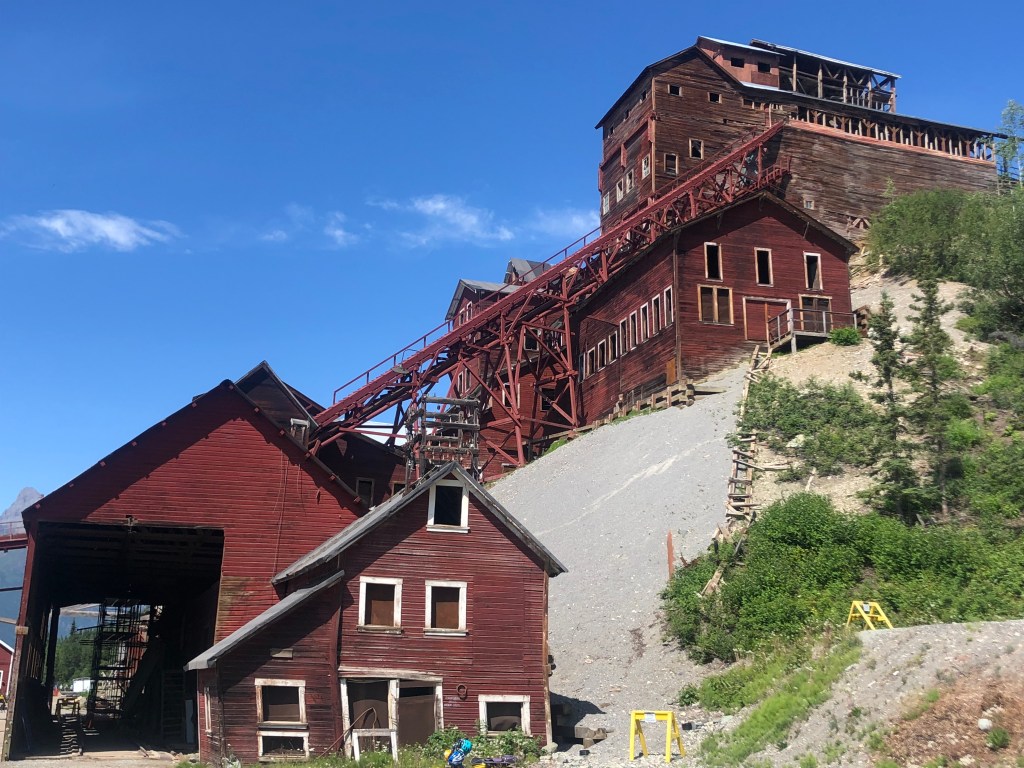
Arrived in the area before 11:00am; dropped off my bag at the hotel, and headed towards Kennecott Mines National Historic Landmark, located within Wrangell – St. Elias National Park and Preserve. Hiked to Root Glacier, followed by a tour of the 14-story, 100-year old, copper mill. Tour was a mistake; won’t take another tour again. Park service provides adequate building and exhibit access, without purchasing the third-party tour.
Wrangell – St Elias National Park & Preserve is larger than Vermont and New Hampshire combined, and it is the largest unit in the national park system; Wrangell mountain range is larger than the state of Connecticut (given that I was raised in Connecticut, not saying much).
Stayed overnight at Lancaster’s Backpackers Hotel, it was the least expensive lodging option, besides camping, in the area. The shower was hot; the rooms were clean, and breakfast the next morning was included, two eggs, sunny-side up, with cheesy potatoes.
The area was certainly crowded, due in part to the Independence Day weekend. There were free shuttle vans, to travel the five miles between McCarthy and Kennecott, but they were delayed due to the crowd volume. Back in the mining days, the miners would walk from Kennecott (mines) to McCarthy, where the brothels and saloons were located, for a “boilermaker” and a side of gonorrhoea.
My impression is that McCarthy may be overrated and overpriced. It’s definitely worth visiting, if you’re in the area, but likely coordinate as a day trip; alternatively, a person may choose to camp, on the west side of the Kennecott River.
Monday (July 4th), woke up at 1:00am with a migraine; I can tell the difference between a headache and an (oncoming) migraine. My intention was to abort the migraine before the pain became incapacitating; took Benadryl tablet. Woke up at 3:00am, pain not worse, but not improving; took Excedrin (migraine) tablet. Woke up at 5:00am, pain not worse, but not improving; took CBD gummy. Woke up at 7:00am, and pleased that I wasn’t nauseous.
Progress; I was functional, and didn’t have to return to bed. Felt better by mid-day, and felt fine by evening. Wanted to go running in the morning – that didn’t happen – but grateful that I didn’t lose the day. Watched the town’s fourth of July parade from the hotel’s front deck. Next time that I feel the onset of a migraine, plan to take Benadryl, Excedrin, and CBD at once, with a large amount of water. Hopefully, this rapidly aborts the migraine.
Took 4:00pm shuttle van back to Chitina; and drove 100-miles west along the Richardson Highway to Valdez. The drive was stunning, including Worthington Glacier, Palmer Pass, Keystone Canyon, and Bridal Veil Falls. Arrived in Valdez at 9:30pm, still wearing sunglasses.
Was going to stay at the local oil field hotel, Valdez Mancamp; that reservation was fouled up by the host, and I was put up for free at the local Keystone Hotel.
Tuesday (July 5th), explored Valdez, before driving 300-miles to Anchorage. Valdez marks the terminus of the 800-mile Alaska pipeline. Back in 1964, just five years after Alaska became the 49th state, the area was impacted by the “Good Friday” 9.2-magnitude earthquake, lasting four minutes; the strongest earthquake ever recorded in North America. The city, built at the base of the Chugach Mountains, experienced severe liquefaction, and much of the city slid into the harbor; the city was later condemned by the Army Corps of Engineers, and moved four miles west, to its current location.
I was able to drive through the old part of town; signs mark the old buildings (for example, “post office”). Valdez is also the site of the March 1989 Exxon Valdez oil spill, where the tanker ran aground, spilling more than ten million gallons of crude oil – 20% of its cargo – into Prince William Sound. This is the second largest oil spill in the United States, after the 2010 Deepwater Horizon incident, in the Gulf of Mexico, spilling 210-million gallons of crude oil.
Should have taken ferry from Valdez to Whittier, feel foolish in hindsight. Ferry would have taken five hours, and cost $300, passing through Whittier tunnel, en route to Anchorage.
Wednesday (July 6th) was a quiet day; writing in the morning at the local Starbucks. Stopped for groceries, and perused the local used book store; visited Kincaid Park and Point Woronzof; drove past Anchorage International Airport; the FedEx operation is massive.
At one intersection, a person shouted, “Texas is in the house” after seeing my car. I had an Amazon delivery waiting for me at the local hostel, Base Camp Anchorage. Started taking grass-fed kidney, by Ancestral Supplements; it’s a source of diamine oxidase (DAO), an important digestive enzyme, that naturally reduces histamine levels. When I have a migraine, take Benadryl, an antihistamine, to reduce histamine levels; I’m hopeful that the supplement will beneficially mitigate my migraine frequency, intensity, and duration.
Thursday, went to the local Honda dealer for an oil change and tire rotation; driven 10,000 miles on the trip, and the Alaska roads are rough at times. Honda Fit is ten years old with 150,000 miles. Appreciate someone looking over the car, to ensure that I don’t risk a break-down in a remote location. There was a late model Civic on the lot, with studded snow tires.
The hostel is nice; it’s the only hostel in the greater Anchorage area; before the pandemic, there were five hostels in the area. The owner, Ole, is a nice person; the hostel has a nice vibe, with like-minded guests. Ole acquired the hostel from the previous owner, and he leased the hostel for two years, before making the decision to purchase the business; he wanted to experiment and see if he enjoyed being a business owner. Hostel is open five months, May through September. In the off season, Ole works as a physician’s assistant (PA).
Hostel has a sensory deprivation tank; it’s essentially a large bathtub, with ten inches of water, heated to just below body temperature (93-degrees), with 1,000-pounds of dissolved salt, so that the body floats without support. I signed-up to use the tank in the afternoon, $40 for an hour; typical cost is $100-$125. After showering, entered the tank, shut the lid, the lights went out automatically. Focused on my breath; breathing-in, breathing-out. Halfway through, my body became hot, and I had an overwhelming feeling of claustrophobia. I considered standing up, and opening the lid of the tank; but the sensation passed. In meditation, often told to not supply energy to thoughts and feelings; that thoughts and feelings will pass on their own accord, like clouds in the sky.
Friday (July 8th), drove south along Turnagain Arm, towards Seward, where the cruise ships depart for Vancouver and Seattle. Many tourists take the Alaska Railroad from Anchorage to Seward. I made various stops en route, and various short hikes. Weather was cold, wet, rainy, and windy; sky was obliterated by fog and rain; worked on my laptop in the afternoon at the local library, and checked-in at the Moby Dick Hostel. There was a young couple, visiting from Missouri; they were very nice, and we talked for three hours during dinner; one of those instances where you appreciate the sense of community at a hostel.
Kenai Peninsula weather on Saturday (July 9th) wasn’t any better; 50-degrees and rain, so drove west towards Soldotna, and visited Kenai Fjords National Wildlife Reserve, where the weather was dry. Reserve was created in 1980, but previously known as the Kenai National Moose Range, established in 1941, to protect the moose, dying off in large numbers. Much of the reserve was damaged by the Swan Lake Fire (2019), caused by lightening; in Alaska, fires are allowed to burn un-checked, if the fires don’t threaten property or people.
During the drive, listened to various podcasts on blockchain, cyrpto-currency, and NFTs (non-fungible tokens); trying to better understand what I don’t know.
Alaska was purchased from Russia in 1867 for $7.2-million, by William Seward, Secretary of State; sometimes referred to as “Seward’s folly.” Alaska became a territory in 1912, and became the 49th state in January 1959. The state encompasses 663,000 square miles (1,400 x 2,300 miles). For comparison, Texas encompasses 269,000 square miles (800 x 775 miles).
Vitus Energy is a local company in Alaska. It’s marine division provides fuel and freight to remote communities in Western Alaska. It’s central division, is developing a 7-million gallon petroleum storage facility for wholesale customers. It’s Terminals division, provides fuel to commercial and retail customers. Instead of building new gas stations, Vitus purchases and renovates older stations. The strategy provides value to the old owner, and provides Vitus an existing customer base. Stopped at the Vitus station in Tok, located in eastern Alaska; the fuel was $0.20 less per gallon than competing stations, and the store interior, was nicely refurbished. I’ve been making it a point to re-fuel at Vitus, whenever reasonably possible.
Sunday (July 10th), the weather improved, with a break in the rain and fog. Hiked Harding Ice Field and Exit Glacier, at Kenai Fjords National Park; ten miles, with 4,000-feet of elevation gain. Once above the tree line, parts of the hike were in snow fields, and had to follow “orange flags” to delineate the trail. Conditions became windy; hands became red and cold. Some of the snow fields were tinted red, as if sprayed with paint, caused by algae blooms. The mountain view was quite rewarding; trail was un-crowded in the early morning.
Following the hike, returned to the hostel for breakfast, and did some laptop work at the dining table, before driving north to Girdwood, checking in at Alyeska Hostel.
Monday (July 11th), ran seven miles through Girdwood, exploring this year-round ski resort community. It’s home to Alyeska Ski Resort, with helicopter skiing in the Chugach Mountains; the region is known as the best sea-level skiing in the world. In the evening, there was a 58-second, 4.3-magnitude earthquake, south of Girdwood, on Kenai peninsula.
Tuesday (July 12th), threw kettlebell around the room, before working on laptop. Following breakfast, went for a hike on nearby Crow Creek Trail; sky was overcast, with low-hanging clouds; limited visibility, cold, clammy weather; turned around, hiking only four miles.
Wednesday (July 13th), went trail running, past Alyeska Hotel, on Winner Creek Trail; nice, undulating path through the forest; turned around at the gorge, as the hand tram, is out-of-service. Nine-mile run; and pleased to report no injuries; my IT-band cooperated, too; dynamic stretching – before, during, and after the run – has been more effective than static stretching. I’m not fast, the run took two hours, but at this point, I’m less concerned with speed records. In the afternoon, worked on laptop at the local library.
Thursday (July 14th), returned to Anchorage, and errands about town before returning to previous hostel, Base Camp Anchorage. Day started off grey with showers; pleased that the afternoon cleared-up with sunny skies; didn’t see the sun all week.
Friday (July 15th), seven-mile, out-and-back trail run along Chester Creek green space; didn’t have to run on the sidewalk and breath-in traffic exhaust. There were homeless people camped out along the trail – not unlike Zilker Park – in Austin. I wasn’t threatened, but given that (untreated) mental illness often accompanies homelessness, the experience was uncomfortable, at times. Laptop work in the afternoon; fund modeling for a colleague.
Saturday (July 16th), low pressure system passing through, bringing wind and rain. Threw around the kettlebell, followed by laptop work at the local Starbucks. Used the (outdoor) hostel sauna for an hour in the afternoon, heated by a wood stove; reaching 150-degrees.
One of the books on the hostel bookshelf was Calypso, by American humorist, David Sedaris; I read this book several years ago, and re-read the book at the hostel. Sedaris is one of the few authors that can make me laugh out loud until my stomach hurts.
With five siblings, there is no end to Sedaris’ story-telling fodder. Two stories in particular, stand out, “Now We are Five,” which previously appeared in the New Yorker, and “I’m Still Standing.” The first story, documents Sedaris buying a beach house, and coming up with completely inappropriate names, including, Sea Section, Seaman, or Conch Sucker. The second story documents various bouts of gastrointestinal virus at completely inappropriate venues, including a plane, on stage, and best friend’s house.
Sunday (July 17th), early-morning yoga, followed by getting my Zen on at the local Zen center, Anchorage Zen Community. I was allowed to attend in-person, by emailing my vaccination record; morning meditation and service, followed by a dharma talk.
Other thoughts:
This trip is not without potential issues. I’ve set-up three Google alerts, so that I’m not caught off-guard. The first alert, is to be notified if the Canada-US border is closed; appears that COVID continues to rage over the summer, and I’m planning to return to the United States, by driving through Canada.
The second alert, is to be notified if the Alaska-Canada highway is closed. Two weeks ago, there was a strong thunderstorm that washed out a section of the ALCAN. More than 1,200 cars drive the ALCAN each day during the summer. Canada road crews put in place a temporary fix, allowing one-way traffic, by following a pilot truck, while permanent repairs are completed over the next eight weeks. In addition, there are scattered wildfires in the province of British Columbia that threaten to close the highway, as well.
The third alert, is to be notified if the M/V Tustumena (aka “Trusty Tusty”), is delayed. The vessel was delayed coming out of winter maintenance, hence my low-key week in Anchorage-Seward-Girdwood; the vessel resumes service on Saturday July 16th. Tustumena travels out to the Aleutian Islands, only once a month in the summer, and suspends service in the winter, when weather conditions are too severe. The Discovery Channel’s television series, Deadliest Catch, is based out of Dutch Harbor, in the Aleutian Island chain. Tustumena is one of two ocean-rated ferries in the Alaska Marine Highway System fleet.
As mentioned previously, beginning September 1st, after posting fifty-two consecutive blog posts, I will only publish two, long blog posts each month. However, I recently decided, that I will begin a daily blog post, similar to Seth Godin, beginning September 1st. This post will be pinned to the top of the feed, titled “Observations,” with the newest content always on top. Observations could be a sentence or paragraph. The intention – largely another experiment – is to capture thoughts and feelings in a more fluid manner.
Listened to a Malcolm Gladwell podcast; he interviewed singer/songwriter, Paul Simon. At one point, Simon suggested that life is trial and error, and that error is okay (likely inevitable).
 garthmonroe