Fairbanks:
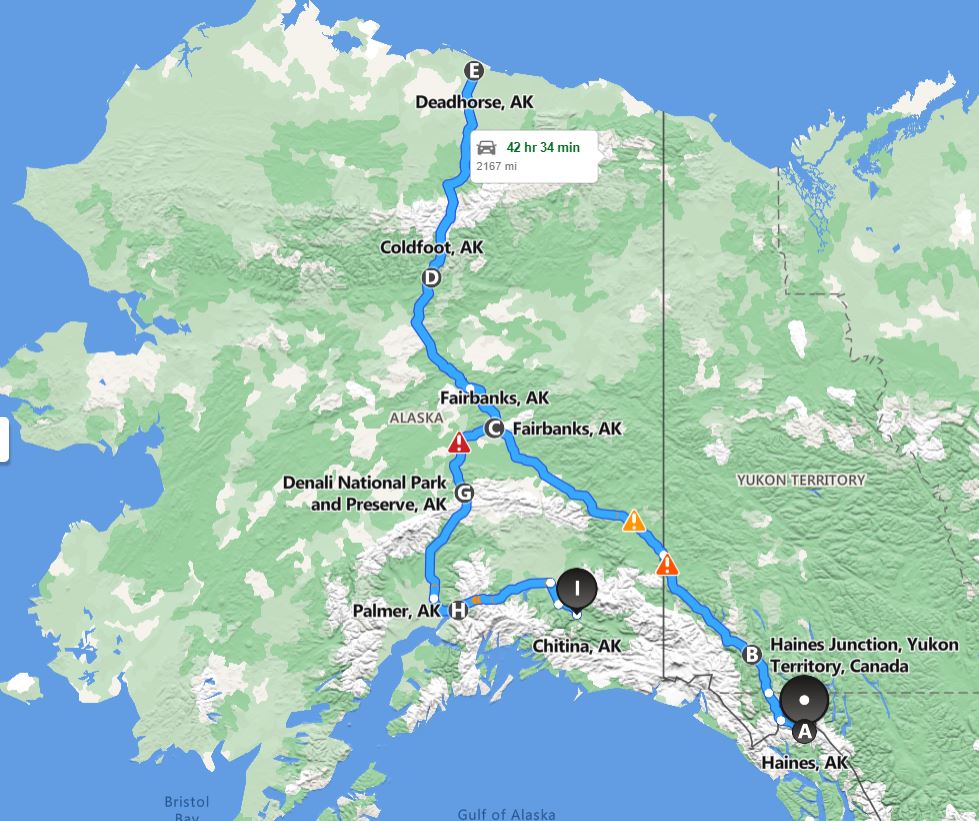
Departed the ferry at Haines Alaska; drove north to Haines Junction, Yukon Territory, Canada. If you blinked your eyes, you could drive through Haines Junction, and miss the town. Planned to stay two days in Haines Junction, allowing a buffer if the ferry was delayed. On Sunday (June 19th), was planning to trail run at nearby Kluane National Park. Woke up with a migraine, and by 9:00am, returned to bed. Pain was excruciating, likely triggered by eating a Nutella crepe for dinner. If someone offered to drag me outdoors, onto the dirt driveway, and put me out of my misery, like a dying animal, I would not object.
Sun didn’t set on Sunday until 11:45pm; when I woke up at 3:45am on Monday (June 20th), the sun was already up, and drove 500-miles from Haines Junction to Fairbanks, clearing US customs en route. There were scattered showers, and the road was rough in places; despite being paved, there were massive sink holes, requiring speeds slower than 40mph. While driving, saw a black bear, grizzly bear, red fox, wolverine, and two moose. Stayed at Sven’s Basecamp Hostel in Fairbanks for three nights, in a canvas wall tent; the guests were like-minded, and there was a great vibe to the place.
On Tuesday (June 21st), did some yoga and kettlebell, and drove out to Chena Hot Springs Resort alternating between the natural outdoor hot pool (106-degrees) and the cold pool.
On Wednesday (June 22nd), went trail running at University of Alaska at Fairbanks; when I stopped to stretch, I was swarmed by mosquitos; if I didn’t know better, I thought that I saw a large mosquito fly off with a small child. Contrary to popular belief, the state bird of Alaska is not the mosquito, but rather, the ptarmigan. In the summer, the ptarmigan is mostly brown, but in winter, the bird is white, allowing it to blend into the tundra. Sunset at Fairbanks is 1:00am, sunrise at 3:00am; the sky never becomes dark. There are more than 100 wildfires in Alaska; the smoke has been blowing east, and the air quality is poor at times.
Dalton Highway:
On Thursday (June 23rd) drove to Northern Alaska Tour Company, located on the back side of Fairbanks International Airport, and picked-up rented SUV at 7:00am to drive the Dalton Highway. The trip was delayed two years due to the pandemic. I took the Artic Circle tour with the company back in September 2009; the guide was fantastic.
SUV was a 2018 Ford Explorer with aggressive tires, two full size spare tires, and a CB radio to monitor channel 19 for the 1,000-mile round trip to Deadhorse and the oilfields of Prudhoe Bay. I felt like a state trooper, or, if nothing else, felt like “Billy Badass.”
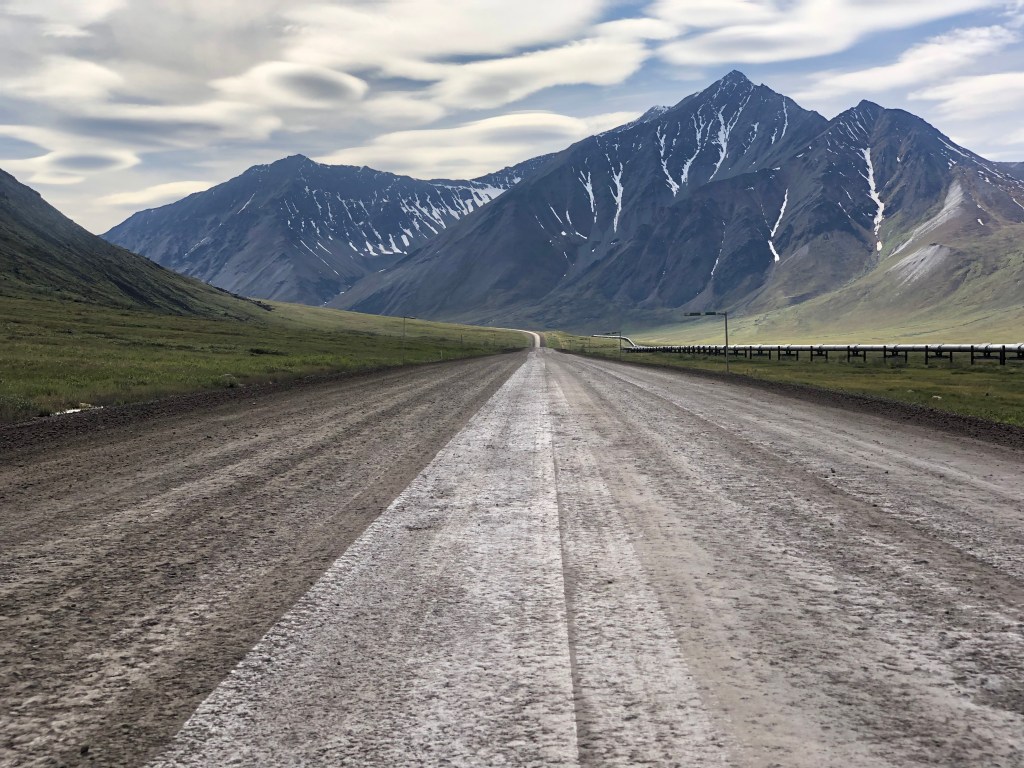
Dalton Highway, also known as the haul road, was built in 1972, and parallels the Alaska Pipeline, which runs 800-miles from Prudhoe Bay on the north slope, to the port of Valdez. The road is mostly dirt, sections are paved, but often, mother nature wins the battle against the road crews. The road is treated with calcium chloride, to reduce dust, but when it rains, the road surface turns to muddy slop, referred to as “snot” or “slime” by locals.
The Alaska Pipeline is an engineering marvel; it is 800-miles long, and 400-miles is buried underground, when it doesn’t compromise the permafrost. When permafrost is at-risk, the pipeline is built above ground, and heat is vented, to prevent permafrost melt. The pipeline is built to withstand earthquakes, as the Denali fault line runs across the state; the most recent earthquake on this fault line, was 2002, at 7.9 magnitude. The pipeline is not built in a straight-line, but rather, zigs and zags, to allow room for the pipeline to expand, given a temperature range from 100-degrees (summer) to 100-degrees below zero (winter).
Drove 250-miles north on Thursday, stopping for gasoline at Coldfoot ($7 per gallon); thought that someone stole the SUV’s gas cap, but learned that the vehicle uses a capless fuel filler system; camped overnight at nearby Marion Campground.
On Friday, woke up early, and continued driving north to Deadhorse (70-degrees latitude). Sky turned to rain after passing through the Brooks Range and Atigun Pass, marking the continental divide. There were no trees north of the Brooks Range, and the landscape changed to boggy tundra. The road became a muddy, sloppy mess; the traction control warning light illuminated continuously on the dashboard; at times, the SUV “crabbed” its way sideways down the road.
As I approached Deadhorse, there was a Jeep off the road, fourteen feet below, in the tundra, and a Subaru Outback on its roof. I was told that the insurance companies wouldn’t remove the vehicles due to the high cost of towing. I saw a Tesla going southbound on a flatbed tow truck, and was told that the tow cost $3,500. Calcium chloride is corrosive to vehicles, which is why I chose not to drive my Honda Fit. I saw two Honda CRV’s, which have decent size tires, full-size spare tire on the rear hatch, and have available all-wheel drive.
Deadhorse is an ugly end to a beautiful road trip; it is an industrial city without the city. I stopped at the only gas station to fill up ($8 per gallon); it took ten squeegees to clean the quarter-inch of mud caked on the back window. The 500-mile drive north took 16-hours, an average speed of 30mph. Deadhorse census indicates only 20 residents, with 3,000-6,000 itinerant oil field workers. For six weeks in the summer, there are 24-hours of sunshine per day; the sun does not set. In contrast, between December and January, there is no sunshine.
Stopped at the Aurora Hotel, where I had a reservation, and was allowed to check-in early, before mid-day. The hotel is modular construction, with each unit transported by flatbed truck on the Dalton Highway. The hotel is geared towards oil field workers; it takes tourist reservations, by calling two weeks in advance. For $150 (and no sales tax), the hotel includes three hot meals per day, a 24-hour snack bar, a gym, free laundry, and cable television; all in all, good value. The hotel was very clean; guests had to wear booties to not track in mud.
On Saturday (June 25th), took a tour of the oilfields, as they are secured from the public.
With a water temperature of 30-degrees, the Arctic Ocean was covered in ice, with the exception of the immediate coast. During the tour, saw a muskox, caribou, and tundra swan. All in all, the tour was underwhelming; waste of time and money.
After the tour, departed mid-morning, and drove 500-miles south to Fairbanks, stopping for gasoline in Coldfoot. As I passed the Yukon River, I saw a couple, my age, staging gear at a pullout. I stopped and asked if they were camping or needed help. As it turned out, their (full size) truck blew out two tires; they put one tire in the back of my SUV, and I drove them 100-miles to Fairbanks to get it repaired, and dropped them off at their hotel. The only cell service on the Dalton Highway is Fairbanks, Coldfoot, and Deadhorse. Road conditions were dry; drive south took 10-hours, average speed of 50mph. I was probably driving too fast at times, as the SUV became airborne more than once, after hitting some large bumps.
Saw several people on motorcycles; often a BMW R-series adventure bike, or Kawasaki KLR; not a single Harley Davidson, of course. Given the road conditions, you’d see riders standing on the foot pegs, often commenting later, that “their nether regions hurt.”
If you’re interested in this trip, three days is quite manageable; two days northbound, one day southbound. Guests may stay overnight at Coldfoot Camp, but the lodging is not inexpensive; alternatively, Marion Campground costs only $10 per night (cash only). I returned the car, and returned to Sven’s Hostel, getting to bed at midnight, exhausted.
Driving the Dalton Highway was not inexpensive; $1,300 for three full days. I enjoy road trips, I find them truly fascinating, and this was a unique, once-in-a-lifetime experience.
- Car rental: $750 (three days)
- Gasoline: $320 (45 gallons @ $7 gallon)
- Hotel: $150 (one night | four meals)
- Arctic Circle tour: $80
- Total: $1,300 (three days)
On Sunday, five mile trail run at the nearby university. Thank goodness for a porta-potty on the trail (with toilet paper), or I would have destroyed my new running shorts.
Denali National Park:
On Monday (June 27th), drove south from Fairbanks to Denali National Park. There are wildfires in Anderson (Clear Fire), caused by lightening strikes, and the wildfire smoke was excessive. Traffic was stopped on the highway, due to road construction, and had to wait for the pilot truck. I’m told that there are two seasons in Alaska; winter, and, road construction (season). I picked up maps to the park at the visitor center, watched the two park films, and purchased a bus ticket to enter the park on Wednesday.
On Tuesday (June 28th), woke up early, and entered the park by 6:00am (to avoid road construction). Did a ten-mile trail run, by linking several of the hiking trails, and creating a big loop, without having to backtrack, repeat, or run on asphalt. Air quality was poor, due to wildfire smoke; the sky and sun were completely obliterated by smoke.
On Wednesday (June 29th), entered the park early, and took the 6:00am bus stopping at East Fork (mile 43). In 2021, the park road collapsed into the deep ravine at Polychrome Pass. I walked to the pass; the rock colors were amazing. The park is going to install a bridge, to be completed by 2024, to allow access to the remainder of the 92-mile park road. I understand that the project cost estimate is $50-million, with 50% already funded.
On Thursday (June 30th), entered the park early for 7-mile trail run along Savage River Alpine Trail; the trail is steep at times, with loose scree, which required walking, at times. Last trip to Denali was September 2009; the tundra was a beautiful shade of crimson; whereas now, everything in the park is green and vibrant.
Friday (July 1st) was going to be an off day. However, showers overnight cleared some of the wildfire smoke. Hiked six miles (round-trip) along the Triple Lakes Trail; this is the longest trail in Denali, stretching south from the Visitor Center to Denali Park Village. Given that the southern trail terminus was so close to the hostel, and the improved weather, hiked to each of the three lakes, before circling back. Due to the early morning hour (6:00am), I was the only person on the trail, and appreciated the silence and solitude, interrupted only by bird song. At the third lake, I was startled by a porcupine, busy eating flowers for breakfast. After returning to the hostel, I threw the kettlebell around the room, followed by laptop work.
On Saturday (July 2nd), drove southeast from Denali, and was overwhelmed by the beauty of Denali peak at sunrise, in stunning shades of pink and orange. Denali is often shy, hiding behind clouds 60% of the time; this past week was more challenging, given the wildfire smoke. Stopped in Wasilla for groceries, and visited Matanuska Glacier, located off the Glenn Highway, before visiting the National Park’s Copper Visitor Center in Glennallen.
On Sunday (July 3rd), took shuttle van from Chitina into Wrangell – St Elias National Park, the largest national park in the system. The access road is built on an old railroad line, and it’s been said that railroad spikes sometimes creep out of the ground, and damage vehicle tires, in an area without cellphone access; stayed overnight at Ma Johnson’s Historical Hotel.
Other thoughts:
In a recent post, noted that the United States appears to have a structural homeless problem; recently listened to a New York Times podcast, How Houston Moved 25,000 People From the Streets Into Homes of Their Own, which highlights how Houston, the fourth largest city in the United States, has reduced homelessness by more than 60%, through a cross-departmental initiative under the leadership of Mayor Sylvester Turner.
While in Fairbanks, finished reading a collection of short stories by actor Sam Shepard, titled Cruising Paradise; the narratives are often about damaged people, sometimes described as, “rootless characters living on the outskirts of American society.” The last several stories reflect on filming a movie in Mexico, so humorous, that I laughed out loud. Shepard received the Pulitzer Prize for drama in 1979, for his play, Buried Child.
Recognize that there are a lot of blogs out there, people with YouTube channels, and podcasts. Some propose various small, daily “hacks” to improve our lives, improve ourselves on the margin. I wonder if I am simply fooling myself; I fail to see how my constant scheming, planning, and hacking has benefitted my life, even at the margin.
I’ve tried to identify priorities in my life: world travel, productive work, family, health, and Zen practice. I feel sheepish that I’m not working, but at the same time, don’t wish to return to corporate America, and an 80-hour work week. I feel embarrassed that I haven’t found something to which I wish to dedicate and invest my life and energy. I’m wondering if it’s possible to divide a year into quarters, and invest time on each focus area. So perhaps four months of travel, residential Zen practice, visiting family (during winter holidays), etc. After seeing many seasonal workers in Alaska, I’m open to a seasonal bread-baking opportunity.
May also return to San Francisco Zen Center in 2023; my experience in 2020 wasn’t “normal” due to the pandemic, and perhaps, deserves a second chance. The experience of living at a Zen monastery is different from visiting a Zen center once a week; the experience is truly immersive; as suggested by Shunryu Suzuki, founder of San Francisco Zen Center, “it is not like going out in a shower in which you know when you get wet. Walking in a fog, you do not know you are getting wet, but as you keep walking you get wet little by little.”
Anyway…recognize that my intentions are often mis-guided.
Continue to struggle to find any sense of meaning or purpose; continue to struggle to find any purpose to life. Perhaps, there is no meaning; perhaps, there is no purpose (to life).
 garthmonroe