Part I: Mountains
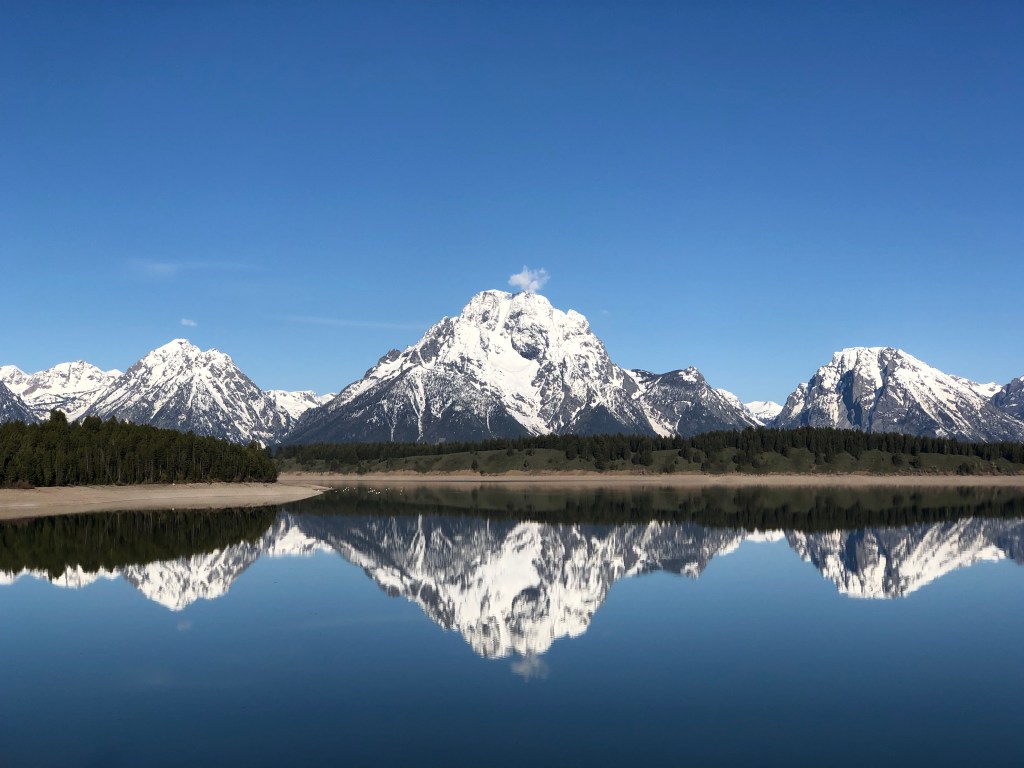
Glacier National Park
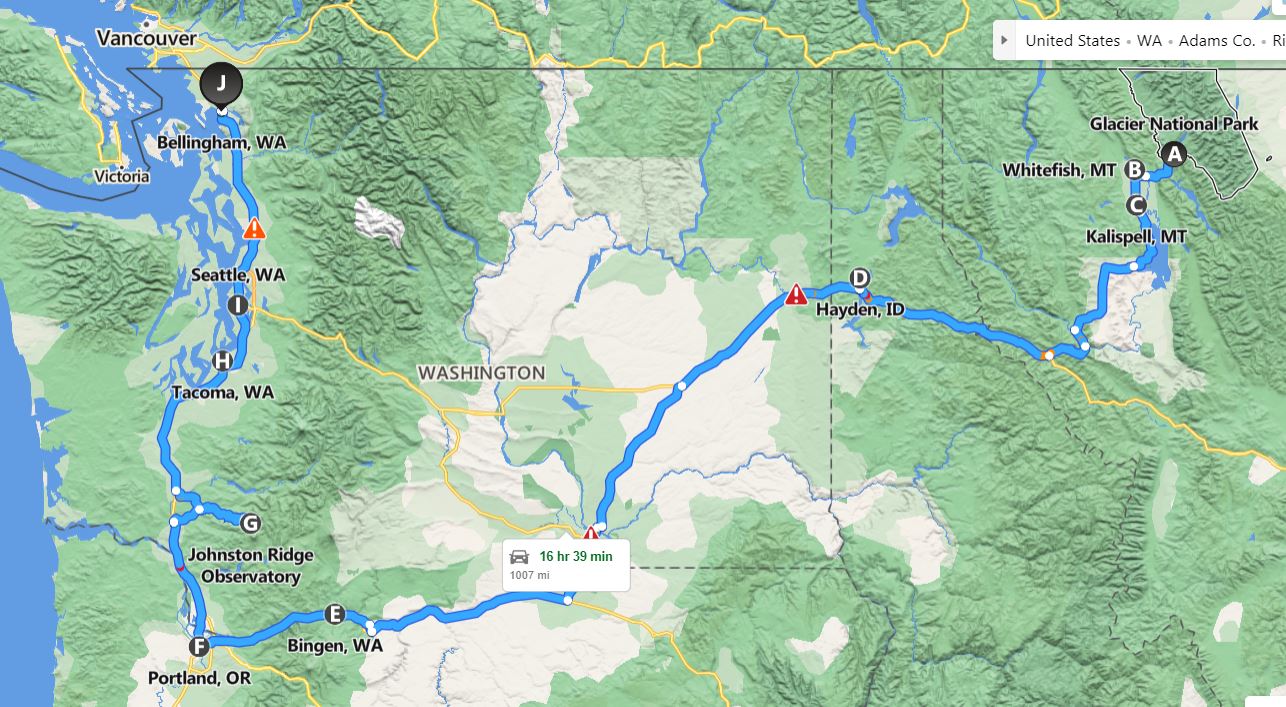
Visited west side of Glacier National Park on Monday (June 6th); hiked several trails, about eight miles. There were scattered showers, my feet were wet, but my body stayed mostly dry. As the park ranger explained to me at the gate, “there is no such thing as a bad hike, only bad hiking gear.” In the afternoon, drove west towards Whitefish, and worked at the public library. The town is pleasant; the downtown core is walkable and pedestrian friendly.
In September 2014, stayed at a hostel in Columbia Falls, west of Glacier; a very nice town. It appears that the hostel closed down during the pandemic. Alternatively, stayed at Whitefish Bike Retreat, a lodge, hostel, campground, and retreat, that focuses on mountain bikers. It was a wonderful place to stay; clean, quiet, and well-appointed.
Kalispell MT
Woke up early Tuesday morning, as I tend to do, and returned to Glacier National Park.
After parking the car, made a trip to the vault toilet; it’s better than not having a toilet – especially before a run – but sometimes wonder if a rat is going to jump up and bite my ass, or, perhaps I’ll drop my keys, or drop my iPhone.
Six-mile trail run to Fish Lake; it was 50-degrees with steady showers; was going to run 8-miles; but became cold and wet. Next time, I should bring an extra pair of shoes; had to run the car heater at full blast to dry the shoes, and of course, the smell was less than pleasant.
I ran with a bear bell attached to my safety whistle. I wear a safety whistle in the parks, in the event that I hurt myself, and require help; no one is going to hear me yell, but the whistle is very piercing. The bear bell is designed to make noise while on trail, so that a bear isn’t startled or surprised. Glacier hosts both grizzly bears (dangerous) and black bears (less dangerous). I reviewed the trail guides on-line, and hikers noted seeing both types of bears on trail. My twin brother, Brett, likes to suggest that the bear bell actually attracts the bear. If a bear saw me in the woods, it’s possible that it would ignore me, on the basis of being just skin and bones, and not worth the hassle of a chase.
I have now visited Glacier National Park for five days; two days in 2014; three days in 2022; I can say that it rained all five days. It could be that the mountain peaks coerce the clouds to drop its precipitation before moving east. I haven’t yet experienced the alpine section of the park, due to snow-related closures. It’s likely that the window to experience the alpine section is between Independence Day and Labor Day.
I left the park, and drove south towards Kalispell. I stopped in town, and did some work at the local library. There was a notable homeless presence at the library; one that I had not observed at Bozeman or Missoula. Stayed overnight at the Kalispell Hostel, located in the downtown core, over a bicycle shop. I enjoyed my time in Montana; the state is stunningly beautiful; next time, would like to experience Billings and Helena.
Hayden ID
Woke up early Wednesday morning; drove south, along the west side of Flathead Lake. Arrived mid-day in Hayden ID, just north of the the scenic Coeur d’Alene (lake) region. Northern Idaho is quite scenic, compared to the rest of the state; it’s also in Pacific time zone, compared to the rest of the state (mountain time); at 70-degrees, the temperature was 20-degrees warmer than Montana.
I did some work at the local library, before visiting my friends Tom and Gwen. I’ve known Tom for more than ten years; he’s a financial advisor, and I would describe him as a trusted colleague. Sometimes, it seems that financial advisors are nothing more than snake oil salesmen; Tom has a moral compass, and truly wants people to save enough for retirement.
Their house is located in a lovely, wooded area of fir trees and evergreens, often visited by deer, elk, and turkeys. Gwen made a lovely dinner, and even better, strawberry shortcake for dessert. They adopted two cats from the local animal shelter, aptly named, Lewis & Clark. We last visited in May 2019, before the pandemic isolation; it was enjoyable to re-connect.
Yellowstone National Park has been in the news the past few days; heavy rains flooded the park, necessitating the closure of all five park entrances, due to damaged roads and bridges, and widespread power outages; a reminder that national parks are wild places.
Part II: Pacific Northwest
Cook WA
Sunrise was early on Thursday; 4:45am Pacific time; had coffee with Tom and Gwen, before driving west 300-miles, various secondary roads, towards the Columbia River Gorge National Scenic Area. Drove along the north side of Hood River, on the Lewis & Clark scenic highway, parallel to the train tracks; Interstate 84 is on the south side of the river. The drive takes you through the Washington desert, the section of the state, east of the Cascade mountains, that lies in the rain shadow; other sights included various (stone) fruit orchards and wineries.
Stayed two nights in Bingen WA, across from Hood River OR, at the Society Hotel, which used to be an old school building. The stay was enjoyable; the staff was attentive. Friday morning, had time for yoga, kettlebell, and an outdoor run, before showers took over the region. The afternoon was a quiet day to catch up on phone calls and computer work.
Portland OR
Woke up early on Saturday; drove west towards Vancouver WA, and stopped for breakfast, before continuing north to Mount St. Helens National Monument; second visit to the park.
Mt. St. Helens erupted on May 18th 1980, following a 5.1-magnitude earthquake, triggering one of the largest landslides ever recorded, when the north face of the volcano slid down the mountain and into the Toutle river valley; the volcano’s ash plume reached a height of 15-miles, and blacked out the daytime skies in both Yakima and Spokane.
Drove south, back towards Portland, and stayed two nights at the NW Portland Hostel. On Sunday morning, woke up early, and based on the recommendation of the hostel staff, ran five miles along the south waterfront park, along the Williamette River. Weather forecast called for showers by 7:00am, so I went out at sunrise, 5:30am.
Walked to Ken’s Artisan Bakery, located around the corner from the hostel; wanted to get some fresh bread; bread ovens were not working, and only pastries were available, oh well.
Explored downtown, walking along the sidewalks. The smell of marijuana was prominent, even outdoors. No judgment, just an observation. I don’t mind if people choose to smoke, but I don’t want to smell the smoke. I’m sensitive to smoke, and it often triggers a migraine.
I’ll suggest that the United States appears to have a structural homeless issue. Downtown Portland was filthy, with trash strewn about, overflowing trash cans, and tent cities, not unlike Los Angeles or San Francisco. There was no shortage of homeless in Austin TX, Las Vegas NV, Eugene OR, and Kalispell MT. It’s not just an issue of homelessness, but also one of mental health, as many of the homeless talk to themselves out loud, or, whose presence is aggressive or un-nerving. I don’t know what the solution is; I don’t know how a country addresses its homeless issue, without anything other than a “handout.”
Seattle WA
Woke up early Monday morning; drove north, and stopped for breakfast in Tacoma, before continuing north to Everett WA, to visit the Boeing airplane factory. It’s not possible to tour the shop floor, but it’s possible to visit various displays in its Future of Flight Center. The ticket cost $20; the experience was underwhelming; better videos are likely available on YouTube for free. It was interesting to note how Boeing highlighted its diverse fleet, especially in the gift shop; even highlighting its 777-900, which enters revenue service in 2025, borrowing many of the material composites used on the 787. Conspicuously absent, was any reference to the 737 MAX, after suffering two hull losses in less than two years, Lion Air (October 2018) and Ethiopian Airlines (March 2019).
I found it difficult to find an affordable place to stay in Seattle. There are hostels, but car parking in the city is as expensive as the lodging. AirBnB was not reasonably priced, either. After the tour, drove south, and stayed overnight at Moxie Meadows Hostel in Graham WA. The host smoked in his room, and the smoke permeated the bedrooms on the second floor. I awoke the following morning with a headache, and puffy eyes. For the second night, made a last-minute reservation, and moved to an AirBnB in Renton WA; host had Netflix, and I binge watched all ten episodes of Lincoln Lawyer.
On Tuesday, was supposed to meet my good friend, Chris, on Bainbridge Island for coffee; we worked together at JetBlue Airways. He was called out of town on business, and we weren’t able to meet; I would have enjoyed seeing him, as its been three years, and I greatly enjoy his friendship. Alternatively, went running at Frontier Park, a nice wooded area in the center of Graham. After arriving in Renton, went running again at Cedar River Trail Park, located adjacent to Boeing’s Renton production facility, responsible for narrow body aircraft.
Bellingham WA
On Wednesday (June 15th) arrived at Bellingham ferry terminal at 1:00pm; checked-in, and picked-up my boarding passes, and staged my car in the parking area; vehicle loading began at 3:00pm, taking almost two hours, as vehicles were loaded by weight and destination, with campers and trailers loaded first. Honda Fit was tucked into the rear corner of the vehicle deck, in front of a motorcycle. It was a surreal experience, as I was scheduled to take this trip two years ago, before the pandemic brought world travel briefly to an end.
Didn’t purchase the ticket until mid-February, only after Canada relaxed its border crossing restrictions. Didn’t want to purchase the non-refundable ticket if COVID conditions didn’t improve. The ticket cost $2,100; $500 for passenger ticket and $1,600 for the vehicle; the ticket would have been less expensive, if I purchased sooner. I could have purchased a private berth (bed), but this would have cost an additional $1,000.
Passengers were instructed to change their time pieces to Alaska Daylight Time (AKDT), one hour behind Pacific Daylight Time (PDT), and the vessel departed on time at 5:00pm (AKDT).
M/V Matanuska was built in 1963, and in 1978, the vessel was cut in half, and extended in length. The vessel can hold up to 500 passengers, up to 80 vehicles, with a draft depth of 16 feet (a cruise ship drafts at more than 30 feet), and a cruising speed of 16 knots (18 mph). Vessel burns more than 200 gallons of diesel per hour. Each of the ferries in the Alaska Marine Highway System (AMHS) are named after glaciers. Six scheduled stops included: Ketchikan (FRI 7:00am), Wrangell (FRI 4:00pm), Petersburg (FRI 8:00pm), Juneau (SAT 4:00am), Haines (SAT 12:00pm), and Skagway (SAT 3:00pm).
The ship has 100 cabins, a cafeteria serving three hot meals per day, and snacks available around the clock; observation lounge, reclining chairs, a lounge serving beer and wine in the evenings, and a heated solarium, where passengers may put up tents, taped down to the deck with copious amounts of Gorilla tape. At night, I slept on a couch in one of the lounges, plenty of space to stretch out; carried a small fleece blanket to stay warm, ear plugs to block out noise, and an eyeshade to block out any light.
The weather on Thursday was 50-degrees and cloudy, with fog and rain; traveled along the inside passage, a series of islands and inlets carved by glaciers, where the water was surprisingly calm. Evergreen trees came right down to the water’s edge, and reminded me that a cruise to the Scandinavian fjords would be an enjoyable journey.
While in Ketchikan (FRI 7:00-10:00am), vessels M/V Columbia and M/V Hubbard were also docked; while in Juneau (SAT 4:00am-7:00am, vessels M/V LeConte and M/V Tazlina were also docked. Between Wrangell and Petersburg, the vessel negotiated the 22-mile Wrangell Narrows, which includes more than 60 lighted buoys to navigate the shallow, twisting waterway. In Ketchikan, the weather was 50-degrees and sunny; I stepped off the vessel, and had time to walk to the local Safeway grocery store, to compare grocery prices. In Seattle, I paid $1 for an avocado to take on the ferry; in Ketchikan, avocados were $4.
Passengers are allowed to bring animals on board, but the pets are not allowed on passenger decks, and must remain in the vehicles while cruising. When the vessel is in port, pet owners are allowed to walk their dogs, but must clean up after them; while cruising, owners were allowed to walk their dogs at 8:30am, 2:30pm, 8:30pm, and 12:30am. I could go down to my car during these times as well, if I needed to retrieve or return items to my car.
The ship was 50% full; so plenty of space to move about; the ship was clean, and the crew was attentive and pleasant. I brought on board a canvas bag with snacks, toiletries, reading materials, and Sudoku puzzles to pass the time. Each of the port cities had adequate cell phone service to check email.
This wasn’t my first ferry; in April 2015, I took the overnight ferry across the Gulf of California from Topolobampo (Mexico) to La Paz (Baja California).
It would have been easier to fly to Anchorage; but ferry traveling is interesting, watching the landscape unfold and evolve in front of one’s eyes. Slow travel teaches me a certain amount of patience, patience that I may not normally manifest. When you spend three days alongside your fellow travelers, it certainly requires an element of kindness, too.
On board the ferry, finished reading Crossing the Yard, by Richard Shelton, which describes his thirty years teaching creative writing in the Arizona prison system; “Give in to the power you are powerless to resist, and wait. Things change. People forget.” Also finished reading Interpreter of Maladies, by Jhumpa Lahiri; collection of short stories with slightly damaged characters, and interesting twists.
Arrived on-time in Haines; vehicles quickly exited the ferry; drove north and passed through Canadian customs at Pleasant Camp, where I was interrogated about carrying firearms. Canada border crossing restrictions have been relaxed, but still had to record transit information on the ArriveCAN iPhone app. My ears kept ringing after got off the ferry; appreciated the silence driving north to Haines Junction, Yukon Territory, Canada. Arrived at the Wanderer’s Inn Backpackers Hostel, a small hostel in town; stayed two nights, providing a buffer, had the ferry arrived late.
Part III: other thoughts
During the drive across the country, been listening to Malcolm Gladwell’s podcast, Revisionist History. I’ve always enjoyed reading his books, he often presents a unique point of view that requires thoughtful consideration. One of his podcasts, titled, Hamlet was Wrong (August 6th 2020), stipulated an interesting point of view.
Gladwell posits that Hamlet was wrong; Hamlet was someone whose doubts made him incapable of taking action; Hamlet was frozen, “to be or not to be, that is the question.” Hamlet had it backwards; a person’s doubts should be liberating; once a person accepts that s/he doesn’t know what happens next, that s/he can’t predict or plan everything in one’s life, then s/he is free to act. What’s holding you back There is nothing to fear once s/he surrenders the illusion of knowing what may happen.
Or perhaps, as suggested by singer Janis Joplin, “freedom is just another word for nothing left to lose.”
 garthmonroe