Part I: background
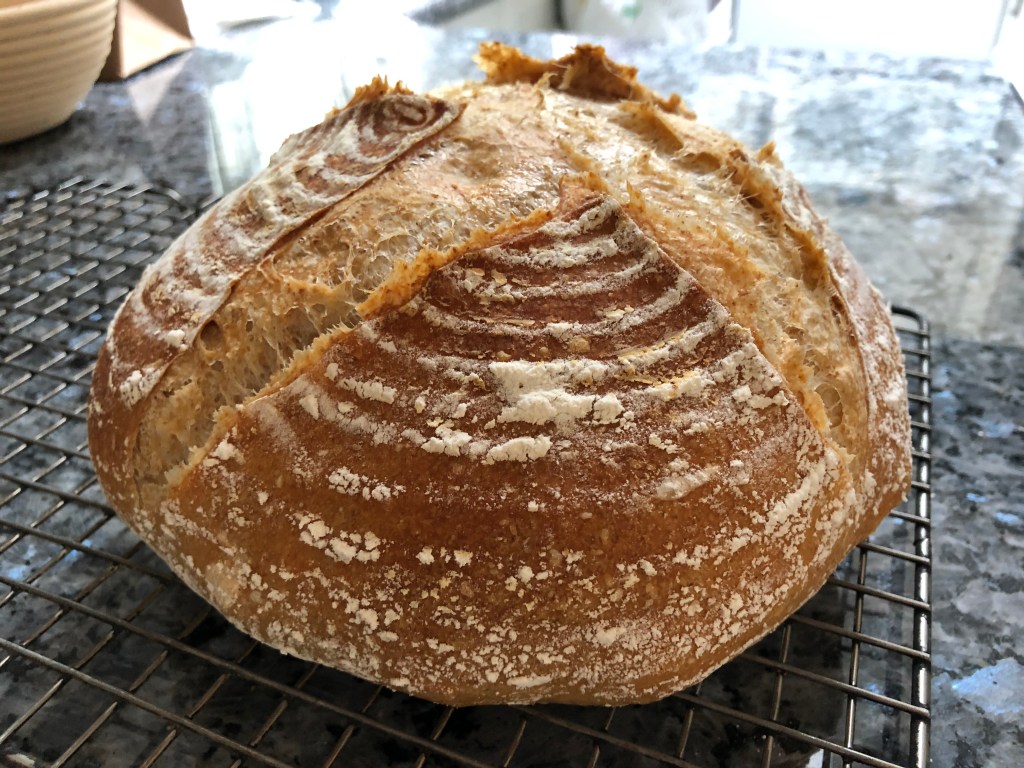
Started baking in 2017. Traveled to San Francisco on business, and attended one-day bread baking class at Green Gulch Farm Zen Center in Muir Beach CA. Returned home to Houston, cultivated a sourdough starter, and began baking bread every weekend.
Good baking is similar to good writing. As Anne Lamott suggests, have to write a lot of “shitty” first drafts; good writing is a lot of re-writing. I have baked many underwhelming loaves – flat or dense – and while I wouldn’t share with guests, they were often still edible, and learn from experience.
Enjoy baking; it’s an opportunity to turn off the laptop, put away the iPhone, and work with my hands and use my senses. Unlike co-workers, bread dough doesn’t talk back, either.
Part II: experience
It was difficult to find a short-duration bread-baking class in the gulf coast region. I reached out to stage (apprentice) at several local bakeries, but no one was interested; either because I lacked training and skills, or, likely, because a non-employee is an insurance liability.
After stepping down as CFO in spring 2019, as part of my sabbatical, attended six-week training program at the San Francisco Baking Institute. SFBI is located just north of the airport; visited several times, while traveling on business, learning more about its baking program. Appreciated the program’s short duration, but concentrated training, with four weeks on bread, and two weeks on viennoiserie (laminated pastry), baking more than 250 loaves of bread, and an equal number of croissants. During the course, I staged at Tartine Bakery, and worked every Saturday at the Midwife and the Baker in nearby Mountain View.
Couldn’t find affordable housing in the bay area. For the training program, stayed at an AirBnB in south San Francisco, with twelve people in the house, akin to a hostel or dorm. Didn’t mind given the short duration of training, but didn’t wish to extend. Indeed, the bay area has a structural housing issue. Relocated to New Orleans, to apprentice at Bellegarde Bakery; Graison Gill, the owner, also attended SFBI. Bellegarde is noteworthy, because at the time, it milled its own flour. Wholesale (grocery and restaurant) orders accounted for 95% of volume, which relieved reliance on walk-in, retail sales. The pandemic wasn’t kind to the bakery; as restaurants closed, wholesale orders evaporated, but at least, the bakery found creative ways to remain in business. Thoroughly enjoy New Orleans; the food, the music, the architecture; lived at the corner of St Charles and Carrollton Avenues, walking distance from Tulane University; would ride my bicycle in Audubon Park every afternoon.
I’m a morning person, and enjoy the bakers schedule. Often up at 3am and at the bakery by 4am; on busy production days (Friday and Saturday), up at 2am and at the bakery by 3am. Some mornings were quiet; no one talking; everyone knowing what to do. We often would play music (Spotify) in the background; employees taking turns with their favorite play list. The bakery is located in a restored Knights of Columbus building (8300 Apple Street); it had high windows near the peak, and we could watch the morning light change during sunrise.
Working in the bakery is hard, hot, heavy work. When lifting a fifty pound bag of flour, it’s center of gravity shifts, and the bag often folds in half, like wrestling a large animal. Flour in the air would often aggravate a person’s sinuses. The dough racks, where the bread dough would develop, were five feet high; bakers would remove the thirty-five pound dough bins to “fold” (strengthen) the dough. Bread baking is very physical, and this likely explains why the average baker is 35-years old, and not 50-years old.
As the junior baker, spent a lot of time washing dishes, sweeping floors, taking out the trash. Never viewed these tasks as “below” me; my intention was to perform the tasks with the same care as making bread. In the afternoon, walked home, and would often stop at the New Orleans Public Library (Nix branch) to pick up books. Sometimes, the library staff would meet me at the door, so I wouldn’t track bread flour into the library. When I returned home, the wash machine was on the back porch, and I’d wash my clothes every afternoon; preferred going into the bakery each morning with clean clothes, despite the futile, Sisyphean effort.
Considered apprenticing in New Hampshire, at Orchard Hill Breadworks. It has a unique, one-year program, but this would have created a not inexpensive state income tax nexus.
In winter 2020, lived at Green Gulch Farm Zen Center; had many jobs; worked in the kitchen, worked on the grounds, and worked in the bakery one day a week with Mick Sopko. Enjoyed baking with Mick; he was kind and patient, as I improved my dough handling skills, to create adequate dough tension during pre-shaping and shaping, for the loaves to rise.
Part III: favorites
Continue to enjoy baking, and enjoy baking at home; if not every day, than almost every day. While the baking volume is lower than a commercial bakery, a person may continue to learn, experimenting with what works and what doesn’t work. Use a baking notebook, to record every recipe and every bake; and identify different techniques or strategies that I may deploy to achieve the desired results; sometimes science, sometimes art (craft), sometimes both.
Enjoy baking sourdough loaves, bread with a natural ferment (levain), rather than relying on commercial (instant or active) yeast. These loaves often require 36-hours from start to finish, which means that they have a great deal of flavor, and are often easier to digest, for people with gluten sensitivity. In contrast, a commercial bakery, like Bimbo, may produce a loaf of bread in two hours. Artisan bread, like sourdough, often has just four ingredients; water, flour, salt, and yeast. In contrast, commercial bread, may have more than twenty ingredients.
When making French toast, or sandwiches – especially grilled cheese – enjoy baking pain de mie, which is baked in a rectangular baking pan – called a Pullman pan, as it resembles the old Pullman rail cars – producing perfectly square slices of bread. The bread is often enriched with milk and butter, which helps to produce a closed crumb with no holes, unlike the coveted open crumb of an artisan sourdough.
Baguettes are also nice to make at home; often the litmus test for skilled bakers. In France, the baguette is designed to be baked and eaten in the same day. In a commercial bakery, baking on a large, steam-injected deck oven, we would make a baguette two and a half feet long; in a home often, baguettes are much shorter, often just eighteen inches, in order to fit inside a conventional home oven.
Also enjoy making pull apart dinner rolls; in addition to enriching the dough with butter, the “secret” ingredient is adding a potato or sweet potato to the dough. When the rolls bake, the moisture from the potato and butter evaporates as steam, creating a light and flaky dinner roll. Often use an egg wash before baking, that yields a caramelized crown on top.
When invited to family or friends as a dinner guest, an enjoyable part of bread baking, is to bring something to the host that is not purchased, but rather, thoughtfully made by hand.
Part IV: philosophy
I’ve often believed, and toyed with the idea that working as a skilled carpenter, making fine wood furniture, could be similarly rewarding to bread baking.
I’ve read the book Shop Craft as Soul Craft: an Inquiry into the Value of Work, by Matthew Crawford. He’s a PhD, with useful skills as an electrician and motorcycle mechanic. He argues that there is merit to working with one’s hands, and questions the imperative of making everyone a “knowledge worker.” His message is often consistent with the message in Robert Pirsig’s infamous book, Zen and the Art of Motorcycle Maintenance.
Attended SFBI training with Norman. He worked as a professional photographer, with celebrity covers on GQ, Vanity Fair, and Vogue, before opening his bakery, Bread Folks, in Hudson NY. His bakery is in a lovely restored building on main street, and was recognized as best bread in New York state by Food & Wine. Look forward to visiting Norman and his bakery Friday morning, before departing for summer travels.
You might see Dave’s Killer Bread in the grocery store; its a nice product for commercial bread. The bakery’s backstory is interesting, because the bakery hires incarcerated people, with the belief that everyone deserves a second chance. Visited the Portland, Oregon bakery in summer 2019, while on sabbatical. I toyed with the idea of opening a bakery with the same intention of giving people a second chance, particularly, after volunteering with the Texas Department of Criminal Justice, Ramsey Unit in Rosharon, Texas.
Bread baking tends to be a local business, due to sourcing ingredients and freshness, which likely means that the United States may economically sustain many, fine, artisan bakeries. Wide Awake Bakery, in Ithaca NY, uses what it calls a “breadshare” subscription model, where customers sign-up to receive a certain volume of fresh bread each week. The bakery’s founder, Stefan Senders, was a PhD candidate at Cornell, before opening the bakery.
Part V: still baking
Continue to bake; appreciate and respect that it’s a craft, and a lifelong learning process. Baking withstands the test of time, and appreciate having practical skills outside of business.
Enjoy visiting bakeries during my travels, including Albemarle Baking Company in Charlottesville VA; often times, when traveling overseas, and walking the local streets, I’ll smell the bakery before I see the bakery, as was often the case in Cuba and Mexico.
While passing through Lyme, Connecticut this spring, visiting family and friends, visited the owner of a home bakery, Beaver Brook Bakery to learn about navigating the cottage food laws. His bakery is expanding into a conventional, commercial space this summer; look forward to visiting again in the fall, seeing his expanded operation, and bakery items.
Anticipate visiting Barrio Bread in Tucson Arizona in late May; Don Guerra, the founder, was a recent James Beard finalist. He baked out of a garage-based home bakery for a decade, before opening his bakery in a commercial space; it’s enjoyable to learn of his success.
If you enjoy baking, there are a number of useful resources for information, tips, and trouble shooting. Enjoy watching the Foodgeek on YouTube; he conducts a number of useful experiments to evaluate bread-baking techniques. Also find useful suggestions on two blogs The Perfect Loaf and The Fresh Loaf. Happy Baking!
Other thoughts:
I’ve been back in the United States one week; I’m eating well, and regaining the weight that I lost in Mexico. A quart of hand-made, coffee ice cream was wonderful.
I find myself sleeping eight to ten hours a day; I sleep soundly, and wonder if I’m making up for lost (quality of) sleep from all those pounding night clubs in Mexico.
I also find that there is no dissonance being back in the United States. It’s funny how living in a foreign country makes things that much more difficult. Wouldn’t expect that shopping for groceries, or taking the local bus should be that stressful…almost feel lazy…at least for now.
 garthmonroe