Aguascalientes:
Aguascalientes is the capital of Aguascalientes state, with a population of more than 1.2-million; city is a business hub, and includes a large, joint-venture Nissan automotive plant. Passed through the city for two nights, to break-up the bus trip from Guadalajara to Zacatecas.
Woke-up before sunrise in Guadalajara; took light rail from centro to bus terminal. Light rail stations were very clean; cars were sleek and modern; one of the nicer subway, light rail systems used during my world travels.
Bus, Primera Plus ($20 USD), was 2.5-hours for 75-mile drive; 30-minute walk to AirBnB, checked-in past mid-day, and allowed time to explore the city. Stopped at the mercado for lunch, chorizo quesadilla.
AirBnB host asked me to change rooms; apparently, the room that I reserved was damaged by water; the room to where I was moved was small; not much larger than the twin bed; paint was peeling off the concrete walls; room felt like a prison cell, feedback that I shared with the host. Host offered me a refund if I wanted to cancel; but given the short duration of the stay, and my fatigue, accepted the room. Frequently amazed by the ability to accept and adapt.
Only intention was to visit the Museum of Death; however, museum is closed for the year as it reorganizes its extensive display. Museum celebrates death in a manner that is uniquely Mexican, consistent with the November holiday, Dia de las Muertos (Day of the Dead).
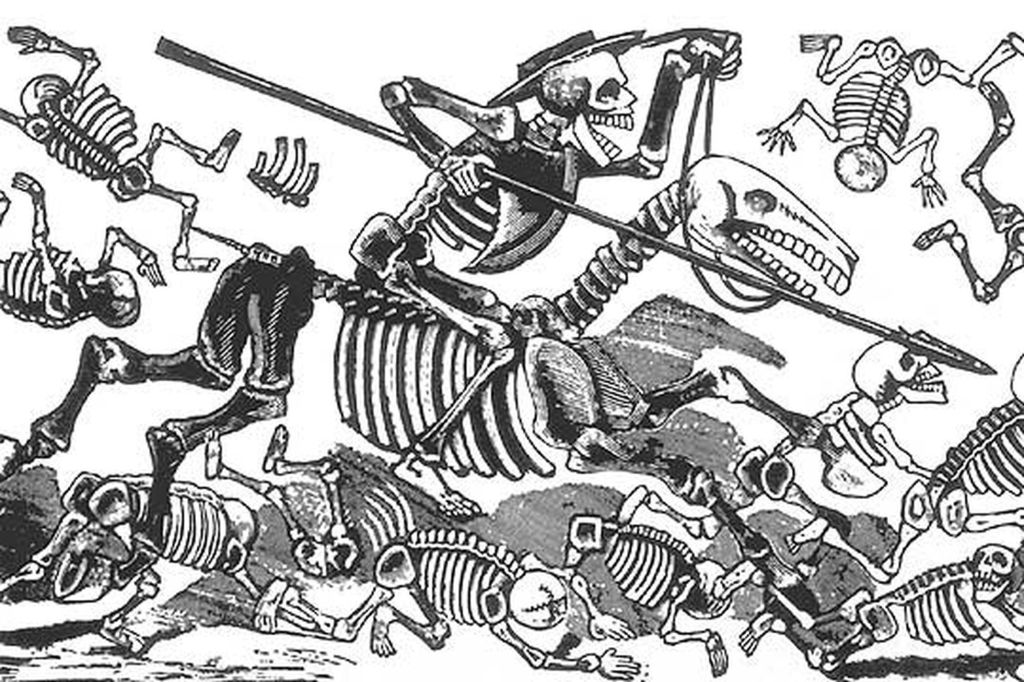
Museum was created following donation of artifacts by Octavio Bajonero Gil; museum expanded, following subsequent donation by Daniel Mercurio López Casillas. Noted pieces include a rare crystal skull, and art by José Guadalupe Posada, 19th century artist, born in Aguascalientes, and famous for his calavera (skeleton) artwork, including the Don Quixote (above), and La Calavera Catrina, an iconic symbol of the Day of the Dead.
Espolón tequila, in the United States, features calavera woodcut illustrations created by Steven Noble; these labels are inspired by, and pay tribute to, José Guadalupe Posada.
Zacatecas:
Zacatecas is 400-miles northwest of Mexico City, just south of the Chihuahuan Desert. City sits in a narrow valley at 8,000 feet elevation, and was named a UNESCO colonial city in 1993, due to its well-preserved core, established during the city’s silver mining history.
City is remembered for 1914 Battle of Zacatecas, bloodiest battle in the campaign to overthrow Mexican President Victoriano Huerta. Pancho Villa decisively defeated General Luis Medina Barrón, taking control of the train to Mexico City. This (freight) train route is still used to this day. AirBnB has two framed prints of Pancho Villa on display in the living room.
Woke-up before dark, with the start of a migraine. Walked to the bus station; local bar and night club were still “hopping.” There was a woman standing on the curb, dressed like a prostitute; her dress was so short, it’s unlikely that she could sit down; even her make-up looked tired. Some of the bar patrons were outdoors; wanting to avoid any confrontation, I looked down at the ground, avoided eye contact, and walked quickly past. Walked past one house, and surprised to hear music playing from Carl Orff’s Carmina Burana.
Bus station waiting area was outdoors on the bus platform; it was 48-degrees, not a comfortable wait. There were people on the platform smoking cigarettes, which doesn’t improve a migraine. There was a television overhead, playing an old black and white movie in Spanish. Stray dogs roamed the platform.
Watched buses enter and exit the parking lot. Most were modern tour buses; most appeared nicer than Greyhound. Some buses had two axles; other buses had three axles. First axle in the front; the wheels that turn the bus. Second axle, near the back, often had a set of double tires; so four tires on the axle. Third axle was unique; at slow speeds, driving forwards or backwards, these wheels would turn in concert with the front wheels, reducing the turning radius of the bus; allowing the bus to make tighter turns. Imagine that at high speeds, that this functionality is disabled. Watching the buses was more interesting than watching the movie.
There wasn’t a direct bus to Zacatecas, so purchased bus ticket to Durango, further north, stopping en route in Zacatecas (Omnibus de Mexico, $12 USD). Ticket was for 8:30am, but Durango bus appeared at 7:45am; showed my ticket to the driver, and he let me on; but I wasn’t sure that I was getting on the right bus. Imagined a scenario in my mind, where this was the non-stop bus to Durango; after “yelling” at me in Spanish for getting on the wrong bus – and not understanding a single word – the driver stops the bus on the highway, and drops me off to walk to Zacatecas. WiFi worked; pleasant surprise. Also pleasantly surprised when the bus actually stopped in Zacatecas.
There were taxis on the platform; they ignored me; which was a surprise. Walked to the AirBnB, which took almost an hour, not because it was a long walk, but because the walk was steep. Locals were staring at me like I had two heads; not sure if this is because there are few tourists, or perhaps, because a tourist would take a taxi, rather than walk with a heavy backpack. AirBnB hosts were accommodating, and let me check in at 11am.
At this point, migraine was incapacitating. Whatever reserves I had were depleted getting to Zacatecas; no longer had the ability to stand or function, and went to bed, in complete agony. It took five hours before I could stand up and resume function.
On Monday, visited Mercado de Abastos, two miles from the AirBnB. This is the city’s major fruit and vegetable market. Local grocery stores, including Bodega Aurrera, Chedraui, Soriana, and Wal-Mart purchase its produce here, and often doubles the price to consumers. I find better prices and quality by going directly to the market.
These markets tend to be on the outskirts of town, this one was no different; literally had to walk across train tracks. There are two types of vendors; wholesale vendors, who sell large burlap bags of produce, and local vendors, who sell to local citizens, and gringos.
When I see folding tables and tarps, I recognize that I’m in the right place. This is consistently the best place to purchase grains, seeds, and legumes, too. Prices may be 50% lower than what you find in the market stalls in town; typically purchase by the kilo, or quarter (cuarto), or half (medio); and you are handed your goods in a plastic bag.
Purchased purple cabbage (23 pesos), cauliflower (18 pesos), kilo of potatoes (10 pesos), and cuarto of amaranth (15 pesos). Amaranth is a gluten-free, non-cereal grain (pseudo cereal), native to Mexico and Aztec culture; also purchased fresh ginger and a sweet potato.
I’ve been traveling with a canvas grocery bag; usually wash it with my laundry each week.
Most stores won’t let you enter with a full or partially full shopping bag. Imagine that perhaps shoplifting is an issue. At some stores, migraine pain reliever is behind the counter, with the pharmacist, or secured in plastic containers that need to be unlocked. Even Nutella, the popular chocolate-hazelnut spread, is often secured in these plastic containers, too. This means that on shopping days, one needs to plan ahead. Some stores allow you to leave your shopping bag at a counter; other stores provide coin-operated lockers to secure your bag. Sometimes, gringos enter the store with a shopping bag, and gets the “stink eye.”
On Tuesday, visited key sights, including Templo de Santo Domingo, Teatro Calderon, Plaza de Armas, Catedral de Zacatecas, and historic aquaduct.
There is a tortilleria next door to the AirBnB, Tortilleria la Guadalupana; it makes tortillas, and sells to local residents. Owner starts early in the morning; can hear the squeaking wheels of the conveyor belt as he begins his day between 7:00-8:00am.
David is a college student renting a room at the AirBnB. We speak in the afternoon, when we’re eating lunch. He only speaks Spanish; we’re able to “mangle” a discussion together. When I was at the AirBnB in Morelia, host family had a toddler. There was a television at the kitchen table. When I was cooking meals, toddler was sometimes watching children’s television. It was a beneficial learning opportunity, for example, numbers and colors. Use Duolingo each day, but question the utility; nothing really replaces face-to-face interaction. David suggests learning Spanish by watching movies in Spanish with English subtitles. I find conversing with children useful, as their skills and vocabulary are consistent with my abilities.
It would be nice to have access to a bicycle. Some of the larger cities, like Mexico City and Guadalajara, have MiBiCi bicycle rentals, but geared for residents, not visitors. Don’t mind walking, but bicycle would be faster. Don’t wish to take Uber or taxi; and if I’m not carrying my backpack, don’t need to take colectivo. In the meantime, walk five miles per day; by the end of this experience, will have walked 600-miles.
On Wednesday, AirBnB ran out of water; happened in Oaxaca, too. Messaged the host; he switched over the water tanks on the roof, called tinacos. Showers are often luke warm, not hot; the evenings are cool; luke warm shower often leaves me cold for the remainder of the evening. Sometimes, AirBnB will have hot water, a real treat. However, the water pressure is underwhelming, because the shower is gravity-fed from the tinaco on the roof. This likely conserves water, but it’s also likely that a person could pee a stronger stream than the flow from the shower head. As it turns out, Mexico has the highest consumption of bottled water in the world, 488-liters per person, per year.
Other thoughts:
My travel bag is the Tom Bihn Tri-Star. Bag is made in Seattle; and used it for more than eight years. It fits as a carry-on when flying (19x13x8 inches | 2000cu volume | 33-liter). It may be carried with handles, shoulder strap, or as a backpack. It is black dernier exterior, grey nylon interior, and uses a series of packing cubes. Packing cubes are organized, and ensure that there is nothing loose in the pack; beneficial when clearing airport security. Didn’t weigh the pack before departing, but, based on its density, guess that it weights between 30-35 pounds; maybe I’ll weigh it when I return to the states. Often reminded by what we used to say in the Marine Corps, if you pack it, you carry it.
One benefit of long-term travel – maybe the only benefit thus far – is that travel disrupts routine and habits; it challenges assumptions and beliefs; forces me to learn about myself. As often said in Zen Buddhism, to study the self is to forget the self. Long-term travel hasn’t been glamorous; there have been few luxuries; wouldn’t describe the trip as a “vacation.” Would describe the experience as simply “living” in Mexico. I find it necessary to pace myself; long-term travel is more like a marathon than a sprint, and requires stamina. It’s also lonely at times; there are few tourists; the price that I pay.
One of my favorite writers is Cormac McCarthy. He hails from high plains, west Texas, and his writing is evocative of Texas and Mexico. Perhaps you’ve read his books, or seen the movies based on his books, including, All the Pretty Horses (2000 | Matt Damon), No Country for Old Men (2007 | Javier Bardem), or the post-apocalyptic, The Road (2009 | Viggo Mortensen). Many parts of the movies read line-for-line from the books. The landscape of Zacatecas state, with its steep valley is evocative of McCarthy’s writing.
In 2018, took Amtrak Sunset Limited, westbound, from Houston to Los Angeles. You get to see the west Texas landscape unfold before your eyes. When the train stopped in El Paso, on the border with Ciudad de Juarez, many people, including me, got off the train, to buy tamales from the vendor on the platform; better than the food served on board the train.
Guanajuato & San Miguel de Allende: SAT March 19th – MON April 4th 2022
Bus from San Luis Potosi to Guanajuato via Leon (4-hours), SAT March 19th.
Bus from Guanajuato to Dolores Hidalgo (1-hour), SAT March 26th.
Bus from Dolores Hidalgo to San Miguel (1-hour), MON March 28th.
 garthmonroe