Background: Lived in Ottawa Canada 2007 – 2011; CFO for early-stage, biotech company. Well paid, fancy title, led small team of good people. In 2009, deeply unhappy, despite outward appearance of “success.” If something didn’t change, wouldn’t see 40th birthday.
Visited general practitioner for referral, and consulted with a psychologist. It’s been said that the only thing worse than healthcare in North America is mental healthcare. After several sessions, recognized that the psychologist wasn’t beneficial; recognized that I was on my own. No one was going to save me.
Alternatively, explored a different religious tradition each weekend; didn’t know where else to turn. Read a book on meditation from Ottawa Public Library. Local Zen center, White Wind Zen Center, had an open house, an introduction to Zen meditation. There wasn’t “instant” relief, but there was something. Sitting meditation is similar to diet and exercise; you have to do the “work” yourself, no one will do it for you, and it’s best to do it everyday.
Moved to San Diego after Canada; explored many different Buddhist traditions; found Soto Zen to best support my practice. September 13th 2021 blog post, Zen Centers, shares the various Zen Centers that I visited over the past decade.
Moved to Houston Texas in March 2014. Asked the Abbot of Houston Zen Center to receive the Buddhist precepts; desperate to receive the precepts.
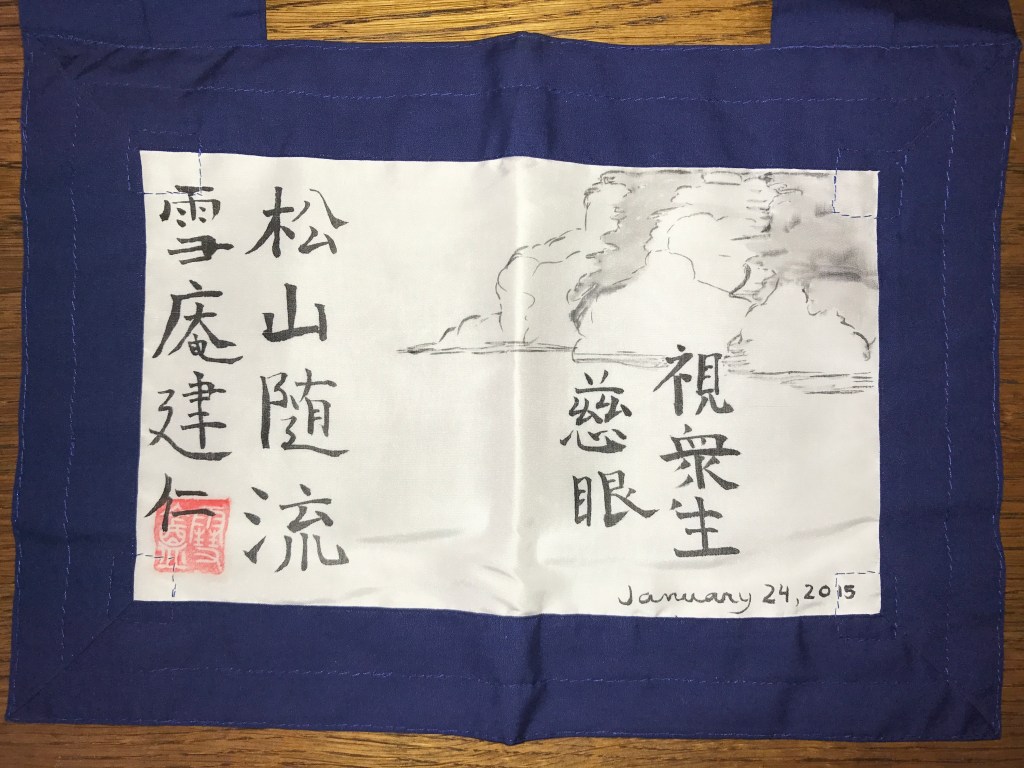
Over six-month period, sewed a rakusu, which is a small garment worn over the neck, in front of the body. Zen priests wear an okesa, which goes over the shoulder, and covers most of the body. Describe the process of sewing a rakusu, as cutting up a perfectly good piece of cloth, and sewing it back together, using a very small, delicate, intricate stitch. With each and every stitch, recite “Namu Kie Butsu” or “I take refuge in Buddha.” Historically, the rakusu is assembled from scraps of cloth. Pattern on the front of the rakusu is sometimes described as a rice field.
Rakusu color is significant; for lay practioners, like myself, rakusu is blue. For novice priests, color is black; for Zen priests who have (dharma) transmission to teach, color is brown.
After sewing the rakusu, Abbot inscribes the white silk on the back, with my given Buddhist name; my name is Shōsan Zuiryū; translated as pine mountain, follow the stream. In a formal ceremony, referred to as jukai, or lay ordination, Abbot gifts the rakusu to the student. Received the Buddhist precepts in January 2015, after practicing Zen Buddhism for six years.
Buddhist precepts are a series of sixteen intentions on how to live an ethical life; intentions that I will surely break during the course of my life; Zen practioners re-affirm the precepts each month during the Full Moon Ceremony. It is sometimes said that Zen Buddhism is simple enough for a child of three to understand, but difficult for a person of eighty to live.
Three Refuges
- Take refuge in Buddha (to be aware)
- Take refuge in Dharma (teachings)
- Take refuge in Sangha (group of Buddhist practioners)
Three pure precepts
- To do no evil
- To do only good
- To save all sentient beings
Ten essential precepts, a disciple of Buddha:
- Does not kill, but rather, cultivates life
- Does not take what is not given, but rather, cultivates generosity
- Does not misuse sexuality, but rather, cultivates caring relationships
- Does not lie, but rather, cultivates truth
- Does not intoxicate self or others, but rather, cultivates clarity
- Does not slander, but rather, cultivates right speech
- Does not praise self, but rather, cultivates awareness
- Does not possess, but rather, cultivates abundance
- Does not harbor hatred, but rather, cultivates kindness and understanding
- Does not abuse the three refuges, but rather, encourages the path of practice
Way-seeking mind is the first talk shared by a student of Zen Buddhism. Way-seeking mind, or perhaps, mind seeking the way, describes how a person comes to Zen Buddhism. For many people, this story is not pretty. People who are feeling well don’t find themselves in a semi-dark room, facing a wall, sitting quietly. In October 2017, I was asked to share my first talk with the sangha, titled, the Buddha Saved my Life. Excerpt of the talk is below.
I teach suffering and the end of suffering, said the Buddha.
Suffering brought me to practice.
Freedom from suffering brings me back to practice each day.
Suffering is created by the three poisons:
- Greed: crave (fame, gain, pleasure, praise)
- Hate: resist (blame, disrepute, loss, pain)
- Delusion: ignorance (emotion, feeling, judgment, opinion, preference, thought)
My Zen practice hasn’t been one of hatred, but rather, one of self-hatred.
Hatred directed not towards others, but directed towards the self.
Cycle of self-judgment, guilt, and un-productive thought.
Dalai Lama was once asked about self-hatred.
With a confused look, Dalai Lama replied, “what’s that.”
Hatred destroys the vessel in which it is contained
Hatred is to pick-up and throw a hot coal, and burn the self.
Hatred is to drink poison, and to expect the other person to die.
Never punished for my anger; punished by my anger.
Meditation is my core practice.
Meditation allows space and time for awareness.
Meditation is an opportunity to:
- Turn towards pain, rather than turn away
- Face reality, accept reality, rather than resist reality
- Drop the story line
- No victim, no perpetrator
- No accuser, no accused
- Recognize that pain exists, but suffering is optional
- Recognize that suffering exists only in the mind (there is no permanent self)
Path to practice:
2007, relocated for work: Austin Texas to Ottawa Canada
2009, introduced to Zen Buddhism at White Wind Zen Center
Began daily meditation practice (at home)
Attended weekly practice at the local Shambhala Center (in Ottawa)
2011, relocated for work: Ottawa Canada to San Diego California
Attended weekly practice at Zen Center San Diego
Visited local Zen centers
Visited San Francisco Zen Center while traveling on business
Attended morning meditation and morning service before work
Recognized that Soto Zen tradition supported my Buddhist practice
2014, relocated for work: San Diego California to Houston Texas
Attended weekly practice at Houston Zen Center
Volunteered with Texas Department of Criminal Justice.
Led small Buddhist sangha at Ramsey unit in Rosharon, south of Houston.
There is a famous koan, or teaching story.
Koans are like a riddle; not solved by the thinking mind.
The koan “mu” famously asks, does a dog have Buddha nature.
I would often ask, does an incarcerated person have Buddha nature.
Prison is like a crucible.
Incarcerated people are like pebbles in a bag, polishing each other.
Sometimes, people ask, why does the Buddha smile.
Share the following quotation by Shunryu Suzuki, founder of San Francisco Zen Center. “The difficulties that you experience…will continue…for the rest of your life.” Gentle reminder. Obstacles and hindrances don’t block the path. Obstacles and hindrances, are the path.
 garthmonroe