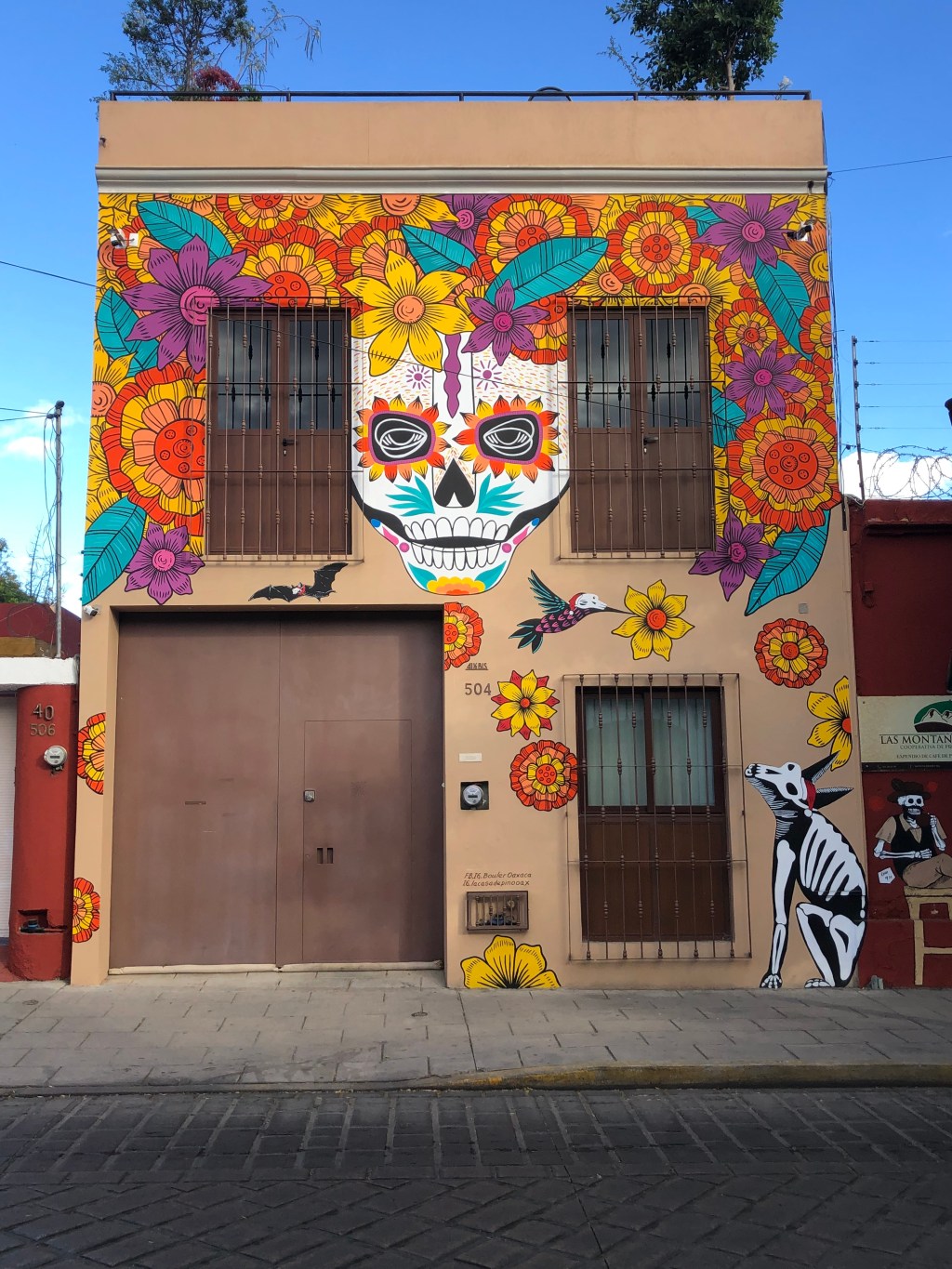
Oaxaca: Oaxaca is a state and city, southeast of Mexico City. Its origins date back to the ancient Aztecs, followed by Spanish colonization in the 1500’s. City is built in a grid layout, around a central square, or zocalo, offering historic buildings, cathedrals, art, and food. Oaxaca was named a UNESCO world heritage site in 1987.
Economy: Mexico’s GDP is $2.6-trillion (purchasing power parity | 2021 IMF), 126-million people, $20,000 GDP per capita. Unemployment is 3.2%, one of the lowest of the OECD nations. Underemployment, measure of labor utilization, is 25%. Mexico’s economy is 64% service, 32% industry, 4% agriculture.
For comparison, US GDP is $22.7-trillion, 333-million people, $68,000 GDP per capita, and 8% underemployment; US economy is 80% service, 19% industry, 1% agriculture.
In my observations, see street sweepers, armed with a pushcart, and either a commercial broom, or broom made of sticks and branches. They keep the streets, sidewalks, and parks clean. Also see “water tricycles.” People pedaling a bicycle with two wheels in front with a large basket, delivering heavy, twenty liter bottles (garrafon) of drinking water to homes.
While there are many restaurants, there are also many food stalls; some are small push carts, selling elote, tejate, or tacos. Others are larger, fixed in place, selling “comida corrida,” an economical mid-day meal, often served between 1:00 and 4:00pm, and includes soup, rice, a prepared dish, and sometimes, a small dessert or sweet.
There are also many merchant stalls selling consumables, clothing, and other sundries. Without an ability to order goods on-line, a person needs to buy these items in-person.
TUE Jan 4th: Mexico City to Pueblo
Purchased bus ticket on Estrella Roja for $9 USD, for the two-hour trip from Mexico City to Puebla. This wasn’t a tourist bus; was the only Caucasian on-board; three stops en-route.
Leaving Mexico City, it’s difficult to not describe the environs as anything but “gritty.” Once outside the city limits, the drive was quite scenic. Upon arrival at the Puebla bus station, purchased bus ticket to Oaxaca. It took an hour to find the colectivo (mini-bus) for the three-mile drive to the city center. Many locals use the colectivo, as the fare is just $0.50 USD, versus a taxi for $5 USD. Puebla is an attractive, colonial city; will visit for two weeks after Oaxaca. Had time to explore the city, ate “street” tacos for dinner; five for $0.50 USD. Arrived at the AirBnB before dark; first floor merchants had electricity, apartment block on the second and third floors had a blackout; no power or internet. I was tired from traveling, and was hoping for a hot shower; oh well, first-world problem.
Prefer taking public transportation versus a taxi, intention is to live more like a local than a tourist. When I traveled to China in 2008, with my friend, Cathy, we used public transportation. The only exception was when we had an early morning flight; we would take a taxi to reduce the risk of uncertainty, and missing the flight. When I traveled to Dominican Republic in 2017, used Uber motorcycle taxi, which was easy, traveling with a backpack. In Haiti, also used a moto-taxi, which was surreal; the driver swerved to avoid people, at times, driving off the street and onto the sidewalk.
Enjoy this type of non-tourist bus travel, an opportunity to be surprised, an exercise in patience and humility, an opportunity to accept reality (as it is). Travel often reminds me that I control very little. Paul Haller is a senior monk at the San Francisco Zen Center; his teachings resonate with me; enjoy the soothing tone of his voice during his public talks. He often reminds monastics to “experience the experience that you are experiencing.” Resisting reality – what I don’t want – with anger or hatred – only seems to make that condition stronger. It’s been said, that, what we resist, persists. Accepting reality – is likely – the only path forward. I’m reminded that reality is not my thoughts, beliefs, emotions, or feelings; reality is only that which I may see, hear, or touch. Often have to remind myself, not to believe what I think.
WED Jan 5th: Puebla to Oaxaca
First-class bus ticket with ADO cost $33 USD; primarily a tourist bus, with a large group traveling from Europe; trip took five hours, non-stop. Buying the bus ticket in advance was a good idea; the bus was full. When boarding the bus, spoke with a woman traveling from Holland. She asked how long I was visiting Oaxaca, and my travel plans. Replied that I was visiting for two weeks, and that I was doing “nothing.” She stared back with incredulity. After arriving at the bus station, walked one mile to the AirBnB, and dropped off my backpack. Walked to the local grocery store, Soriana, for sundries, and then explored the city. For dinner, purchased bowl of elote, or “street corn” mixed with mayonnaise, queso, and spices for $1.50 USD.
Weather is enjoyable; 75-80 degrees during the day; 45-50 degrees at night; Oaxaca is at 5,000 feet, lower elevation than Mexico City. Days are sunny, and the sun is quite intense. On Sunday, there was a magnitude-5.3 earthquake, in Oaxaca state, southwest of the city.
Food: Oaxaca is known for its cheese; a young, un-aged, stringy cheese, similar in texture and mild taste to Mozzarella, and made a cheese omelet. Oaxaca is also known for its mezcal, an alcoholic spirit derived from the agave plant. Mezcal is quite smoky, not my favorite, but sipped a shot, neat, at the local mezcaleria, taking one “for the team.” Oaxaca is also known for its chocolate; tried tejate from a street vendor; it’s a chilled chocolate drink made with maize; not overtly chocolatey or sweet. Tried a custard, from a street vendor; mild taste, similar to a flan, without the hard shell. Also had hot chocolate, which was not unique.
Purchased a young, “trimmed” coconut at the market for $1 USD; inserted a straw, and a full glass of refreshing, coconut water. Afterwards, split the coconut with a paring knife, and ate the coconut flesh; the flavor was quite mild, almost flavorless. Also wanted to comment about eggs. Purchased 30 eggs in the market for $3 USD; the eggs sit at room temperature. Eggs may be stored at room temperature because they haven’t been washed, and there’s a “natural” coating that preserves the egg. In the US, FDA mandates that eggs need to be washed, which removes this protective coating, and hence the need for refrigeration.
Mentioned in the Mexico City post, that instant coffee appears to be more popular in grocery stores than any form of brewed coffee. Never enjoyed the taste or mouth feel of instant coffee; often tasted like someone “shit” in my mouth. AirBnB had a small jar of instant coffee; with enough sugar and cream, it was tolerable.
Patience: I find world travel to often be an exercise in patience. It took a day to figure out WiFi calling; thought that I would have to use 001 to dial out of Mexico, but when using WiFi, to avoid roaming charges, simply dial the number, as if I was still in the US.
In Puebla, it took an hour to find the colectivo (mini-bus) from the bus station to centro. Knew from the Lonely Planet guidebook, that there was a mini-bus, knew roughly where it was supposed to be, and eventually found it; just not intuitive.
In Oaxaca, AirBnB has a wash machine (no dryer) on the rooftop deck. Wanted to wash clothes Friday night, and for the life of me, could not get the wash machine to work. Messaged the host, who explained how to fill the drum manually, as the water sensor was broken. Eventually got my clothes washed, but probably took an hour to figure things out.
Turns out that the AirBnB is next to a rooftop piano bar with live music in the evening, from 10:00pm to 4:00am; it’s loud, even with earplugs, to the point where the building shakes at times. It’s funny, when I went back to check the AirBnB reviews, no guests mentioned the music; maybe they didn’t notice because they were next door at the piano bar.
Shopping for vegetables at the market is tiring; it’s dusty, near the second-class bus station; there is frequently a “crush” of people; it’s loud with shouting and yelling. However, it does provide an opportunity to learn numbers in Spanish and understand commodity prices. The market is subdued on Sunday, it seems that many of the merchants take this day off.
The other day, strolled through the central square, the zocalo, and sat down on a park bench under a large tree, when a bird shit on my shoulder; go figure. If any of these experiences are the worst parts of living in Mexico for four-months, the trip will be just fine.
Travel: In the Mexico City post, mentioned my interest in long-term travel, and how Rick Steves’ interest in travel created for him, his own travel company. Some people might question the value of long-term travel, but Rick has arguably made many contributions.
When COVID unfolded in March 2020, his company refunded (cash) to more than 20,000 people who were scheduled to take his European summer tours. Rick mentions that he was disturbed by airlines making refunds difficult for customers, or issuing only travel credits.
Also during COVID, his travel company continues to pay its employees, despite the travel disruption. He argues that he has good people, travel will return to normal, and that the company has been more than profitable in prior years.
Rick has also made significant donations, including $4-million to build Trinity Place, in Lynnwood Washington, an apartment complex to reduce homelessness, and he also donated $1-million to the Edmunds Center for the Arts. Rick sets a strong example that travel doesn’t have to be self-serving, self-centered, or selfish.
Sights: enjoyed many of the art museums in the city, including: Museo Textil de Oaxaca, Centro Cultural San Pablo, Instituto de Artes Graficas de Oaxaca, Centro Fotografico Alvarez Bravo, Galeria Quetzalli, and Museo de los Pintores Oaxaquenos. The buildings, often with a central courtyard, are as beautiful as the artwork. Signage is often only in Spanish, there is nothing in English, which mutes the experience. Visited several of the large churches; very beautiful structures. One church had an inscription in English, referring to the introduction of Christianity as a “cult.” An interesting choice of words.
The central square, or zocalo, is a pleasant space to sit and relax, and practice the art of people-watching; it’s well-shaded from the sun by large trees. If you sit near Cafe Mayordomo, which serves hot chocolate and breakfast to tourists, you may listen to a pair of musicians playing the marimba, as their music gently echoes across the square.
Templo de Santo Domingo de Guzman is a large cathedral in Oaxaca; it’s a block away from the AirBnB. On Saturday afternoon, there was a large wedding celebration; including dancing, parade, and marching band. Band consisted of a bass drum, tuba, two trumpets, and two clarinets; the band was loud, and was surprised to not see bricks fall out of nearby buildings. Wedding party and guests were dressed impeccably; everyone looked happy and joyful; the event attracted a large number of tourists, including me, into the church square.
Visited the “reforma” section of Oaxaca, just north of centro across Highway 190, the major east-west artery. It appears more modern than centro, with few, if any tourists; the area is composed of businesses and scattered residential areas.
Wanted to visit Portal del Palacio and Palacio de Gobierno; both are closed due to Omicron. As I explore the city, iPhone tells me that I’m walking more than 5-miles per day, more than 15,000 steps per day. Pleased that after a week, may navigate the city without a map. Also note, that from time to time, see guards making deliveries to the local banks and merchants; they are armed with shotguns; very intimidating sight. The Federal Police also have a notable presence; some armed with semi-automatic machine guns; again, intimidating.
Usually wake up by 6:00am; often hear roosters in the morning; one of the local churches rings church bells in the morning, too. Early morning is my favorite time of the day; appreciate the quiet and solitude. Have one cup of (brewed) coffee in the morning, like the smell and the taste, and enjoy just sitting down drinking coffee, doing nothing else. No multi-tasking, not reading the news, not writing a to-do list.
After a week in Oaxaca, I’ve seen much of what I’ve wanted to do, and look forward to the second week, where I may do nothing, because, I often seem to be doing something.
Other thoughts: When I look back on my sabbatical (March 2019 – June 2020), it didn’t unfold as expected; who would have guessed that there would be a global pandemic. Don’t regret moving on, and stepping away from CFO. Don’t regret moving on from University of Connecticut after teaching for one-year. I’ve felt “trapped” too many times during my career, and could easily have been “trapped” at the University. As difficult as it is, it seems that I need to “let go” in order to “move forward.” It’s likely not intuitive, unless you’re a mountain climber (ie. if I “let go” I will fall). Imagine that when I’m done traveling, that I’m going to do something interesting; don’t know what it is; but it will be interesting.
Puebla: WED January 19th – WED February 2nd 2022
Plan to take the bus from Oaxaca to Puebla (5-hours), WED January 19th.
Dreaming the life – living the dream, or, maybe, I’m just fooling myself.
 garthmonroe